
How to Tune LLMs for Production: Temperature, Top-P, and Repetition Penalties Explained.
Master LLM generation parameters. Understand the exact Softmax math and Python code behind Temperature, Top-P, Top-K, and repetition penalties.
You send the exact same prompt to a Large Language Model (LLM) twice.
Output 1: “The castle stood silently on the hill.”
Output 2: “An ancient fortress watched over the valley.”
Same model. Same prompt. Completely different answers. Why?
Most people will tell you, “LLMs are just random.”
But that is technically wrong. An LLM doesn’t just guess words randomly. For every single word it writes, it calculates raw scores (logits), converts them into a probability distribution using Softmax, and then filters those choices through LLM generation parameters like Temperature, Top-P, Top-K, and Repetition Penalties.
Once you understand how this math works, these confusing API settings stop being a mystery. They become powerful engineering tools you can use to stop hallucinations and control your AI’s behavior.
In this complete developer guide, you will learn:
Logits & Softmax: How an LLM actually calculates word probabilities.
LLM Temperature: The exact math behind it and what really happens at
temperature = 0.Top-K vs. Top-P Sampling: How they differ and why Top-P is smarter.
Frequency vs. Presence Penalty: How to properly control repetition.
The Best LLM Settings: Exactly how to tune parameters for RAG, coding, chatbots, and data extraction.
But before we touch a single API parameter, we need to understand what the model is actually looking at under the hood.
1. Before Temperature: What Does an LLM Actually Predict?
People often say:
“An LLM predicts the next word.”
That is useful for intuition, but technically it is not quite correct.
LLMs usually predict the next token.
A token may be:
- an entire word;
- part of a word;
- punctuation;
- whitespace;
- a number;
- a programming symbol;
- or another unit defined by the model’s tokenizer.
Suppose our prompt is:
The capital of France isThe model processes the prompt and produces a score for every possible next token in its vocabulary.
Imagine, purely for illustration, that some of those scores are:
| Token | Raw score |
|---|---|
| Paris | 8.2 |
| Lyon | 4.1 |
| London | 2.7 |
| Berlin | 2.1 |
| banana | -1.8 |
These raw scores are called logits.
What is a logit in an LLM?
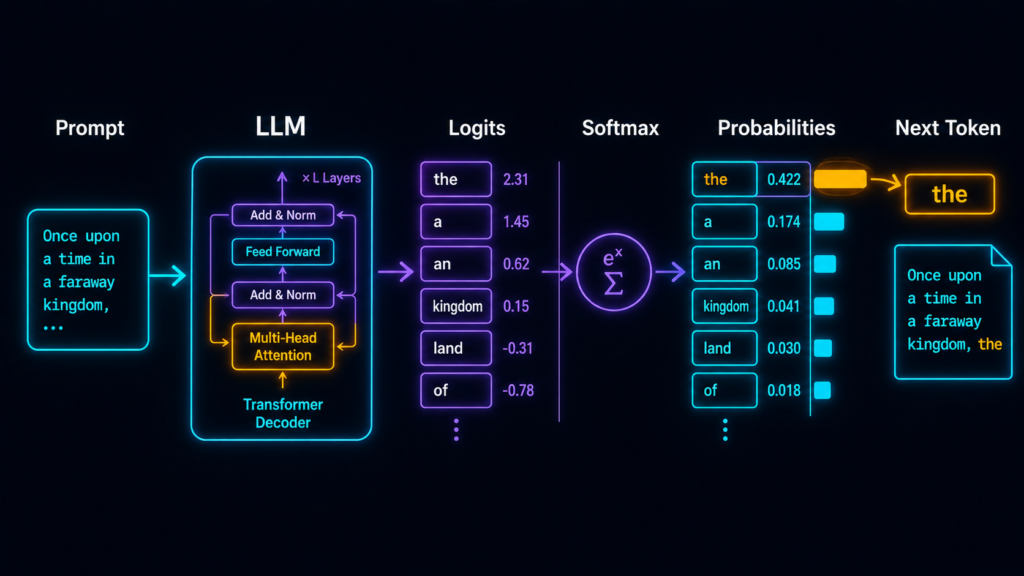
Before an LLM generates the next word (token), it looks at its entire vocabulary and assigns a raw, mathematical score to every possible option. This raw score is called a logit.
When a word gets a high logit score, it means: “Based on the training data, this word perfectly fits the current context.”
However, there is a catch: a logit score of 8.2 does not equal an 82% probability.
Logits are just raw, unnormalized numbers. To actually predict the next word, the LLM must convert these messy logit scores into a clean, 0-to-100% probability distribution where all the options add up to 100%.
To make this conversion, the LLM uses a mathematical function called Softmax.
Logits to Softmax Calculator
Raw Logits (Inputs)
Final Probabilities (Softmax)
2. Logits and Softmax Explained: How LLMs Calculate Probabilities
Before an LLM picks the next word, it assigns a raw score to every possible word in its vocabulary. These raw scores are called logits.
Because logits are just messy numbers (sometimes even negative), the model uses a mathematical function called Softmax to translate them into clean percentages.
Here is the standard Softmax equation:
Where $z_i$ is the raw logit score, and $P_i$ is the final probability.
While the math looks intimidating, Softmax does just three simple things:
Turns all raw logit scores into positive numbers.
Scales them down into percentages.
Ensures all the percentages add up to exactly 1 (or 100%).
A Simple Example:
Imagine the LLM is choosing between just three words. Here are their raw logit scores:
Word A = 2
Word B = 1
Word C = 0
After passing through Softmax, they become clear probabilities:
Word A -> 66.5%
Word B –> 24.5%
Word C -> 9.0%
Word A is the most likely choice. But notice that Words B and C haven’t disappeared—they still have a small chance of being picked.
This leftover randomness is exactly where the LLM Temperature setting enters the picture.
3. What Does Temperature Actually Do?
You often hear this common shortcut:
Low Temperature = Accurate and logical
High Temperature = Creative and random
While that helps as a mental shortcut, it doesn’t explain what actually happens under the hood.
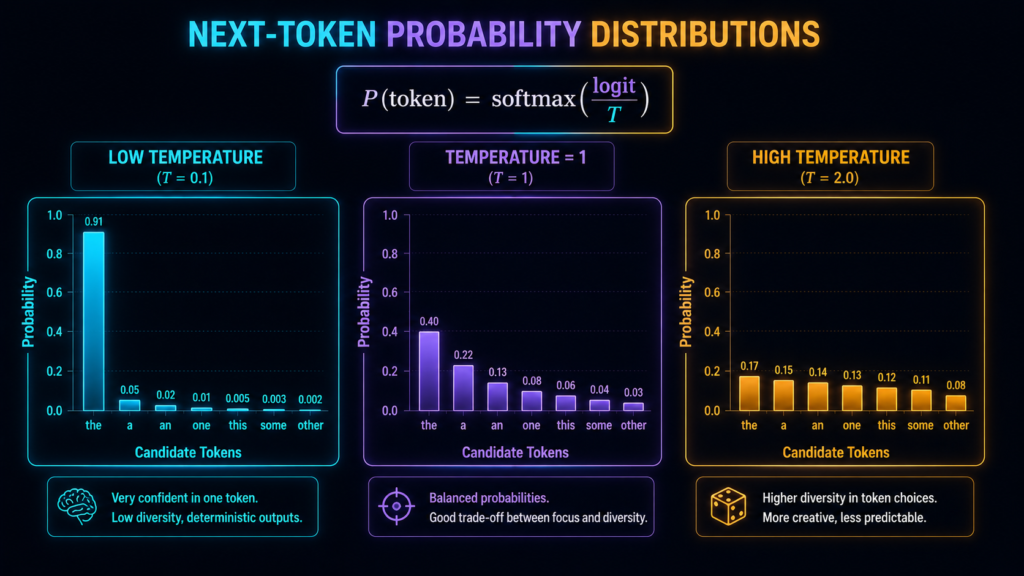
LLM Temperature does not change the model’s intelligence—it reshapes the probability distribution of the next possible words (tokens).
The Softmax Temperature Math:
Before the model picks a word, it takes its raw prediction scores (logits, written as $z_i$) and runs them through the temperature-adjusted Softmax function:
The critical part of this equation is simple:
Before Softmax converts raw logits into percentage probabilities, it divides every logit by the temperature value ($T$).
That single division changes everything:
Dividing by a small number ($T < 1.0$): Makes high scores much bigger and low scores almost zero. This sharpens the curve, forcing the model to pick only the top-ranked word.
Dividing by a large number ($T > 1.0$): Flattens the scores so all words have similar chances. This increases randomness and creative variety.
4. The Exact Mathematical Impact of Temperature
Let’s return to our three logits:
A = 2
B = 1
C = 0
At [T=1]:
nothing unusual happens because dividing by 1 changes nothing.
The approximate distribution is:
| Token | Probability |
| A | 66.5% |
| B | 24.5% |
| C | 9.0% |
Now reduce temperature:
At [T=0.5]:
The logits effectively become:
2 / 0.5 = 4
1 / 0.5 = 2
0 / 0.5 = 0
After Softmax:
| Token | Approx. probability |
| A | 86.7% |
| B | 11.7% |
| C | 1.6% |
Notice what happened.
The model already preferred A.
Lower temperature made that preference much stronger. The distribution became sharper.
Now increase temperature:
At [T=2]:
The effective logits become:
1
0.5
0
The approximate probabilities are:
| Token | Approx. probability |
| A | 50.6% |
| B | 30.7% |
| C | 18.6% |
The model still prefers A. But alternatives now have much more probability mass. That is the real meaning of temperature.
Low temperature sharpens the distribution.
The strongest candidates become relatively stronger.
High temperature flattens the distribution.
Less likely candidates become more competitive.
Temperature therefore does not directly tell the model:
“Be creative.”
It changes the mathematics of token selection. Creativity is an emergent consequence of allowing more alternative tokens to compete.
5. A Better Mental Model for Temperature
Imagine an LLM considering four continuations:
The scientist opened the...

door       55%
box        30%
container  10%
pineapple   5%
At a lower temperature, the distribution might behave more like:
door       82%
box        15%
container   2%
pineapple   1%
At a higher temperature, it could become more like:
door       38%
box        29%
container  20%
pineapple  13%
These numbers are illustrative, but the principle is correct.
Higher temperature gives weaker candidates a better chance of being sampled.
Sometimes that creates:
- unusual metaphors;
- varied phrasing;
- novel ideas;
- unexpected story directions.
But it can also create:
- irrelevant details;
- unusual syntax;
- factual drift;
- inconsistent formatting;
- or implausible continuations.
This explains why high temperature can increase the risk of hallucination-like behavior.
It does not mean temperature is the root cause of hallucinations.
Hallucination can occur even with low-temperature or greedy decoding because the highest-probability continuation itself can still be factually wrong.
That distinction is important.
6. Does Higher Temperature Cause Hallucinations?
The short answer: Not directly. There is no “hallucination switch.”
Temperature simply changes the math. When you increase the temperature, it flattens the probability curve, giving low-probability words a much higher chance of being picked.
This means the AI takes more risks to be “creative.” It might suddenly choose fake names, wrong dates, made-up facts, or broken code just because those rare words got a math boost.
So, while high temperature increases factual risk, simply setting temperature = 0 will not magically stop all hallucinations.
To truly reduce LLM hallucinations in real-world applications, you cannot rely on temperature alone. You need stronger engineering controls:
Retrieval-Augmented Generation (RAG): Feed the model real facts to read before it answers.
Tool Use & APIs: Let the AI search the web or check a database.
Structured Outputs: Force the model to output strict JSON data.
Post-Verification: Write code to double-check the AI’s answer before showing it to the user.
Temperature is just one small knob; building a reliable AI system requires the whole toolkit.
7. What Actually Happens at Temperature = 0?
The “Divide by Zero” Problem:
Normally, an AI uses a math formula to calculate the probability of the next word. This formula requires dividing the word’s raw score by the temperature.
But what happens if you set temperature = 0? In math, you cannot divide a number by zero. If the AI actually tried to do this, the whole system would crash!
The Override Switch: Greedy Decoding.
Because of this math rule, AI systems (like OpenAI, Claude, or local models) treat temperature = 0 as a special override switch. It tells the AI to completely skip the probability math. Instead, it enters a mode called Greedy Decoding.
Greedy decoding is extremely simple: the AI looks at the list of possible next words and always picks the #1 highest-scoring word. No rolling the dice, no randomness.
For example, if the AI ranks the next possible words like this:
Paris (Highest score)
Lyon (Second highest)
London (Third highest)
At temperature = 0, the AI will pick Paris every single time. Then it moves to the next word, finds the #1 choice again, and repeats.
When Should You Use Temperature 0? Because the AI always takes the safest, most obvious path, its answers become 100% predictable. All creativity is turned off.
This makes temperature = 0 the absolute best setting for coding tasks, extracting JSON data, or RAG pipelines, because it stops the AI from taking weird risks and heavily reduces hallucinations.
8. Temperature Does Not Decide Which Tokens Are Allowed
Here is where another parameter becomes important.
Temperature changes:
How probability is distributed among tokens.
But sometimes we want to restrict:
Which tokens are even allowed into the sampling pool.
That brings us to Top-K and Top-P.
9. What Is Top-K Sampling?
Top-K sampling is one of the simplest LLM generation parameters. Suppose the model has a vocabulary of 100,000 possible tokens.
Instead of sampling from all 100,000 tokens, you say: top_k = 5
The inference engine keeps only the five highest-probability candidates. Everything else is removed from consideration.
Suppose the next-token distribution is:
| Token | Probability |
| A | 35% |
| B | 25% |
| C | 15% |
| D | 10% |
| E | 5% |
| F | 4% |
| G | 3% |
| H | 3% |
If you set top_k = 3, the model only keeps A, B, and C.
D through H are excluded. The surviving probabilities (A, B, and C) are then recalculated (normalized) so they add up to 100% again for the final selection.
Top-K therefore means:
Keep exactly K of the most likely token candidates.
This is a fixed-size candidate pool. And that fixed size is also its main weakness.
10. The Problem With a Fixed Top-K
Consider two different prediction situations.
Situation A: The model is extremely confident
Paris   96%
Lyon     1%
London   1%
Berlin   1%
Rome     1%
Situation B: The model is uncertain
run      15%
walk     14%
move     13%
travel   12%
drive    11%
leave    10%
go        9%
...
If we always use:
top_k = 5both situations keep exactly five candidates.
But those situations are completely different.
In Situation A, the model barely needs alternatives.
In Situation B, many alternatives may be genuinely reasonable.
A fixed candidate count cannot adapt to this difference.
That motivated another approach.
Nucleus sampling, usually called Top-P.
11. What Is Top-P or Nucleus Sampling?
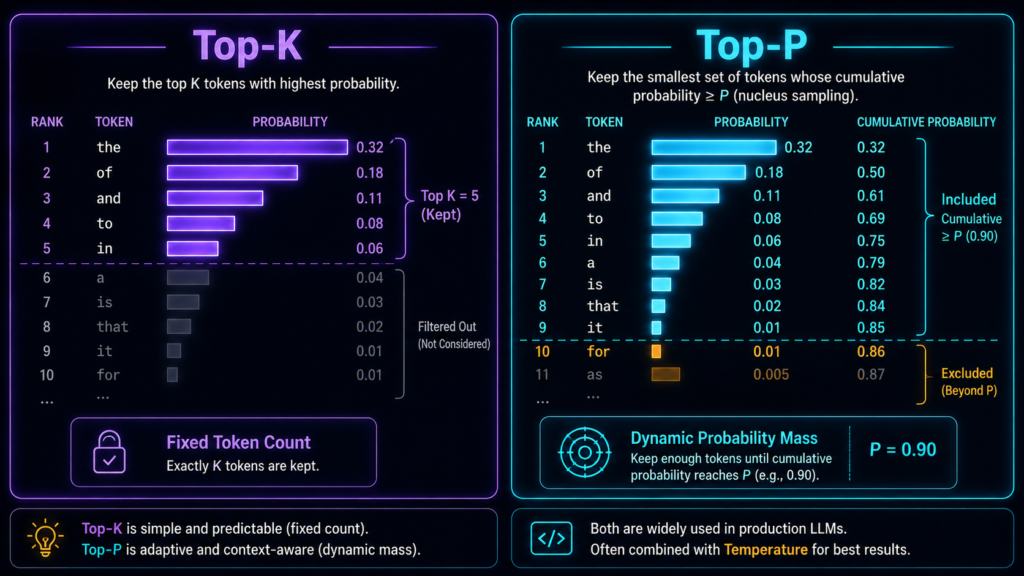
Instead of keeping a fixed number of words (like Top-K does), Top-P (Nucleus Sampling) dynamically selects the smallest group of words whose combined probability adds up to a set threshold (like 90%).
How Top-P Works :
Suppose an LLM predicts the following next-token probabilities:
Token A: 40%
Token B: 30%
Token C: 15%
Token D: 8%
Token E: 4%
Token F: 3%
If you set top_p = 0.90, the model adds probabilities from highest to lowest until it reaches 90%:
A = 40%
A + B = 70%
A + B + C = 85%
A + B + C + D = 93% (Target crossed!)
The model keeps {A, B, C, D} (called the nucleus) and completely cuts off the remaining low-probability tail {E, F}.
Why Nucleus Sampling Matters ?
This is known as dynamic truncation. Instead of using a rigid cutoff, Top-P automatically expands or shrinks the pool of candidate tokens based on how confident the LLM is:
When the model is confident: Only 1 or 2 tokens make up 90% of the probability, so the pool shrinks to keep answers focused and accurate.
When the model is uncertain: More tokens are needed to reach 90%, so the pool expands to allow safe creativity without picking bad, low-probability tokens.
12. Top-P vs Top-K: The Critical Difference
The easiest way to remember the distinction is:
Top-K controls the number of candidate tokens.
Top-P controls the amount of probability mass retained.
Top-K asks:
How many tokens should survive?Top-P asks:
How much cumulative probability should survive?That gives us:
| Feature | Top-K | Top-P |
| Controls | Number of tokens | Probability mass |
| Candidate pool | Fixed | Dynamic |
| Example | Keep 40 tokens | Keep tokens covering 90% probability |
| Adapts to confidence? | No | Yes |
| Common in open-source inference? | Yes | Yes |
| Useful for sampling? | Yes | Yes |
Modern open-source inference frameworks still support both approaches.
Hugging Face, for example, documents top_k as keeping the highest-probability K tokens and top_p as retaining the smallest high-probability set whose cumulative probability reaches the threshold.
13. Temperature vs Top-P: They Are Solving Different Problems
Now we can connect the concepts.
Temperature
Changes the shape of the probability distribution.
Top-P
Changes the candidate set by removing tokens outside the selected cumulative probability mass.
A simplified generation pipeline can therefore look conceptually like:
Prompt
   ↓
Transformer
   ↓
Raw logits
   ↓
Logit processors / penalties
   ↓
Temperature scaling
   ↓
Probabilities
   ↓
Top-P / Top-K filtering
   ↓
Renormalization
   ↓
Sampling
   ↓
Next token
Exact implementation details and operation order can vary across inference engines, so treat this as a conceptual pipeline rather than a universal provider specification.
The essential point remains:
temperature reshapes probabilities; truncation methods restrict the sampling pool.
14. Should You Change Temperature and Top-P at the Same Time?
Usually, when tuning an application, start by changing one primary randomness control at a time.
Why?
Because temperature and Top-P interact.
Imagine:
temperature = 0.4
top_p = 0.7
Temperature first makes the distribution sharper.
Then Top-P may remove a significant part of what remains.
Now imagine:
temperature = 1.3
top_p = 0.95
Temperature flattens the distribution.
The nucleus can consequently contain a different set or number of candidate tokens.
If you change both simultaneously during optimization and output quality improves, which change caused the improvement?
You do not know.
That makes:
- debugging harder;
- A/B testing harder;
- regression analysis harder;
- evaluation harder;
- production tuning harder.
A clean experimentation strategy is therefore:
Baseline configuration
        ↓
Change temperature
        ↓
Evaluate
        ↓
Keep/revert
        ↓
Then test Top-P if needed
Some APIs explicitly recommend altering either temperature or Top-P rather than both.
This is not because combining them is mathematically forbidden.
It is because using one major sampling control at a time is often easier to reason about and tune.
15. What Happens If Both Temperature and Top-P Are Low?
Let’s say you set temperature = 0.2 and top_p = 0.3. What actually happens?
First, the low Temperature forces the LLM to only focus on the most obvious, high-scoring words. Then, the restrictive Top-P strictly chops off all other options.
The result? The AI’s output becomes extremely predictable, conservative, and robotic.
✅ When to use low settings (Strict Logic): This combination is perfect when you need exact, zero-hallucination outputs. Use it for:
JSON data extraction
Text classification
Code formatting and strict data transformations
❌ When to avoid low settings (Creativity): This makes the AI too repetitive and boring for open-ended tasks. Avoid it for:
Creative storytelling
Brainstorming ideas
Human-like chatbot conversations
The Golden Rule: The “best LLM settings” completely depend on your use case. If you need strict accuracy, keep both low. If you need creativity, turn them up.
16. Why Do LLMs Repeat Themselves?
Imagine your AI chatbot gets stuck in a loop, writing things like:
“Our platform improves productivity. Productivity helps teams. We build a productivity platform…”
Most developers try to fix this by tweaking the LLM Temperature. But Temperature is the wrong tool here. The real problem is that the LLM is mathematically hooked on words it just used, constantly assigning them high probability scores.
To stop LLMs from repeating words, you need Repetition Penalties.
The two most important LLM generation parameters to fix this are Frequency Penalty and Presence Penalty.
They might sound like the exact same thing. But mathematically, Frequency Penalty vs. Presence Penalty work completely differently to force the AI to use fresh vocabulary.
17. Frequency Penalty vs Presence Penalty
If your LLM gets stuck in endless text loops or repeats the same phrases, you need to adjust its repetition penalties.
Under the hood, the API fixes this by subtracting points from the raw score (logit) of words the model has already used. Here is the exact math:
Don’t let the notation scare you. The concept is incredibly simple:
$z_i$ and $z’_i$: The original word score ($z_i$) versus the new, penalized score ($z’_i$).
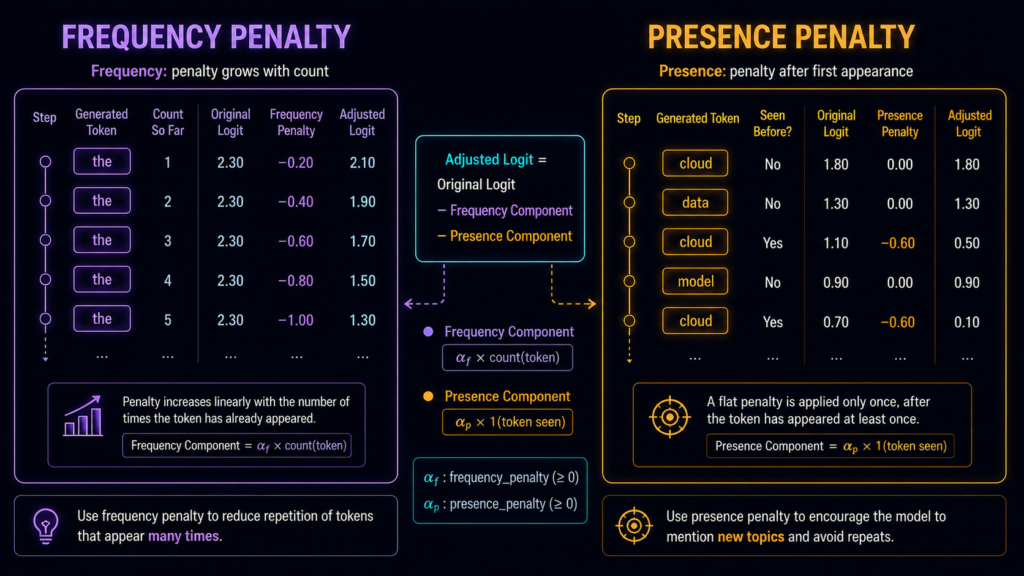
Frequency Penalty ($\alpha_{\text{frequency}}$): Punishes a word based on how many times it has appeared ($c_i$). The more the AI repeats a word, the harsher the penalty becomes. It forces the model to use a diverse vocabulary.
Presence Penalty ($\alpha_{\text{presence}}$): A one-time, flat penalty applied if a word has appeared at least once ($\mathbf{1}[c_i>0]$). It doesn’t matter if the word was used 1 time or 50 times—the penalty stays exactly the same. It forces the model to bring up new topics.
18. How LLM Frequency Penalty Works ?
The frequency penalty prevents an LLM from getting stuck in repetitive text loops. It asks one simple question: “How many times has this exact word already appeared?”
Unlike a flat penalty, this parameter is progressive. The more a word is used, the harder it gets penalized. It mathematically lowers the word’s raw score (logit) based on its exact count.
The Math in Action If you set frequency_penalty = 0.5:
Appears 1 time → Score drops by 0.5
Appears 2 times → Score drops by 1.0
Appears 4 times → Score drops by 2.0
When to use it: Increase the frequency penalty when your AI keeps recycling the same vocabulary, repeating descriptions, or getting stuck in infinite loops.
The TL;DR: “The more you say a word, the harder I make it to say it again.”
19. How the LLM Presence Penalty Works ?
The Presence Penalty asks one simple question: “Has this word appeared yet?“
It does not care how many times a word was used. It applies a one-time, flat penalty the moment a word shows up in the text.
0 uses: No penalty.
1 use: Penalty applied.
10 uses: The exact same penalty.
Because it penalizes words just for being present, the presence penalty forces the LLM to explore new topics and use a wider vocabulary, rather than getting stuck on the same ideas.
The simple rule to remember: “You already brought that up. Talk about something else.”
20. Frequency Penalty vs Presence Penalty: Simple Example
To control word repetition, LLMs lower a token’s raw score (logit) using two distinct penalties:
Frequency Penalty: Punishes a word based on how many times it has already appeared.
Presence Penalty: A flat, one-time punishment applied just because the word appeared at least once.
The Math in Action :
Suppose the word “AI” has already appeared 5 times in the text, and your API settings are:
frequency_penalty = 0.4presence_penalty = 0.6
Here is how the model calculates the penalty for the word “AI”:
Frequency Penalty: $5 \times 0.4 = 2.0$ (Scales with count)
Presence Penalty: $0.6$ (Flat one-time fee)
Total Logit Deduction: $2.0 + 0.6 = 2.6$
The Result: The model subtracts 2.6 from the raw score (logit) of the word “AI”. Because its score is now much lower, the LLM will naturally pick an alternative word instead—such as “system”, “model”, or “machine learning”.
21. When Should You Use Frequency Penalty?
Consider frequency penalty when the model is producing:
- repeated phrases;
- repetitive wording;
- loops;
- monotonous descriptions;
- excessive reuse of the same terminology.
Example:
The product is fast.
The product is reliable.
The product is affordable.
The product is scalable.
A moderate frequency penalty may encourage more varied sentence construction.
22. When Should You Use Presence Penalty?
Consider presence penalty when you want the model to explore broader vocabulary or concepts.
For example, during brainstorming:
Give me 20 distinct ideas for improving a developer productivity platform.Without enough diversity, the model may repeatedly circle around:
automation
workflow automation
AI automation
task automation
automated workflows
A presence penalty can discourage already-used tokens and push generation toward alternatives.
But use it carefully.
Because sometimes repetition is correct.
23. The Hidden Danger of High Repetition Penalties
When developers try to stop an LLM from looping or repeating itself, they often create a much worse bug: broken outputs.
Human language and programming code rely on repeating words (tokens).
Consider this sentence:
The API sends the request to the server, and the server returns the response.
Words such as"the","server"repeat because English requires or benefits from them.
Code repeats even more aggressively:
user = get_user()
if user:
    return user
Structured formats also require repeated syntax.
JSON repeatedly uses the exact same syntax over and over ({, ", ,, :).
If you set your frequency penalty or presence penalty too high, you force the LLM to artificially avoid these necessary tokens. Instead of picking the logical next word, the AI scrambles to find a unique one.
The result? A severely damaged output:
Awkward synonyms and unnatural grammar.
Inconsistent terminology across a document.
Broken code and malformed, invalid JSON.
The Golden Rule for Repetition Controls: In LLM parameter tuning, higher penalties do not equal better text. Treat these settings like a scalpel, not a hammer. Always use the lowest possible value needed to fix your specific looping problem.
24. Temperature vs Repetition Penalty: Don’t Confuse Them
These parameters solve different problems.
Temperature asks:
How strongly should the model favor its highest-scoring candidates?
Top-P asks:
How much of the probability mass should remain eligible for sampling?
Top-K asks:
How many of the highest-probability candidates should remain eligible?
Frequency penalty asks:
How strongly should repeated use increase the penalty?
Presence penalty asks:
Should previously used tokens receive a penalty simply because they have appeared?
This distinction is extremely useful when debugging LLM applications.
If the model is too repetitive, blindly increasing temperature may introduce randomness without solving the actual cause.
If the model is too unpredictable, adding repetition penalties may make the situation worse.
Tune the parameter connected to the failure mode you are actually observing.
25. Do Temperature and Top-P Affect RAG Retrieval?
This is one of the most important architectural questions.
Short answer:
Usually, no.
Consider a standard RAG pipeline:
User Question
      ↓
Embedding Model
      ↓
Query Embedding
      ↓
Vector Search
      ↓
Relevant Chunks
      ↓
Prompt / Context Construction
      ↓
Generator LLM
      ↓
Final Answer
Temperature and Top-P generally operate in the generation stage.
They do not normally change the embedding vector produced by your embedding model.
Therefore:
temperature ≠ embedding similarity controland:
top_p ≠ vector search thresholdRetrieval has its own controls, such as:
- embedding model;
- chunking strategy;
- similarity metric;
- retrieval
k; - score threshold;
- metadata filtering;
- hybrid search weights;
- reranking;
- query rewriting.
Generation has another set of controls:
- temperature;
- Top-P;
- Top-K where available;
- maximum output tokens;
- repetition controls;
- stop conditions;
- constrained decoding.
Confusing these two layers is a common RAG engineering mistake.
26. Should RAG Systems Use Low Temperature?
Often, yes—but not because RAG mathematically requires it.
Suppose your retrieved context says:
Employees receive 24 paid leave days per year.You usually want the model to answer:
Employees receive 24 paid leave days per year.You probably do not want creative reinterpretation.
So factual RAG applications commonly benefit from relatively conservative generation.
But the ideal setting depends on the application.
A RAG-powered creative writing assistant may intentionally use more sampling diversity.
A compliance assistant may use very little.
The correct principle is:
Match decoding behavior to the risk and purpose of the task.
27. Production Pattern: Dynamic Temperature Scaling
Static settings are not your only option.
In an agent workflow, you can modify generation settings according to the task or previous result.
Imagine:
User Request
     ↓
Agent
     ↓
Generate Answer
     ↓
Validator
     ↓
Valid?
   /     \
 Yes      No
  ↓        ↓
Return    Retry with stricter generation
For example, your first attempt might allow moderate variation.
If validation fails, your retry strategy could:
- lower temperature;
- tighten the prompt;
- constrain the output schema;
- retrieve better evidence;
- switch tools;
- or use a stronger model.
Notice something important:
lowering temperature should not be your only retry mechanism.
If the first answer failed because the retrieved evidence was wrong, changing temperature does not fix retrieval.
If the answer failed JSON validation, structured output enforcement may be better.
If the model lacks necessary information, a tool call may be required.
Production tuning is therefore a system-level problem, not simply parameter tuning.
28. Task-Aware Sampling Is Better Than One Global Setting
The biggest mistake developers make is hardcoding a single setting—like temperature = 0.7—for their entire application.
A modern production AI agent handles many different jobs in a single workflow. It might extract invoice data, write SQL code, search a vector database (RAG), and brainstorm marketing ideas.
Should all these tasks use the exact same LLM generation parameters? Absolutely not.
Instead, you need Task-Aware Sampling. This means dynamically changing your API settings based on the specific job.
Here is the best practice for tuning LLM parameters per task:
Data Extraction & JSON:
Temperature = 0.0(Strict, predictable, no hallucinations)Coding & SQL:
Temperature = 0.1(Highly logical and structured)RAG (Q&A):
Temperature = 0.3(Factual but reads naturally)Chatbots:
Temperature = 0.7(Conversational and engaging)Brainstorming:
Temperature = 0.9(Highly creative and diverse)
The goal isn’t to find one magical global temperature. The secret to a reliable AI system is matching the parameters to the task.
29. Dynamic Tuning in Multi-Step Agents
Imagine a LangGraph-style workflow:
START
  ↓
Retrieve Evidence
  ↓
Generate
  ↓
Validate
  ↓
┌───────────────┐
│ Valid output? │
└───────────────┘
    ↓       ↓
   YES      NO
    ↓       ↓
 Return    Retry
            ↓
      stricter generation
            ↓
         Validate
Your application state could track:
{
    "attempt": 2,
    "validation_failed": True,
    "generation_profile": "strict"
}
The second generation attempt can then use a stricter configuration.
But production systems should usually combine this with:
- validation feedback;
- improved instructions;
- retrieved evidence;
- schema enforcement;
- maximum retry limits.
This is much more robust than simply telling the model:
Try again.30. Temperature and Structured Output
Suppose you need:
{
  "name": "Alice",
  "age": 31,
  "department": "Engineering"
}
The priority is not creativity.
It is structural correctness.
A common beginner mistake is:
temperature = 0
therefore valid JSON guaranteed
No.
Temperature controls sampling behavior.
It does not itself enforce a JSON schema.
When your provider supports schema-constrained structured output, use it.
Then validate the result programmatically.
Think:
Prompt
   +
Schema
   +
Constrained generation
   +
Validation
rather than:
low temperature = guaranteed structure31. What Is Speculative Decoding?
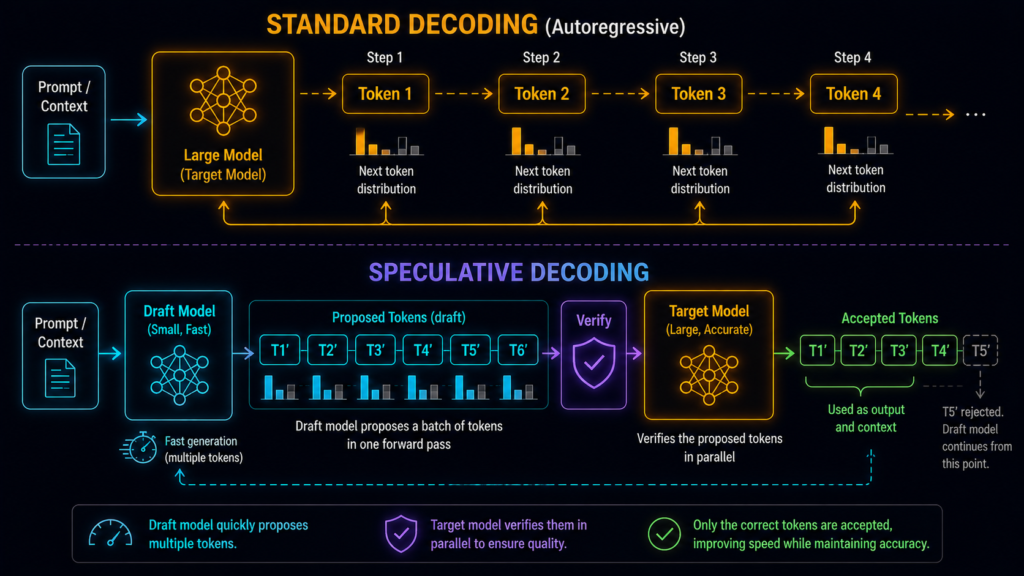
People often confuse Speculative Decoding with generation parameters like Temperature or Top-P. Don’t make this mistake.
Temperature and Top-P change what the AI chooses to say.
Speculative Decoding changes how fast it says it.
Speculative decoding is strictly an LLM inference optimization technique designed to fix one major problem: latency.
The Problem: Normal Generation is Slow Standard LLMs use autoregressive generation, meaning they calculate and print one single word at a time. This step-by-step process is a huge bottleneck for speed. Big Model → Word 1 → Word 2 → Word 3
The Solution: The Draft and Verify Method Speculative decoding speeds this up by using two models working together:
The Draft Model (Small & Fast): Quickly guesses the next several words all at once.
The Target Model (Large & Smart): Checks those guessed words simultaneously. If the guesses are correct, it approves them instantly. If a guess is wrong, the big model steps in and corrects it.
Speculative decoding drastically speeds up LLM generation times without changing the quality or probability of the final answer. It does not alter your sampling math—it simply solves a totally different problem at a completely different layer of the stack.
32. A Production Mental Model for LLM Generation
We can now assemble everything.
At a simplified conceptual level:
                    USER PROMPT
                         │
                         ▼
                 ┌───────────────┐
                 │ Transformer   │
                 └───────────────┘
                         │
                         ▼
                     LOGITS
                         │
                         ▼
              ┌────────────────────┐
              │ Logit Adjustments  │
              │ / Penalties        │
              └────────────────────┘
                         │
                         ▼
              TEMPERATURE SCALING
                         │
                         ▼
                  PROBABILITIES
                         │
                         ▼
              TOP-P / TOP-K FILTER
                         │
                         ▼
                  RENORMALIZE
                         │
                         ▼
                      SAMPLE
                         │
                         ▼
                    NEXT TOKEN
                         │
                         └──────────────┐
                                        │
                                        ▼
                                repeat generation
This happens token after token until the model:
- produces a stop token;
- hits an output limit;
- reaches another stopping condition;
- or is interrupted.
That is the machinery hidden behind a seemingly simple API call.
33. LLM Parameters Cheat Sheet
| Parameter | What It Controls | Lower / Restrictive Setting | Higher / Broader Setting | Good For |
| Temperature | Shape of probability distribution | More concentrated | Flatter / more varied | Overall sampling diversity |
| Top-P | Cumulative probability mass retained | Smaller dynamic candidate pool | Larger candidate pool | Nucleus sampling |
| Top-K | Number of candidate tokens retained | Fewer candidates | More candidates | Explicit vocabulary truncation |
| Frequency Penalty | Repeated token usage | Little discouragement | Increasing discouragement with repetition | Phrase/vocabulary repetition |
| Presence Penalty | Previously used tokens | Little discouragement | Encourages unseen alternatives | Topic/vocabulary exploration |
| Max Output Tokens | Output length ceiling | Shorter maximum | Longer maximum | Cost and response length |
| Stop Conditions | Where generation terminates | Earlier termination | Depends on configuration | Structured workflows |
34. One Variable at a Time
This rule saves enormous debugging time.
Do not start with:
temperature changed
top_p changed
prompt changed
model changed
retriever changed
chunk size changed
and then ask:
Why did accuracy improve?
You have no idea.
Instead:
Baseline
   ↓
Change one parameter
   ↓
Evaluate
   ↓
Record results
   ↓
Next experiment
Eventually you can test interactions between parameters deliberately.
But establish strong baselines first.
35. FAQs on LLM Temperature and Sampling
What is temperature in an LLM?
Temperature is a decoding parameter that modifies the model’s next-token probability distribution. Lower values concentrate probability around high-scoring tokens, while higher values flatten the distribution and increase the relative probability of less likely alternatives.
Does temperature change the model’s knowledge?
No. Temperature changes how tokens are selected from the model’s output distribution.
It does not retrain the model or add new knowledge.
Does temperature affect embeddings?
Normally no. Embedding generation and text-generation sampling are separate processes.
Does temperature affect RAG retrieval?
Normally no.
RAG retrieval is controlled by the embedding/search/reranking pipeline. Temperature generally affects the generator after relevant context has been retrieved.
Does temperature 0 mean deterministic?
It usually means very conservative or greedy-style decoding, depending on the API, but absolute reproducibility should not be assumed across every hosted inference environment.
Does high temperature cause hallucinations?
Not automatically.
Higher temperature flattens the token distribution, which gives lower-probability continuations more opportunity to be sampled. That can increase factual risk, but hallucinations can also occur at low temperature.
What is Top-P?
Top-P, or nucleus sampling, retains the smallest set of highest-probability tokens whose cumulative probability reaches a specified threshold.
For example:
top_p = 0.9means sampling from a dynamically sized high-probability nucleus covering roughly the selected probability mass according to the implementation.
What is Top-K?
Top-K keeps only the K highest-probability token candidates before sampling.
For example:
top_k = 20means only the top 20 candidates remain eligible.
Which is better: Top-P or Top-K?
Neither is universally better.
Top-P dynamically changes the candidate pool according to the probability distribution, while Top-K always keeps a fixed number of candidates.
The correct choice depends on the model, inference engine, and application.
Is Top-K obsolete?
No.
Modern open-source inference libraries continue to support Top-K.
However, not every hosted model API exposes it.
Can Top-P replace Top-K exactly?
No.
Top-P restricts probability mass.
Top-K restricts token count.
They are related truncation strategies but are not mathematically equivalent.
Should I change temperature and Top-P together?
Usually start by tuning one primary randomness parameter at a time.
They can be combined, but changing both simultaneously makes it harder to understand which parameter caused a behavioral change.
What does frequency penalty do?
Frequency penalty discourages tokens increasingly based on how often they have already appeared.
It is useful when generation becomes excessively repetitive.
What does presence penalty do?
Presence penalty discourages tokens after they have appeared, encouraging the model to explore alternatives.
Frequency penalty vs presence penalty: which should I use?
Use frequency-oriented control when your main problem is repeated wording or token reuse.
Use presence-oriented control when you want stronger movement toward new vocabulary or concepts.
Use neither simply because the parameters exist.
Can high frequency penalties break output?
Aggressive repetition penalties can damage fluency because legitimate repeated tokens may become unnaturally unattractive.
This can produce awkward grammar, terminology changes, broken code, or malformed structured text.
What temperature is best for RAG?
There is no universal value.
Factual RAG systems usually favor conservative generation, but retrieval quality, grounding, prompts, validation, and model choice are often more important than small temperature adjustments.
What temperature is best for coding?
Tasks requiring exact syntax and correctness usually benefit from conservative decoding. Brainstorming software architectures or alternative implementations may benefit from more diversity.
What temperature is best for creative writing?
Creative tasks can benefit from broader sampling because unusual token choices can produce more varied language. However, excessively broad sampling can reduce coherence.
Is temperature a training hyperparameter?
In the context discussed here, temperature is primarily an inference/decoding parameter.
It changes how outputs are generated after the model has already been trained.
This is different from training hyperparameters such as:
learning rate
batch size
number of epochs
weight decay
Calling temperature an “LLM hyperparameter” is common in developer discussions, but decoding parameter or generation parameter is more precise.
36. The Most Important Insight: These Parameters Do Not Make a Weak System Reliable
Suppose your RAG system retrieves the wrong document.
Lowering temperature will not magically retrieve the correct one.
Suppose your prompt is ambiguous.
Changing Top-P will not repair the specification.
Suppose your agent sends incorrect arguments to an API.
Increasing frequency penalty will not validate those arguments.
Suppose your model does not know today’s stock price.
Setting:
temperature = 0does not give it live market data.
Production reliability comes from architecture:
Good Data
   +
Good Retrieval
   +
Good Prompting
   +
Appropriate Model
   +
Tools
   +
Constraints
   +
Validation
   +
Evaluation
   +
Appropriate Decoding
Sampling parameters are important.
But they are one layer of a much larger AI system.
37. Final Mental Model
If you remember nothing else from this article, remember these five lines:
Temperature
Changes the shape of the token probability distribution.
Top-P
Keeps a dynamic set of tokens covering a chosen amount of probability mass.
Top-K
Keeps a fixed number of highest-probability token candidates.
Frequency Penalty
Discourages a token more as it is repeatedly used.
Presence Penalty
Discourages previously used tokens so alternatives become more attractive.
Put them together and the entire topic becomes much easier:
Model calculates logits
        ↓
Penalties can modify scores
        ↓
Temperature controls distribution sharpness
        ↓
Top-P / Top-K restrict candidates
        ↓
Sampling selects a token
        ↓
The token joins the context
        ↓
Repeat
That loop runs again and again, often hundreds or thousands of times, to create what appears on your screen as one smooth answer.
Once you understand that loop, parameters such as temperature, Top-P, Top-K, frequency penalty, and presence penalty stop looking like mysterious API knobs.
They become what they really are:
tools for controlling the decoding process of a probabilistic language model.
And that is the key production lesson.
Do not ask:
“What is the best temperature for an LLM?”
Ask:
“What decoding behavior does this particular step of my application require, and how will I measure whether it is working?”
That is the difference between randomly tuning an LLM and engineering one.
Quick Bookmark Cheat Sheet
| Problem You Observe | Parameter / System Area to Investigate First |
| Output is too random | Temperature / sampling configuration |
| Output is too predictable | Temperature / sampling diversity |
| Low-probability weird tokens appear | Temperature + truncation strategy |
| Need dynamic candidate filtering | Top-P |
| Need fixed candidate count | Top-K |
| Same wording repeats constantly | Frequency penalty / prompt / model behavior |
| Need more concept diversity | Presence penalty / prompting |
| RAG retrieves wrong documents | Retriever, embeddings, chunking, reranking — not temperature |
| RAG invents unsupported details | Grounding, validation, prompts, generation settings |
| JSON keeps breaking | Structured outputs / schema validation |
| Agent makes unreliable tool calls | Tool schema, constraints, validation, evals |
| Generation is slow | Inference optimization, caching, batching, speculative decoding |
| Need identical business behavior | Deterministic code + validation, not temperature alone |