1. The Problem: Why LLMs Need Structured Reasoning
At their core, Large Language Models (LLMs) are just advanced guessing machines. They work by predicting the next word in a sentence based on past patterns, not by actually thinking or understanding the problem.
Because they lack true logic, they suffer from a major flaw: “hallucinations.” This means the AI will give you a completely wrong answer, but it will sound 100% confident about it. For any serious software, this blind guessing destroys trust and makes the system unreliable.
The Real-World Danger These confident mistakes have serious consequences when used in real life:
Business Damage: If a customer support chatbot makes up a fake refund policy, it costs the company money and angers customers.
Safety Risks: If an AI medical tool suggests the wrong medicine dosage but makes it sound perfectly normal, it puts human lives in real danger.
The Solution: Structured Reasoning
The fix is actually very simple: we must force the AI to write down its thought process before it gives the final answer.
Think of it like a math teacher forcing a student to “show their work” on an exam. By making the AI explain its steps out loud, we stop it from just jumping to a quick guess and force it to carefully work through the logic.
Matching the Structure to the Problem: However, not all problems are the same, so the AI can’t use just one way of thinking. The reasoning style must match the task:
Simple Tasks: Need straightforward, step-by-step thinking (A leads to B, B leads to C).
Tricky Tasks: Require exploring multiple different paths to see which one works best before making a final choice.
Highly Complex Tasks: Demand handling several different thought processes at the exact same time to piece together a complete answer.
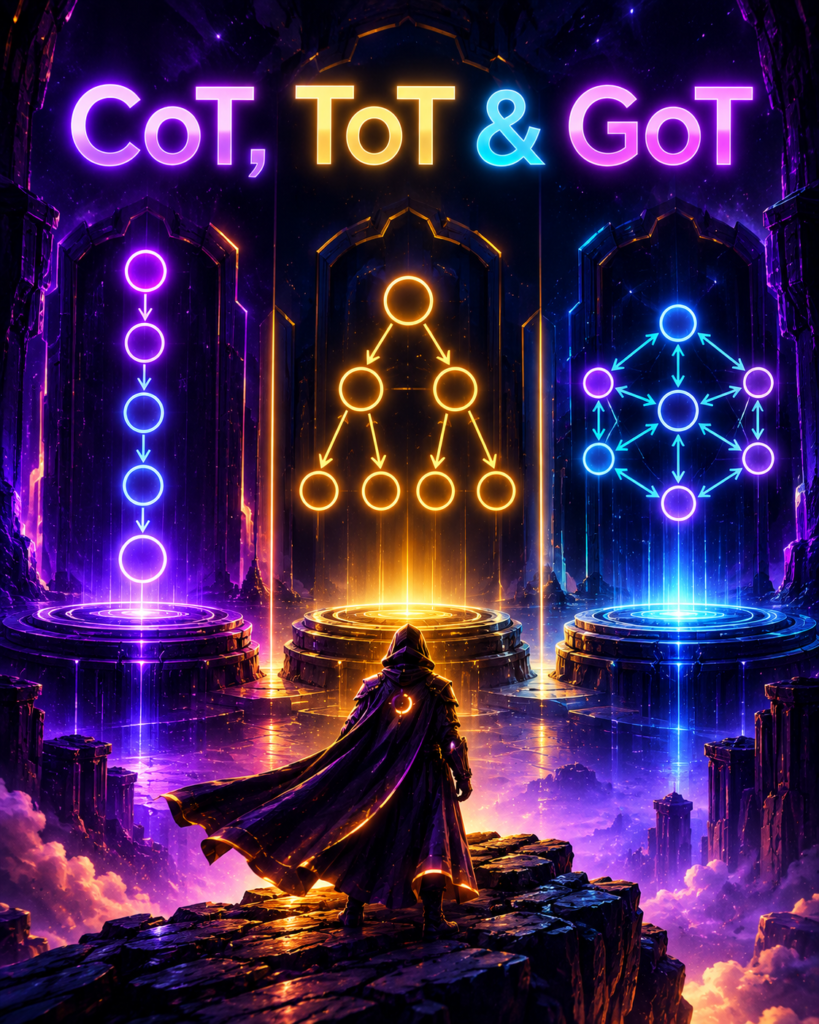
2. Chain of Thought (CoT): Linear Reasoning
Definition and Mechanism
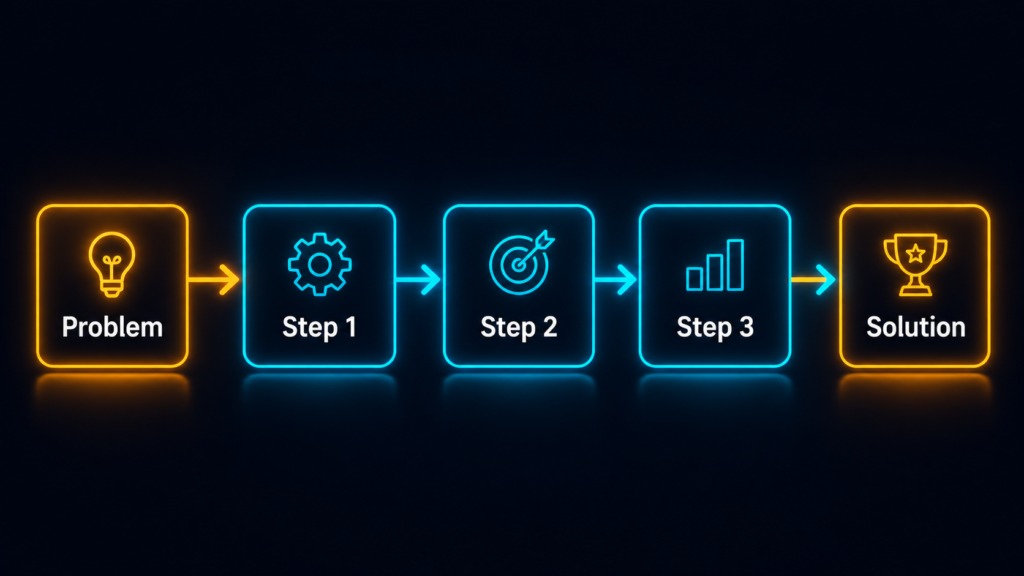
Chain of Thought (CoT) is a prompting technique where the model decomposes its reasoning into a linear sequence of intermediate steps before producing the final answer. The reasoning follows a straightforward path: Step A → Step B → Step C → Final Answer.
The Purpose
LLMs, as next-token predictors, struggle with multi-step logical problems when asked directly for answers. CoT provides the model with computational tokens to process intermediate reasoning steps, reducing hallucinations and improving accuracy on complex tasks.
When and Where to Use ?
| Aspect | Detail |
|---|---|
| When | Multi-step logical reasoning, mathematical word problems, sequential data extraction tasks |
| Where | General chatbots, prompt engineering workflows, basic RAG pipelines |
| Why | Implementation requires minimal effort—append “Let’s think step by step” to prompts. No external infrastructure required |
Implementation Example
from langchain.prompts import ChatPromptTemplate
from langchain_groq import ChatGroq

llm = ChatGroq(model="llama-3.3-70b-versatile")

prompt = ChatPromptTemplate.from_template("""
You are a reasoning assistant. Solve the following problem step by step.

Problem: {question}

Let's think through this step by step:
""")

chain = prompt | llm
response = chain.invoke({"question": "A train travels at 60mph for 2.5 hours, then at 80mph for 1.5 hours. What is the total distance traveled?"})
The Token Cost Reality
CoT generates significantly more tokens than direct responses. Empirical evidence from community benchmarking shows a typical 5x increase in token usage, with approximately 80% of tokens consumed by reasoning chains rather than the final answer.
This is equivalent to asking someone to verbalize every cognitive step while solving a problem—you receive the correct answer but with substantial overhead.
3. Tree of Thoughts (ToT): Branching Exploration
Definition and Mechanism
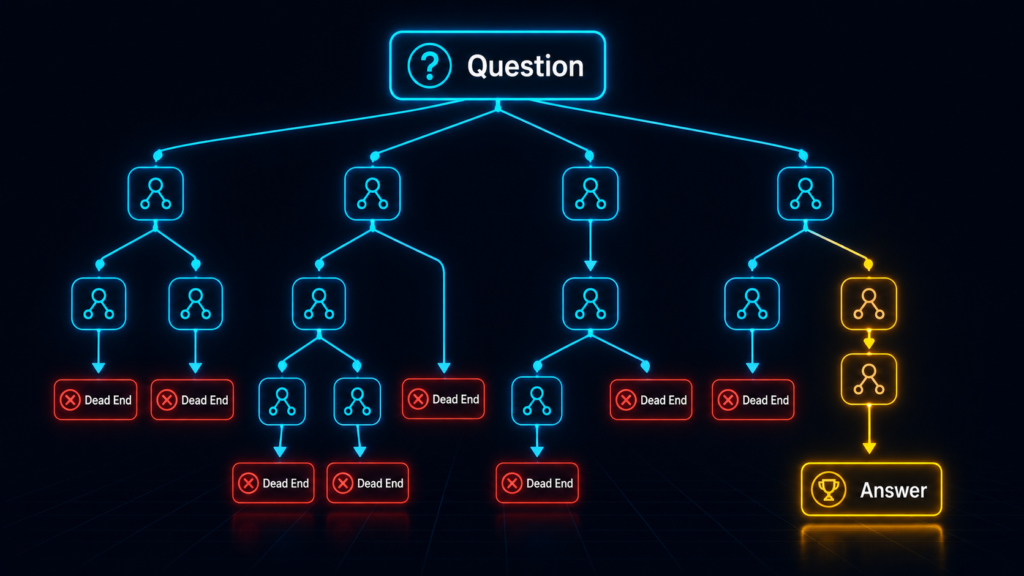
Tree of Thoughts (ToT) extends CoT by introducing branching reasoning paths. The model generates multiple possible reasoning trajectories, explores each branch, and employs backtracking when encountering dead ends. This approach uses algorithms similar to Monte Carlo Tree Search (MCTS), Breadth-First Search (BFS), or Depth-First Search (DFS) to navigate the reasoning space.
The Purpose
Real-world problems rarely follow a single linear path. Decision-making often requires exploring multiple alternatives, evaluating options against constraints, and selecting the optimal solution. ToT enables this exploration by maintaining multiple reasoning threads simultaneously.
When and Where to Use ?
| Aspect | Detail |
|---|---|
| When | Problems lacking a single clear solution path requiring exploration of alternatives—creative writing, complex proofs, puzzle solving (Sudoku, crosswords) |
| Where | AI agents with access to external tools where tool failures require backtracking and alternative approaches |
| Why | When CoT repeatedly hallucinates by getting stuck on incorrect paths, ToT provides self-correction capabilities |
Mechanism Details
ToT operates through a search process:
Branch Generation: The model generates multiple candidate reasoning steps from the current state
Evaluation: Each branch is assessed using a heuristic or LLM evaluation
Selection: The most promising branch is selected for continuation
Backtracking: Dead-end branches are abandoned, and the search returns to the most recent viable state
Implementation Concept
class TreeOfThoughts:
    def __init__(self, max_branches=3, max_depth=5):
        self.max_branches = max_branches
        self.max_depth = max_depth

    def explore(self, initial_prompt):
        current_branches = [initial_prompt]

        for depth in range(self.max_depth):
            new_branches = []
            for branch in current_branches:
                # Generate multiple continuations for this branch
                continuations = self.generate_continuations(branch, self.max_branches)
                for cont in continuations:
                    # Evaluate continuation viability
                    if self.evaluate(cont) > self.threshold:
                        new_branches.append(cont)

            current_branches = new_branches
            if not current_branches:  # All branches dead-ended
                return self.best_path_so_far

        return self.select_best(current_branches)
The Challenge: Error Cascades
A critical weakness of ToT involves error propagation. When one branch contains a hallucination or reasoning error, that error contaminates all subsequent reasoning derived from that branch. Unlike traditional software where abstraction provides reliability guarantees, LLM-generated reasoning cannot be trusted with the same confidence.
Analogy: This resembles a chef over-salting a dish and then compounding the error by adding other ingredients to mask the saltiness—the problem worsens through attempts at correction.
4. Graph of Thoughts (GoT): Networked Orchestration
Definition and Mechanism
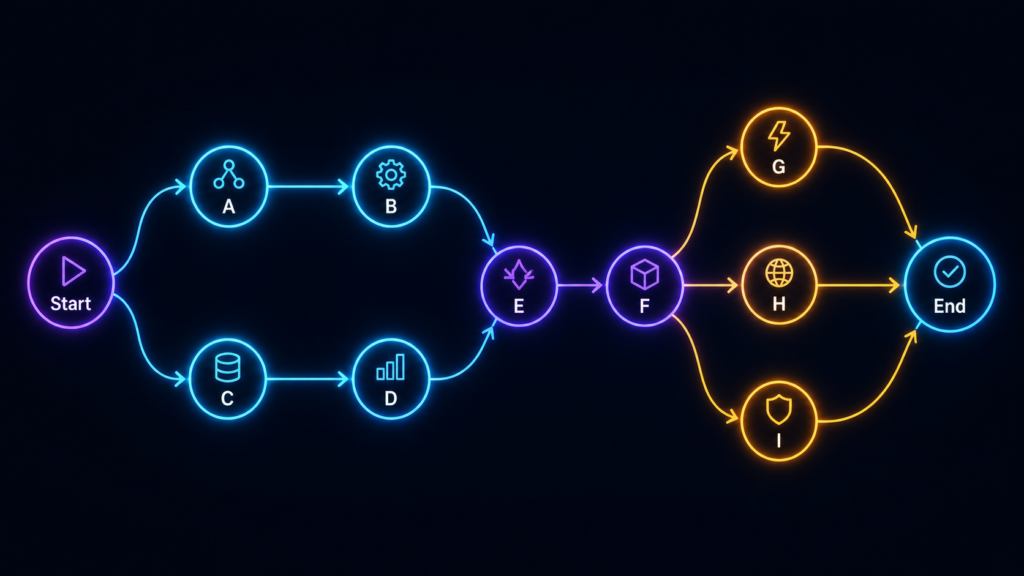
Graph of Thoughts (GoT) represents the most complex reasoning topology. Unlike CoT’s linear path or ToT’s branching structure, GoT allows thoughts to merge, loop, and interact as a network. Output from one reasoning node can be combined with input to another, enabling sophisticated information synthesis.
The Purpose
Human cognition rarely proceeds in strictly linear or branching patterns. We naturally combine multiple ideas to generate novel insights (synthesis). GoT facilitates this through parallel processing capabilities—multiple agents simultaneously solve different sub-tasks, and the graph structure merges their outputs into unified results.
When and Where to Use ?
| Aspect | Detail |
|---|---|
| When | Tasks divisible into independent parallel sub-tasks requiring final state merging—large-scale document summarization, multi-file code generation |
| Where | Production-level agentic workflows requiring state merging, parallel branches, and reducers to maintain stable state dictionaries |
| Why | Enhances execution speed and scalability by preventing single-agent bottlenecks and enabling complex routing logic |
Core Concepts:
State Merging: Combining outputs from multiple parallel reasoning branches into a unified state
Reducers: Functions that aggregate results from multiple sources into a single coherent output
Cyclic Workflows: Reasoning paths that can revisit and refine earlier nodes based on new information
The Challenge: Context Window Exhaustion
Maintaining a complete graph structure rapidly consumes the available context window. The overhead of tracking branching paths and their relationships leaves insufficient space for the actual problem-solving data.
Analogy: This mirrors trying to maintain an entire whiteboard of interconnected ideas while simultaneously working on the problem—mental capacity becomes exhausted.
5. Comparative Analysis: When to Use What
| Architecture | Thinking Style | Computational Cost | Primary Use Case |
|---|---|---|---|
| CoT | Linear (1D) | Low | Multi-step logic, mathematical reasoning |
| ToT | Branching (2D) | Moderate-High | Strategic planning, puzzle solving |
| GoT | Networked (3D) | High-Very High | Parallel tasks, complex orchestration |
6. The “Thought Tax”: Production Costs and Trade-offs
Token Consumption
| Architecture | Token Multiplier | Reasoning Overhead |
|---|---|---|
| Direct Answer | 1x | Minimal |
| Chain of Thought | 3-5x | 80% on reasoning tokens |
| Tree of Thoughts | 10-50x | Substantial exploration overhead |
| Graph of Thoughts | 50-500x | High orchestration overhead |
Note: These figures are based on observed community benchmarks and vary significantly with model architecture, prompt length, and task complexity.
Analysis: ToT and GoT architectures require running inference multiple times per query, making them economically impractical for many production applications.
Latency Considerations
Each reasoning token adds latency proportional to the model’s generation speed. With ToT and GoT requiring multiple inference passes, response times can extend from seconds to minutes.
Practical impact: User experience degrades significantly when response times exceed 3-5 seconds. For applications requiring real-time interaction, ToT and GoT may be infeasible.
Error Propagation :
The aggregation of multiple LLM calls creates compounding error risks. Unlike traditional software where functions provide reliable outputs, LLM calls have inherent unreliability. When chained or branched, these errors multiply:
CoT: Single error path
ToT: Errors can branch and propagate through multiple paths
GoT: Errors can merge, amplify, and create new error states through combination
Post-Hoc Justification :
Recent research indicates that LLMs sometimes determine answers before generating reasoning, producing plausible-sounding explanations to justify pre-existing conclusions rather than genuine step-by-step reasoning. This undermines the transparency benefits CoT aims to provide.
Cost of Search
Applying Monte Carlo Tree Search or other search algorithms to LLM reasoning requires dozens of inference calls for a single query. This approach is financially unsustainable for most applications without careful optimization.
7. Community Solutions and Emerging Patterns
Latent Reasoning :
Models like OpenAI’s o1 series shift reasoning operations into latent space rather than token space, reducing visible token consumption while maintaining reasoning capabilities. This approach internalizes the reasoning process.
Sparse Attention Mechanisms :
Normally, an AI model wastes huge amounts of memory by trying to connect every single word with every other word at the exact same time. With Sparse Attention, we change how the model looks at data. Instead of checking everything, the AI only focuses on a small, carefully chosen group of important words (tokens). By ignoring the unimportant parts, this method drastically cuts down memory requirements (context window), making it much faster and lighter for the AI to handle complex, connected graph reasoning.
Graph Self-Consistency (GSC) :
This technique forces the AI to focus on having solid, logical reasoning rather than just blindly trying to get the final answer right. It completely stops the model from making “lucky guesses”—situations where the AI spits out a correct-looking answer but has no real thinking or proof to back it up.
State Management with Reducers :
When an AI explores multiple different ideas at the exact same time (parallel branches), it can easily lose track of information. Frameworks like LangGraph solve this by using tools called “reducers.” A reducer cleanly collects and merges the memory (state) from all these separate thought paths so the AI doesn’t get confused. This makes it possible to actually build complex Graph of Thoughts (GoT) systems in real-world applications.
8. LangGraph Implementation with State Management :
from typing import TypedDict, List, Annotated
import operator
from langgraph.graph import StateGraph, END

# Define state with reducers for merging
class AgentState(TypedDict):
    question: str
    reasoning: Annotated[List[str], operator.add]  # Reducer: appends, not overwrites
    evaluation: dict
    final_answer: str

# Node functions
def generate_reasoning_paths(state: AgentState) -> dict:
    """Generate multiple reasoning approaches."""
    # In production, this would use an LLM to generate multiple paths
    return {
        "reasoning": [
            "Approach 1: Analyze from marketing perspective",
            "Approach 2: Analyze from product development perspective",
            "Approach 3: Analyze from financial perspective"
        ]
    }

def evaluate_paths(state: AgentState) -> dict:
    """Evaluate each reasoning path and merge results."""
    # Reducer automatically appends evaluations
    evaluations = {}
    for path in state["reasoning"]:
        # In production, each path would be evaluated by an LLM
        evaluations[path] = {"score": 0.5, "confidence": "medium"}

    return {"evaluation": evaluations}

def synthesize(state: AgentState) -> dict:
    """Merge evaluations into final answer."""
    # Combine reasoning paths and evaluations
    best_path = max(state["evaluation"].items(), key=lambda x: x[1]["score"])
    return {
        "final_answer": f"Best approach: {best_path[0]}"
    }

# Build graph
builder = StateGraph(AgentState)
builder.add_node("generate", generate_reasoning_paths)
builder.add_node("evaluate", evaluate_paths)
builder.add_node("synthesize", synthesize)

builder.set_entry_point("generate")
builder.add_edge("generate", "evaluate")
builder.add_edge("evaluate", "synthesize")
builder.add_edge("synthesize", END)

graph = builder.compile()

# Execute
initial_state = {"question": "How should we grow our business in the next year?"}
result = graph.invoke(initial_state)
print(result["final_answer"])
9. Production Decision Framework
Selection Criteria
| Question | If Yes | If No |
|---|---|---|
| Does the task require multi-step reasoning? | Use CoT | Direct answer |
| Does the task benefit from exploring alternatives? | Use ToT | Consider CoT |
| Can the task be parallelized into independent sub-tasks? | Use GoT | Consider ToT |
Recommended Approach
For most production applications:
Begin with CoT for complex reasoning tasks
Monitor token consumption and latency
Adopt ToT only when problem complexity necessitates exploration
Use GoT exclusively for tasks requiring parallel processing and synthesis
Cost Optimization Strategies
Implement result caching for repeated queries
Use smaller models for reasoning where accuracy permits
Consider latent reasoning models as alternatives to prompt-based reasoning
Monitor and audit reasoning chains periodically
10. Frequently Asked Questions {#faqs}
What distinguishes CoT, ToT, and GoT?
CoT follows a linear reasoning path. ToT explores multiple branching paths with backtracking. GoT enables networked reasoning with merging, looping, and interaction between different reasoning threads.
Which architecture should I choose?
Begin with CoT. Evaluate ToT/GoT only when problem complexity requires exploration or parallel processing and your budget allows for the additional computational costs.
What is the “Thought Tax”?
The hidden production costs associated with reasoning architectures—increased token consumption, latency, error propagation, and financial overhead.
Can these techniques work with open-source models?
Yes. CoT works effectively with most models. ToT and GoT typically require more capable models with stronger reasoning capabilities.
How do I manage state in GoT workflows?
Use frameworks like LangGraph with reducer patterns to merge parallel reasoning branches into coherent state.
11. Conclusion
Summary
| Architecture | Best Use Case | Cost | Latency | Complexity |
|---|---|---|---|---|
| CoT | Multi-step reasoning | Low | Low | Simple |
| ToT | Strategic planning | High | Medium | Moderate |
| GoT | Complex orchestration | Very High | High | Complex |
Key Recommendations
Begin with CoT for all reasoning tasks requiring multi-step processing
Monitor token consumption to understand actual costs
Graduate to ToT/GoT only when problem complexity and budget justify the investment
Implement state management with reducers when using GoT patterns
Advanced reasoning architectures provide significant capabilities at substantial cost—implement them deliberately, not by default.