Master embeddings for Agentic RAG — from dense vectors and hybrid search to chunking strategies, latest models like Voyage-4, practical gotchas, code examples, and production tradeoffs.
All About Embeddings in Agentic RAG
Imagine your AI agent staring at a massive knowledge base, needing to decide which facts to pull before reasoning or calling tools. One wrong retrieval and the entire multi-step plan collapses. Embeddings are the silent translator turning messy text into a mathematical map where “quantum entanglement” sits close to “Bell’s theorem” but far from “entangled bureaucracy.” In Agentic RAG, they power dynamic retrieval that lets agents adapt, verify, and synthesize across sources — far beyond static question-answering.
It’s the blueprint that lets you debug why your agent’s retrieval fails at scale and ship production-grade systems.
What Are Embeddings? The Semantic Compass
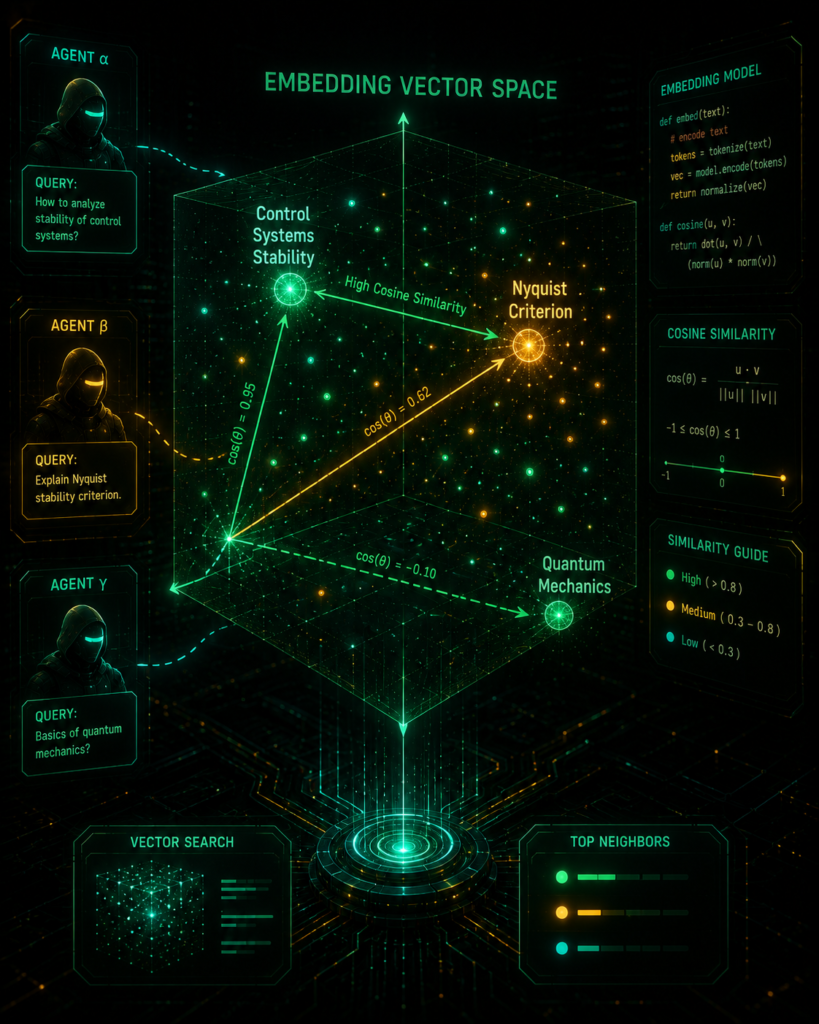
Think of embeddings like a GPS for meaning. Words, sentences, or documents become points in high-dimensional space. Similar ideas cluster together; dissimilar ones stay distant. Your agent doesn’t “read” every document — it queries this map for the nearest relevant vectors.
Technically, an embedding model (usually a transformer) maps input text to a fixed-length dense vector (e.g., 1024 or 3072 dimensions). These vectors capture contextual semantics via self-supervised training on massive corpora, often using contrastive objectives that pull similar pairs closer and push dissimilar ones apart. Example: In an engineering college lab simulation platform, student queries about “control systems stability” retrieve chunks on Nyquist plots or root locus even if exact keywords don’t match, because embeddings understand conceptual proximity.
import numpy as np
from sentence_transformers import SentenceTransformer

model = SentenceTransformer('all-MiniLM-L6-v2')  # 384-dim
texts = [
    "Control systems use feedback for stability.",
    "Nyquist criterion analyzes system stability.",
    "Quantum mechanics is unrelated here."
]
embeddings = model.encode(texts)

# Cosine similarity
def cosine_sim(a, b):
    return np.dot(a, b) / (np.linalg.norm(a) * np.linalg.norm(b))

print("Stability vs Nyquist:", cosine_sim(embeddings[0], embeddings[1]))  # High ~0.7+
print("Stability vs Quantum:", cosine_sim(embeddings[0], embeddings[2])) # Low- Load a lightweight Sentence Transformer model.
- encode() produces dense vectors capturing semantics.
- Cosine similarity measures angle between vectors (ignores magnitude, focuses on direction) — the core of retrieval.
- Run this in Colab; outputs real numbers showing semantic closeness.
Common Misconception 1: “Embeddings understand text like humans.” No — they capture statistical patterns. They can miss rare technical terms or struggle with negation/sarcasm without hybrid techniques.
Dense vs Sparse vs Hybrid Retrieval: The Core Tradeoffs
Dense embeddings excel at semantic understanding but can miss exact keywords (e.g., product SKUs or legal citations).
Sparse (like BM25) relies on term frequency — fast, interpretable, great for exact matches, but blind to synonyms.
Hybrid combines both via Reciprocal Rank Fusion (RRF) or learned fusion, consistently outperforming dense-only by 18-30% on mixed queries.
Comparison Table:
| Approach | Strengths | Weaknesses | Typical Use in Agentic RAG | Example Models/Tools |
|---|---|---|---|---|
| Dense | Semantic, handles synonyms | Misses rare terms, compute-heavy | Conceptual reasoning steps | text-embedding-3-large, Voyage-4 |
| Sparse | Exact match, fast, interpretable | No semantics | Keyword filters, IDs | BM25, SPLADE |
| Hybrid (Dense + Sparse + RRF) | Best of both, higher NDCG | Slightly higher latency | Agent tool selection & verification | Qdrant, Weaviate, Pinecone hybrid |
In Agentic RAG, the agent can route: use dense for planning, sparse for validation, hybrid for final retrieval.
# Hybrid example sketch (using LangChain-style pseudocode that runs with real libs)
from langchain_community.retrievers import BM25Retriever, EnsembleRetriever
# Assume vectorstore and bm25_retriever set up

ensemble = EnsembleRetriever(
    retrievers=[vector_retriever, bm25_retriever],
    weights=[0.7, 0.3]  # Tune based on domain
)
docs = ensemble.get_relevant_documents("specific query with jargon")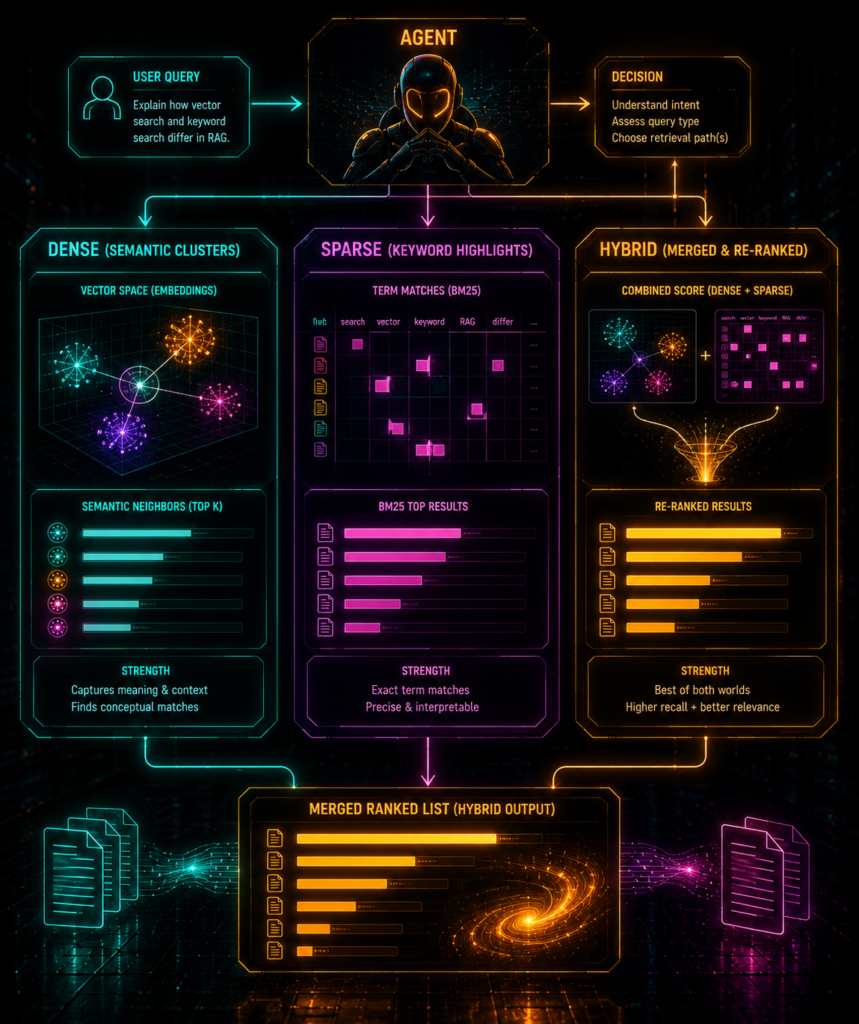
Chunking Strategies: Where Most Agentic RAG Systems Break
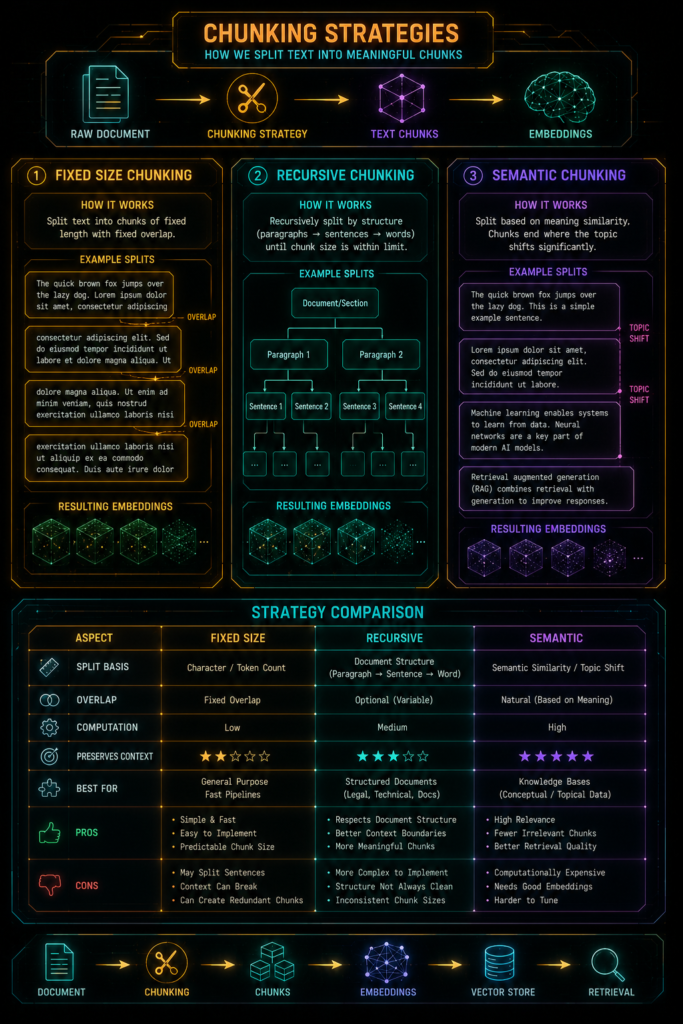
Chunking determines what gets embedded. Bad chunks = noisy or incomplete context for the agent.
Major variants:
- Fixed-size/Token: Simple, consistent. Typical: 512-1024 tokens, 20-50 overlap.
- Recursive: Hierarchy-aware (split on paragraphs > sentences).
- Semantic: Embed sentences, merge similar ones based on similarity threshold (e.g., >0.7 cosine).
- Page/Structure-aware: Preserve tables, sections — crucial for PDFs in enterprise.
Practical example: For long Indian curriculum PDFs with tables, page-level or recursive + metadata (section titles) outperforms naive fixed-size.
from langchain.text_splitter import RecursiveCharacterTextSplitter

splitter = RecursiveCharacterTextSplitter(
    chunk_size=800,  # tokens approx
    chunk_overlap=100,
    separators=["\n\n", "\n", ". "]  # Preserve structure
)
chunks = splitter.split_text(long_document)
# Then embed each chunkCommon Misconception 2: “Bigger chunks are always better.” No — too large dilutes focus and hits context limits; too small loses relationships. Test with retrieval metrics like nDCG.
Embedding Models and Ecosystem:
Key models:
- OpenAI text-embedding-3-large/small: Reliable baselines. Large: 3072 dim, ~$0.13/M tokens. Small: 1536 dim, ~$0.02/M.
- Voyage AI (voyage-4 series): Strong on MTEB, long context (32k), domain-specific (code, finance). voyage-4 ~$0.06/M, lite cheaper.
- BGE (BAAI), E5, Snowflake Arctic Embed, Jina, Nomic: Open-source leaders on MTEB leaderboard. Great for self-hosting.
- Multimodal: CLIP-like for images/tables in agent memory.
Hyperparameters: Dimension (lower via Matryoshka for storage savings, e.g., 256-1024), normalization (often L2), temperature in training.
Vector DB Ecosystem: Chroma (easy local), Pinecone (managed scale), Qdrant/Weaviate (hybrid + filters), pgvector (Postgres integration).
In Agentic RAG: Embeddings for document index and agent memory (past actions), tool descriptions, query rewriting (HyDE: generate hypothetical doc then embed).
For Indic scripts, choose multilingual models (e.g., Voyage multilingual or Indic-specific fine-tunes) to avoid token inefficiency and poor semantic capture in Devanagari/Hinglish mixes common in Indian ed-tech content.
Currency: Recent Advances and Agentic-Specific Techniques
- Long-context & Matryoshka embeddings: Models supporting 8k-32k reduce chunking needs; variable dim for flexible storage.
- Topic-enriched/Hybrid dense-sparse embeddings: Fuse TF-IDF/LDA with dense for better precision.
- Multi-vector & reranking: Store multiple embeddings per doc (summary + full); cross-encoders rerank top-k.
- Agentic patterns: Embeddings for dynamic tool selection, graph RAG (entity relationships), real-time memory updates. Some agents shift toward tool-based “just-in-time” retrieval over pure vector stores.
These aren’t name-drops — they address real limitations like context loss in multi-hop agent reasoning.
Practical Gotchas That Trip Up Production
- Embedding drift: Models update or data evolves — re-embed periodically or use versioning.
- Scale & Cost: Embedding 1M tokens ~$0.02-$0.13 depending on model. Vector storage adds up; use compression/lower dim. GPU for batch embedding (e.g., 8-24GB VRAM for larger models).
- Chunk boundary failures: Split mid-table/formula — use structure-aware loaders.
- Evaluation: Don’t trust manual checks. Use RAGAS, ARES, or nDCG@10. Threshold: >5-10% drop signals issues.
- Multilingual/Indic: Token bloat and semantic gaps — benchmark on domain data.
- Agent loops: Over-retrieval causes latency/cost explosion; implement agent routing and early stopping.
Quick-Reference Recap
| Concept | One-Line Answer |
|---|---|
| Embeddings | Dense vectors capturing semantic similarity via transformer encoders |
| Cosine Similarity | Primary metric for vector retrieval (angle-based) |
| Hybrid Search | Dense + Sparse (BM25) + RRF for precision/recall balance |
| Chunking | Recursive/semantic 512-1024 tokens w/ overlap; preserve structure |
| Top Models | Voyage-4, text-embedding-3-large, BGE; check MTEB |
| Costs | $0.02-$0.13 per M tokens; batch for savings |
| Gotcha | Chunk boundaries, drift, exact-match misses |
| Agentic Role | Retrieval for planning, memory, tool selection |