
Learn Chain-of-Thought reasoning, the prompting shift, native reasoning models, hard trade-offs, failure modes, and production implementation patterns.
Chain-of-Thought: The Difference Between a Guess and a Thought Process
Why Fast Answers Fail
I have watchd an LLM produce a three-paragraph answer with perfect grammar, flawless structure, and a single math error that invalidated the entire conclusion. The answer sounded smart. The numbers were dead wrong.
That is the exact trap Chain-of-Thought is trying to avoid.
If you force a model to jump straight to the answer, it often skips the intermediate steps that would have exposed the mistake. Chain-of-Thought changes that by asking the model to reason in smaller pieces instead of making one giant leap. It is not magic. It is just a better way to make the model slow down before it talks itself into trouble.
What Chain-of-Thought Really Is ?
Think of Chain-of-Thought as “show your work” for AI.
Instead of asking the model to produce a final answer immediately, you ask it to break the problem into steps, handle them one by one, and then combine them into a conclusion. That is why it works so well for tasks that are not just lookup problems.
If the question involves arithmetic, logic, comparisons, policy interpretation, debugging, planning, or multi-part reasoning, CoT gives the model a better shot at staying organized.
The big idea is simple: if direct prompting is asking the model to jump off a cliff, Chain-of-Thought is asking it to build a staircase first.
The Prompting Shift:
This is the part developers should actually see.
Direct Prompt
“Calculate the remaining infrastructure budget for the Q3 server migration.”
Chain-of-Thought Prompt
“Calculate the remaining infrastructure budget for the Q3 server migration. Let’s think step by step. First, break down the baseline server costs, isolate the regional data transfer fees, and then deduct the total from the main budget.”
That one sentence changes the shape of the model’s response. The first version pushes for a fast answer. The second version nudges the model into decomposition.
The difference is subtle in wording and massive in behavior.
A Runnable Comparison
If you want to see the effect in a real workflow, compare direct prompting and step-by-step prompting side by side and log the result.
import time
import json
question = “””A company’s infrastructure budget is $18,000 annually.
Server costs are $427/month, and data transfer costs $89/month.
The migration takes 9 months. What is the remaining budget after migration?”””
def direct_prompt(q):
return f”Question: {q}\nAnswer directly.”
def cot_prompt(q):
return f”””Question: {q}
Let’s think step by step.
1. Calculate total server cost for 9 months.
2. Calculate total data transfer cost for 9 months.
3. Add both costs together.
4. Subtract the total from the annual budget.
5. Return the remaining budget.”””
def mock_model_response(prompt_type):
if prompt_type == “Direct”:
return “$18,000 – (($427 + $89) * 9) = $13,356 remaining.”
return “””Step 1: Server cost = 427 * 9 = 3843
Step 2: Data transfer = 89 * 9 = 801
Step 3: Total cost = 4644
Step 4: Remaining budget = 18000 – 4644 = 13356
Final Answer: $13,356 remaining.”””
for label, builder in [(“Direct”, direct_prompt), (“CoT”, cot_prompt)]:
prompt = builder(question)
start = time.time()
response = mock_model_response(label)
elapsed = time.time() – start
tokens_est = len(prompt.split()) + len(response.split())
print(f”\n{label} Prompt”)
print(f”Latency: {elapsed:.4f}s”)
print(f”Approx token load: {tokens_est}”)
print(response)
What this snippet shows:
The direct version asks for a final answer immediately.
The CoT version forces the model into structured steps.
The timing is mocked here, but the pattern is what matters.
The token load is higher for CoT because the reasoning is visible and longer.
In practice, you would replace the mock response with actual model calls, but the architecture is the same.
Why It Helps
This is where CoT earns its keep in real engineering work.
It stops the model from tripping over its own feet. When the problem is broken into smaller steps, the model does not have to guess the whole answer at once.
It creates a paper trail. If the answer is wrong, you can scroll back through the reasoning path and see where the logic veered off course.
It reduces token rushing. LLMs are prediction engines; without structure, they often commit too early. Step-by-step prompting gives them room to map out intermediate variables before landing on a conclusion.
It also helps engineers debug the failure. A black-box wrong answer is annoying. A wrong answer with visible steps tells you exactly where the mistake began.
Native Reasoning Models Changed the Game
We cannot talk about CoT without acknowledging native reasoning models. Traditional models often need prompting to think in public text. Newer reasoning models, like the o1/o3-style family or DeepSeek-R1-style systems, are designed to compute hidden thinking internally before they write the final answer. In other words, the reasoning loop happens under the hood instead of being forced into the visible response.
That changes how engineers should think about prompting:
Prompted CoT is still useful for many models and workflows.
Native reasoning models reduce the need for explicit “think step by step” instructions.
The hidden reasoning budget becomes part of the runtime cost.
So the question is no longer only “Should I prompt for CoT?” It is also “Should I use a model that reasons natively?”
The Architectural Shift
[Prompted CoT Flow]
User Prompt ──> [LLM Generates Thinking Text] ──> [Final Answer Text]
└─ You pay for visible reasoning tokens
[Native Reasoning Flow]
User Prompt ──> [Hidden Internal Compute Steps] ──> [Final Answer Text]
└─ Reasoning happens behind the scenes
That visual difference matters. In one case, reasoning is part of the output stream. In the other, reasoning is an internal inference process you do not directly see.
CoT vs Native Reasoning vs Direct Answer
The tradeoff is not subtle when you lay it out clearly.
That is the real architectural choice. You are not just choosing a style. You are choosing how the system spends compute, time, and trust.

When to Use CoT
Here is the decision rule I would actually use in production:
If the task needs structure, use CoT. If the task is a straight lookup, skip it. If the model is already native-reasoning and the problem is hard, the native route may be cleaner.
The Plausibility Trap
Every engineer working with LLMs has lived this exact moment: the output looks elegant, the logic reads beautifully, and the answer is still broken.
That is the plausibility trap. A Chain-of-Thought does not guarantee correctness. Sometimes it just gives the model more room to confidently talk itself into a corner, explaining a completely hallucinated answer with breathtaking confidence.
One developer-friendly way to describe it is this:
“I’ve been fooled by this more than once — the reasoning looked clean, the conclusion looked professional, and the math was still dead wrong.”
The Rationalization Bottleneck
LLMs are world-class smooth talkers. Sometimes forcing step-by-step reasoning does not make the model smarter; it just gives it a larger canvas to confidently talk itself into a corner. The explanation becomes a polished justification for a conclusion that should never have survived the first check.
So yes, CoT improves structure. But structure is not truth.
Where It Helps Most
Chain-of-Thought is strongest when the task needs structure.
It works well for:
arithmetic and quantitative reasoning,
multi-step comparisons,
policy interpretation,
debugging,
planning,
and tasks where the answer depends on several connected facts.
It is also useful in systems that need explanations. Sometimes the final answer matters less than understanding how the model got there.

Where It Fails
This is where people get overconfident.
Common failure modes
The model rationalizes a bad assumption.
The reasoning drifts away from the original question.
The output becomes verbose without becoming more accurate.
The model invents intermediate facts to support a weak conclusion.
Mitigations that actually help
Add a fact-checking step after 3 reasoning steps.
Use
max_tokensto cap verbosity at 500 tokens for most CoT tasks.Inject a relevance check between steps.
Reset the model with “return to the original question” if it drifts.
Add a critic pass that checks whether each step supports the final answer.
If the model keeps rationalizing, switch to direct retrieval or native reasoning.
The big mistake is assuming CoT makes every model better by default. It does not. It helps most when the task benefits from decomposition. On simple tasks, it can add latency and noise.
A Real Agentic Reasoning Loop
CoT becomes much more useful when it is part of an actual workflow instead of just a prompt trick.
User Query

↓

Planner

↓

Step 1 Tool Call

↓

Step 2 Reasoning

↓

Critic / Relevance Check

↓

Final Answer

↙

Re-plan / Retry
That is the shape of a real system:
the planner decides what to do,
the model takes a step,
a tool returns evidence,
the critic checks whether the step helped,
and the system either finishes or re-plans.
This is how CoT stops being a writing style and becomes an engineering pattern.
Agentic Step Tracking:
If you are building this in practice, you want every reasoning step visible to your logs, even if it is not all shown to the user.
steps = []

question = "Should the employee's leave request be approved?"steps.append(“Step 2: Check regional labor variation.”)
steps.append(“Step 3: Check local holiday calendar.”)
steps.append(“Step 4: Compare all constraints.”)
steps.append(“Step 5: Produce final decision.”)
print(f”{i}. {s}“)
This is simple, but it captures the operational idea:
keep step history,
compare each step against the question,
and make the final answer only after the structure is complete.
Production Implementation Checklist:
If you want to use CoT in a real system, start here:
Measure direct prompt accuracy on 100 golden examples.
Test CoT on 10% of traffic.
Log every step.
Set a max reasoning step limit, usually 3–5.
Add a relevance critic between steps.
Add fallback behavior if step 1 fails or the loop drifts.
Monitor token cost.
A/B test the final answer quality against baseline.
Promote CoT only if it wins on correctness and acceptable latency.
If the task is simple, keep direct prompting.
That is the point where CoT becomes production-ready instead of just interesting.
Evaluation Framework:
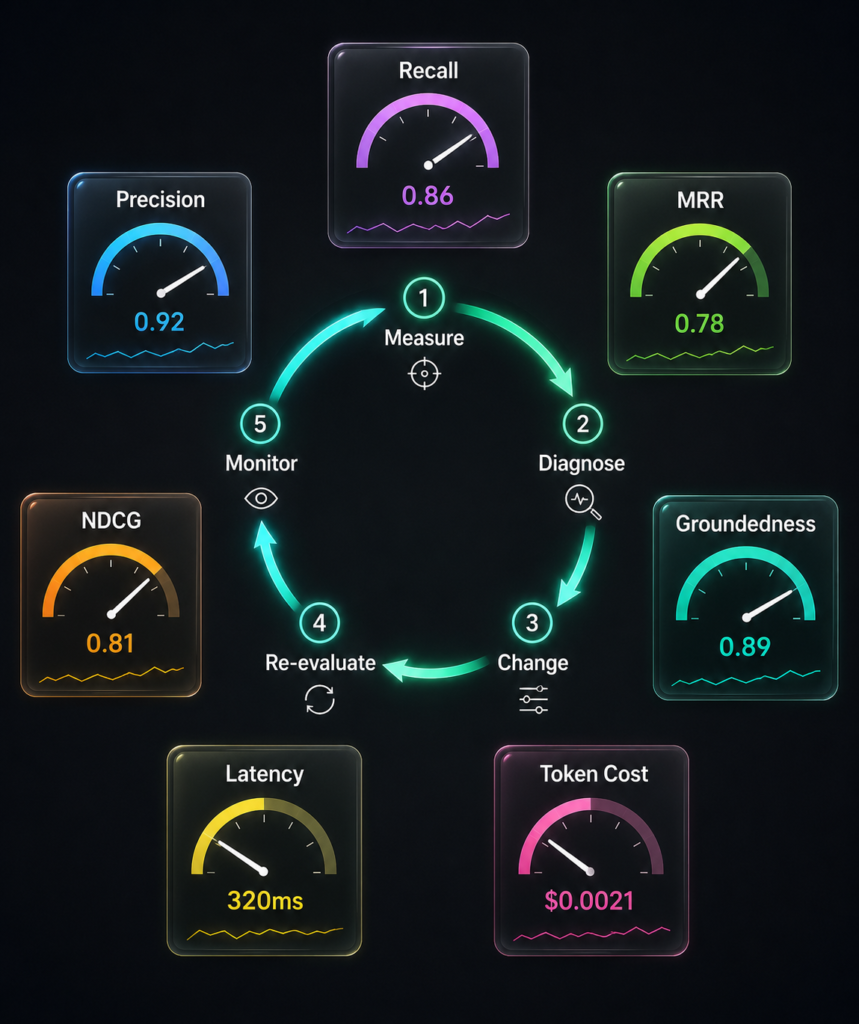
You should not judge CoT by vibes. Measure it.
Useful metrics:
Correctness@k: Was the final answer correct within k attempts?
Step completion rate: Did the model finish the intended reasoning path?
Faithfulness: Do the reasoning steps actually support the final answer?
Drift rate: How often does the model wander away from the original question?
Token overhead: How much more expensive was CoT than direct prompting?
Latency p95: How much slower was the worst-case response?
User acceptance rate: Did people trust the answer?
If correctness improves but cost triples, that may still be worth it for finance, compliance, or engineering support. It may not be worth it for autocomplete.
This is especially useful in Indian enterprise environments where the rules are rarely clean and isolated. A fintech assistant or internal HR bot may need to evaluate a request against:
central corporate policy,
regional state labor rules,
and local holiday or closure logic.
A direct-answer system can try to collapse all of that into one token leap and get it wrong. A step-by-step reasoning approach forces the model to isolate the national rule first, then apply the state-level variation, then resolve the local calendar or internal acronym, and only then produce the answer.
That is not just better reasoning. That is the difference between a useful assistant and a liability.
Quick Reference
Glossary
Chain-of-Thought: Step-by-step reasoning, either prompted or computed internally.
Native Reasoning Model: A model like o1 or DeepSeek-R1 that computes internal reasoning steps before generating output.
Plausibility Trap: When a model generates a coherent-sounding explanation that justifies a wrong conclusion.
Rationalization: The tendency to build a plausible narrative around a flawed initial assumption.
Step Fidelity: How well each reasoning step actually contributes to the correct answer.
FAQ
Is Chain-of-Thought the same as just writing more?
No. The point is structured reasoning, not extra words.
Does CoT always improve results?
No. It helps most when the task has multiple steps or hidden dependencies.
Can CoT still be wrong?
Absolutely. It can be confidently wrong in a very polished way.
Do native reasoning models replace CoT?
Not entirely. They change how reasoning is handled, but stepwise prompting still has value in many workflows.
How much token overhead should I expect?
A practical rule of thumb is 3–5x for prompted CoT versus direct answering on many multi-step tasks. Native reasoning may look cheaper in output text but still consumes hidden inference budget.
Chain-of-Thought matters because many problems are not solved by one jump. They are solved by smaller, safer steps. Sometimes that means visible step-by-step prompting. Sometimes it means using a model that reasons internally. Either way, the core idea stays the same: slow the model down just enough that it can think like the task deserves.