Learn the ReAct framework in RAG with real prompt architecture, tool orchestration, failure modes, production limits, and practical agent design.
ReAct in RAG: The Loop That Turns Search into Thinking
When Simple RAG Stops Being Enough
A user asks a question that looks simple on the surface, but it is really two questions hiding inside one. The system retrieves a document, half-answers the request, and confidently stops. That is how plain RAG fails: it acts like the first good answer is the full answer.
ReAct is the fix. It gives the model a way to think, take an action, see what happened, then think again before answering. That sounds small, but it changes the entire behavior of the system. Instead of one-shot retrieval, you get a controlled reasoning loop.
What ReAct Really Is ?
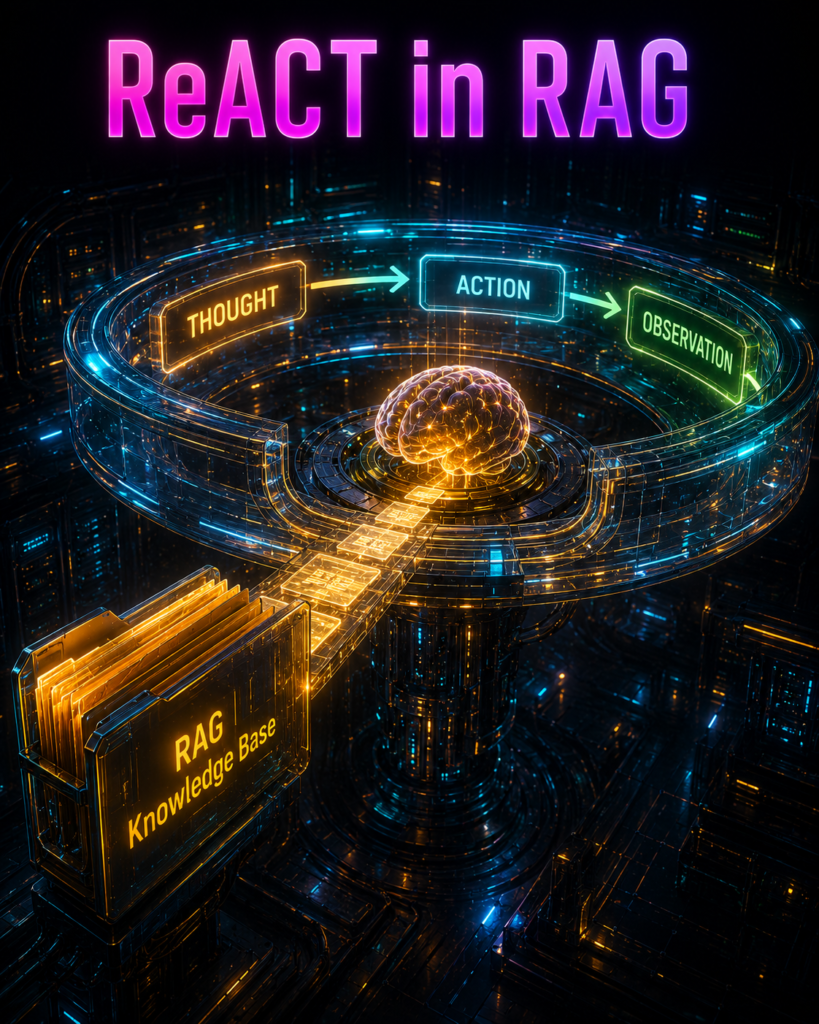
ReAct stands for reasoning and acting. The key idea is that the model does not just generate a final answer immediately. It produces an intermediate reasoning step, chooses an action, observes the result, and continues.
The important part is that the LLM itself decides what to do next at runtime. That is what separates ReAct from a static rule engine. It is not “if the user says compare, then search.” It is the model dynamically deciding whether it needs to search, inspect, compare, or stop.
That difference matters because real questions are messy. The model may need one retrieval step, or three, or a tool call, or a second search after the first result looks weak.
The ReAct Prompt Shape:
In production, ReAct usually runs inside a prompt that forces the model to follow a strict structure. The engine then parses the model’s output, executes the tool call, and injects the observation back into the conversation.
A common format looks like this:
Question: The user question

Thought: What should I do next?

Action: One of the allowed tools

Action Input: The input for that tool

Observation: The result returned by the tool

Thought: I now know the answer

Final Answer: The response to the user
The model is not freewheeling here. It is being guided into a loop that alternates between internal reasoning and external action.
Why the Loop Matters ?
This loop is the reason ReAct is powerful in RAG.
A plain retriever finds documents. A ReAct agent can notice that the first document is incomplete, ask for another one, compare the two, and then answer. That means the system can recover from weak first-pass retrieval instead of pretending the first hit was enough.
That is a big deal in real use cases:
policy questions with exceptions,
technical questions with multiple dependencies,
customer support issues that need more than one source,
and internal knowledge tasks where context lives in several places.
The Orchestration Problem
Here is the part people often miss: ReAct does not work as a single linear script.
After the model produces an action, execution must stop. The external tool has to run. Then the result has to be injected back into the prompt as the next observation. Only then can the model continue. That means ReAct needs an orchestration layer. In practice, that could be a workflow engine, a graph-based agent framework, or a custom loop that parses the model output and feeds observations back in. Without that orchestration, ReAct is just text on a page.
A Minimal ReAct Loop:
This is the kind of structure a real agent needs.
max_iterations = 5
history = []
for step in range(max_iterations):
prompt = f”””
Question: {user_question}
History: {history}
Use this format:
Thought: …
Action: …
Action Input: …
Final Answer: …
“””
model_output = llm(prompt)
history.append(model_output)
if “Final Answer:” in model_output:
break
action, action_input = parse_action(model_output)
observation = run_tool(action, action_input)
history.append(f”Observation: {observation}”)
else:
final_answer = fallback_response(user_question)
What this pattern shows:
max_iterations = 5prevents runaway loops.The prompt is rebuilt each round with the current history.
The model output is parsed for an action.
The tool result is injected back as an observation.
If the loop never converges, the system falls back deterministically.
That last part is not optional. It is production survival.
The Failure Modes:
ReAct is useful, but it has sharp edges.
Infinite loop death spiral
This is the classic failure mode. The model gets ambiguous or weak tool output, then repeats the same thought-action cycle again and again until the token budget dies.
Hallucinated tool names
The model may invent a tool that does not exist, or format the action badly.
Drift from the original goal
After several loops, the model can forget what the user originally asked.
Token flooding
A tool can return too much text and bury the useful signal under a wall of noise.
The answer is not to avoid ReAct. The answer is to design for these failures up front.
Guardrails That Actually Help
A production ReAct system needs hard limits, not hope.
Set
max_iterations=5or something similarly strict.Keep the tool list small and explicit.
Wrap tool execution in error handling.
Compress large tool outputs before reinserting them.
Re-inject the original user goal into each loop iteration.
Use a deterministic fallback when the loop does not converge.
That is how you stop a clever agent from becoming an expensive loop machine.
ReAct in RAG:
ReAct makes the most sense when the retrieval problem is not one-and-done.
A normal RAG pipeline asks: “What document looks relevant?”
A ReAct pipeline asks: “What should I do next to answer this properly?”
That may mean:
retrieve the first evidence chunk,
notice that it is incomplete,
retrieve a second source,
compare the two,
inspect a calculation,
and only then synthesize the answer.
This is why ReAct shines in agentic RAG. It gives the system a way to reason through evidence instead of just stuffing the first result into a prompt.
Real Business Use Cases:
ReAct is especially valuable in workflows where context is messy or distributed.
Customer support
The agent can check one support article, realize it does not cover an exception, then search a second policy source before responding.
HR and internal policy
An employee may mention a regional holiday or a local acronym. The agent can resolve the context first, then search the correct policy definition.
Technical support
The system can inspect logs, retrieve docs, compare versions, and then answer with evidence instead of guessing.
Finance or compliance
The agent can retrieve policy, check constraints, verify a rule, and refuse if the evidence is not sufficient.
That multi-step behavior is exactly where ReAct earns its keep.
This matters even more in Indian corporate and ed-tech environments because the context is often implicit, not cleanly spelled out. An employee may ask about leave using a regional holiday name or a local internal acronym. A basic RAG pipeline may miss it because the exact wording does not match. A ReAct agent can take a step back, resolve the term, run a second search, and then retrieve the correct policy. That is the superpower: not just search, but context recovery.
ReAct vs Plain RAG:
If the question is direct, plain RAG may be enough. If the question needs inspection, comparison, or repeated retrieval, ReAct is the better fit.
Quick Reference:
FAQ
Is ReAct the same as chain-of-thought?
No. ReAct combines reasoning with action. The model does not just think; it uses tools and observations.
Do I need ReAct for every RAG system?
No. Simple retrieval questions do not need the extra overhead.
What is the biggest production mistake?
Letting the agent loop without a hard iteration cap and fallback path.
Why does ReAct work better for complex questions?
Because it can adapt after seeing evidence, instead of guessing after the first retrieval.
ReAct is what happens when RAG stops pretending the answer is always one search away. It gives the agent a rhythm: think, act, observe, refine. That makes it slower than plain RAG, but much better when the problem is layered, ambiguous, or context-dependent. In real systems, that rhythm is often the difference between a confident guess and a useful answer.