Transformer AI Architecture Explained: From Simple Intuition to Self-Attention and QKV Math. Learn how self-attention, QKV vectors, and multi-head attention work with simple analogies and real examples.
Table of Contents
The 60-Second Picture in Your Head
What Exactly Is a Transformer? (No Jargon)
Why Transformers Changed Everything
The Core Magic: Self-Attention
Q, K, and V Vectors: The Library System
The Attention Formula (Without the Panic)
Multi-Head Attention: The Panel of Experts
Why Parallel Processing Matters
The Complete Architecture (Simple View)
Transformers vs RNNs: The Clear Winner
FAQs: Quick Answers to Common Questions
The Bottom Line
1. Before we dive into math and code, let me paint a picture that’ll stick with you forever.
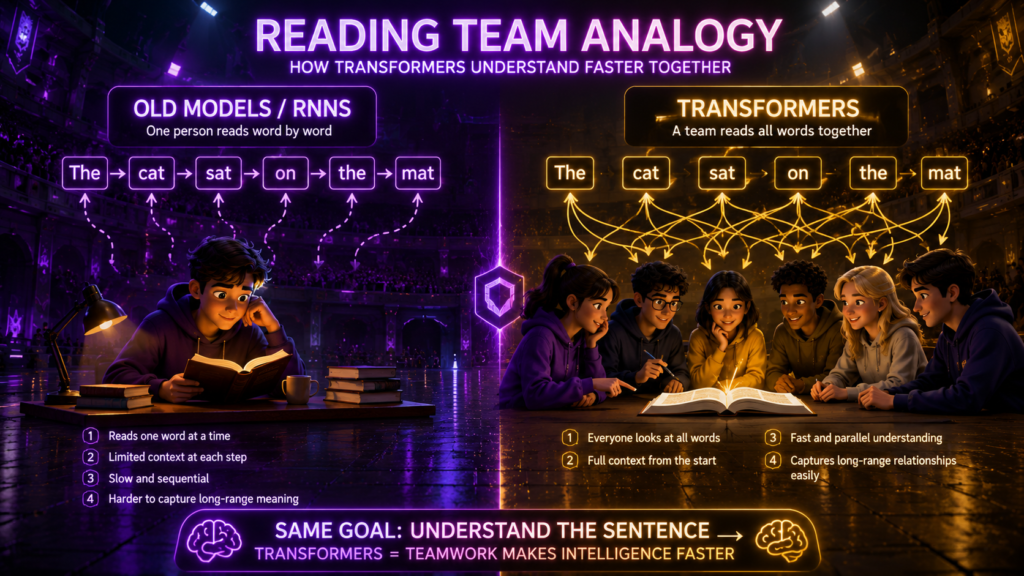
Old Models: The Lonely Reader
Think of an old AI model (like an RNN) as one person reading a book word by word.
They start at page 1. They read word 1, then word 2, then word 3. By the time they reach the end of a long sentence, they may have forgotten what was at the beginning.
Result: They lose context. They miss connections. They struggle with long sentences.
Transformers: The Reading Team
Now think of a Transformer as a reading team.
Every member of the team sees a different word in the sentence. And here’s the magic – all of them talk to each other at the same time.
Word 5 says to Word 2: “Hey, I think you matter to me.”
Word 10 says to Word 1: “You’re actually really important for my meaning.”
Word 3 says to everyone: “I don’t care about any of you.”
Result: Complete understanding of the whole sentence, instantly.
This is why Transformers are fast, powerful, and so good at understanding context. They don’t wait. They don’t forget. They just… understand.
2. What Exactly Is a Transformer?
Let’s pop the hood on this AI engine. It’s a model design that lets an AI look at all words at once, figure out which words matter most to each other, and understand context much better than older sequential models.
Here’s the thing:
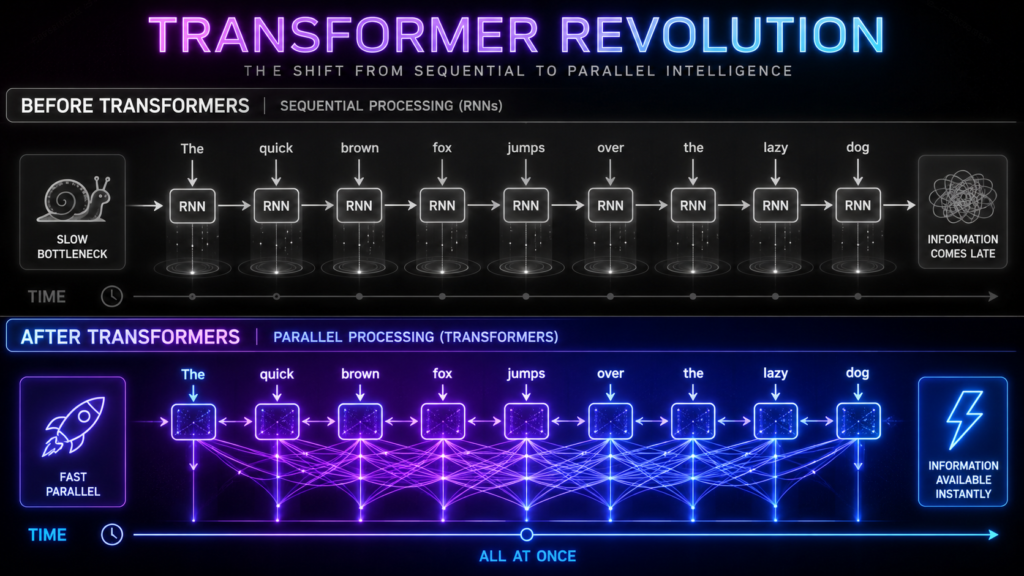
Traditional models (like RNNs) process text one word at a time, in order. Word 1, then word 2, then word 3.
Transformers process all words simultaneously. They don’t wait. They don’t forget. They just process everything at once.
Think of it like this:
Traditional model: You’re reading this sentence and you can only see one word at a time.
Transformer: You can see the entire sentence at once, with all the words glowing based on how important they are to each other.
This is the fundamental insight that made modern AI possible.
3. Why Transformers Changed Everything ?
Before Transformers, models like RNNs processed text in order, one token at a time. That made long-range context harder and slower to learn.
The Problem:
You’d feed the model a sentence
It would read word 1, update its memory
Then word 2, update memory
Then word 3, update memory
By word 50, it had forgotten word 1
This is called the vanishing gradient problem, and it was a nightmare.
The Solution:
Transformers removed that bottleneck completely by using self-attention, which lets the model connect words directly regardless of distance.
Word 1 can directly talk to Word 50. Word 10 can directly talk to Word 100. No forgetting. No bottlenecks.
That is why Transformers became the foundation for modern LLMs. They are not just a better model. They are a better way of thinking about sequence data.
4. The Core Magic: Self-Attention
Self-attention is the Transformer’s superpower. It’s what makes everything work.
The Three Questions :
For every word in a sentence, self-attention asks three simple questions:
Which other words matter to me?
How much should I care about them?
What context do I need from them?
Example :
Let’s look at two sentences:
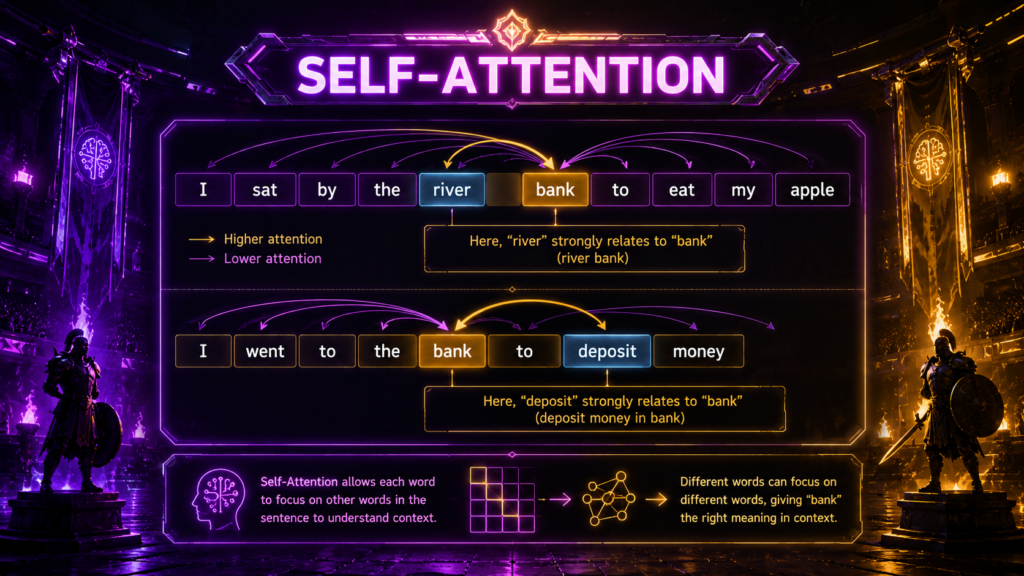
Sentence 1: “I sat by the river bank to eat my apple.”
Sentence 2: “I went to the bank to deposit money.”
The word “bank” has two completely different meanings. In sentence 1, it means the edge of a river. In sentence 2, it means a financial institution.
How does the Transformer know the difference?
Self-attention.
In sentence 1, “bank” looks at “river” and says: “You matter to me. A LOT.”
In sentence 2, “bank” looks at “deposit” and says: “You matter to me. A LOT.”
The connection between “bank” and “river” is strong. The connection between “bank” and “deposit” is strong. Everything else? Weak connections.
Here’s an even simpler way to think about it:
Self-attention is like giving every word a flashlight and letting it shine on the other words that matter most.
Strong connection = brighter light (higher attention)
Weak connection = dimmer light (lower attention)
No connection = darkness
Meaning comes from relationships, not isolated words.
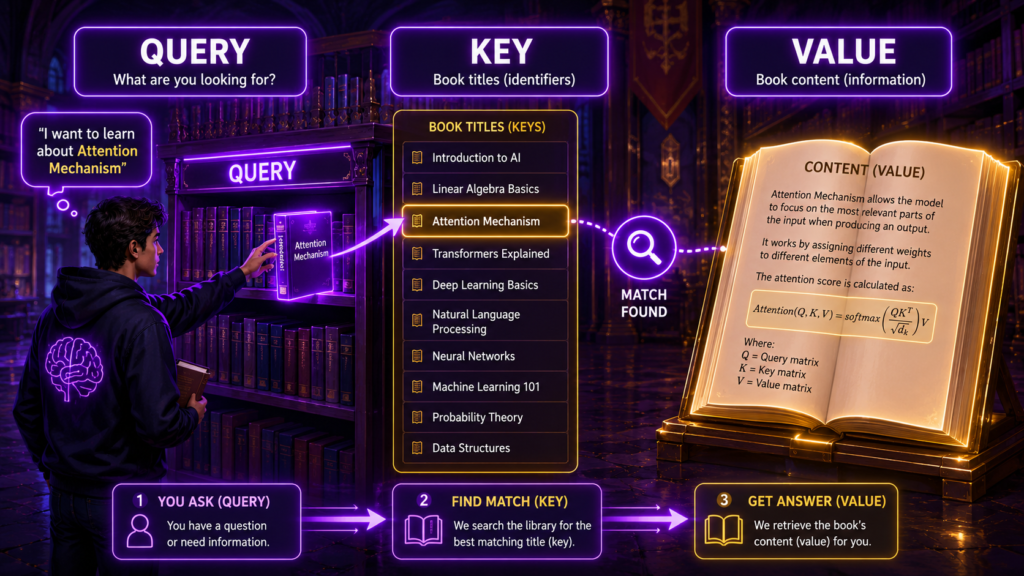
5. Q, K, and V Vectors: The Library System
Imagine you’re in a massive library, and you’re looking for information about “ancient Egyptian pyramids.”
Your search term is the Query (Q). It’s what you’re looking for.
Each book title is a Key (K). It’s what each book has to offer.
The book’s actual content is the Value (V). It’s the information you actually want.
Here’s how it works:
You search the library catalog (your Query)
The system compares your query against every book title (every Key)
It calculates which books are most relevant
It retrieves the actual content from those books (the Values)
How This Works in a Transformer
| Step | Library | Transformer |
|---|---|---|
| 1 | You search for “pyramids” | The word “bank” creates a Query |
| 2 | System compares against all book titles | The Query is compared against all Keys from all words |
| 3 | It decides which books are most relevant | It calculates attention scores |
| 4 | It retrieves the book content | It returns the weighted Values |
That is exactly how attention works inside a Transformer.
The model:
Creates a Query from what it wants
Compares it against all Keys (what every word offers)
Calculates which words matter most
Retrieves the Values (actual information) from those words
WANT TO VIEW ALL THESE IN SIMULATIONS? CHECK OUT THESE LABS:
TOKEN LAB — The Token Party — Transformers as Gossip
SELF-ATTENTION LAB — Attention — Theatre Stage & Solar System
BERT LAB — BERT the Detective — vs GPT the Writer
SELF VS CROSS ATTENTION — The Translation Booth — Self-Attention vs Cross-Attention
GPT SANDBOX — GPT Sandbox — Play with the Machine
6. The Attention Formula
The original Transformer paper gave this formula:
Attention(Q,K,V) = softmax(QKᵀ / √dₖ) × V
Let me translate that into plain English:
Step 1: QKᵀ
The model multiplies the Query matrix by the transpose of the Key matrix. This measures how well queries match keys.
Step 2: √dₖ
The model divides by the square root of the key dimension. This keeps the numbers numerically stable (stops them from getting too big or too small).
Step 3: softmax()
The model turns the scores into probabilities (numbers between 0 and 1 that add up to 100%).
Step 4: × V
The model multiplies these probabilities by the Values. This returns the weighted information.
What This Actually Means
Here’s what’s really happening:
The model:
Compares what it wants (Query) with what each word offers (Key)
Decides which words matter more (softmax scores)
Blends their meanings into the final representation (multiplying by Values)
That’s the whole trick.
Every single Transformer, from the original paper to GPT-4, uses this same basic formula. They just scale it up massively.
7. Multi-Head Attention: The Panel of Experts
One attention head is good. Multiple heads are better.
What It Is
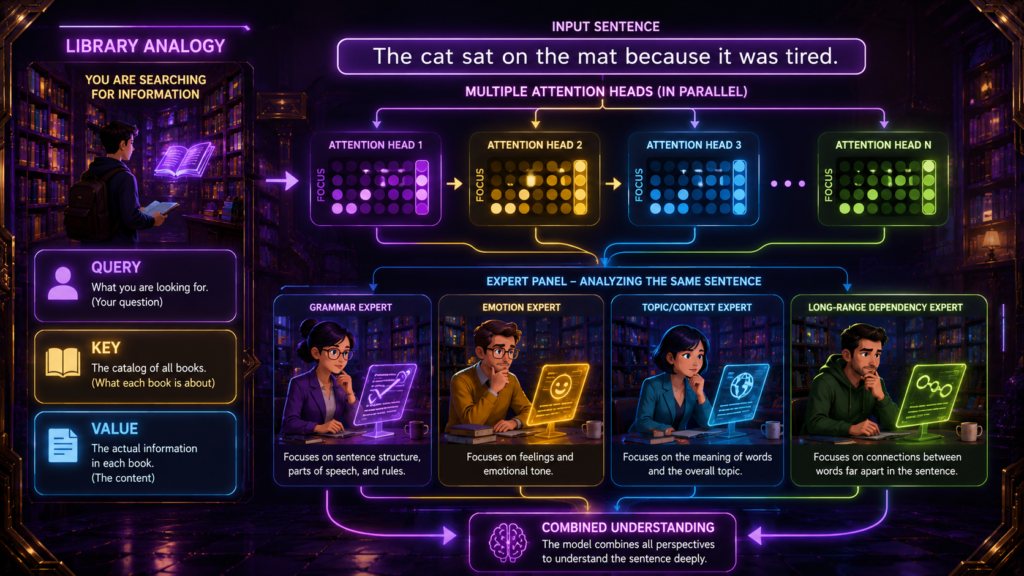
Multi-head attention means the model doesn’t look at relationships in just one way. It uses several attention heads in parallel, and each one can focus on a different kind of signal.
The Panel of Experts
Think of it like a panel of experts analyzing a text:
Expert 1 (Grammar) looks at grammatical relationships: “How is this word connected to that verb?”
Expert 2 (Emotion) looks at sentiment: “Is this word positive or negative?”
Expert 3 (Topic) looks at subject matter: “What topic is this word discussing?”
Expert 4 (Long-range) looks at distant connections: “Does this word at position 5 connect to this word at position 95?”
Each expert focuses on something different. Then they combine their insights. Together, they give a much richer understanding than any single expert could.
8. Why Parallel Processing Matters
This is one of the biggest reasons Transformers beat older models.
RNNs (Old Models):
Process token by token in a strict sequence
Can’t start on token 10 until they’ve finished tokens 1-9
Slow. Very slow.
Transformers:
Process all tokens simultaneously
Start on token 10, token 100, and token 1000 at the same time
Fast. Very fast.
The Scale Advantage
Why this matters:
Transformers scale beautifully to large datasets and large models.
100 million parameters? Sure.
1 billion parameters? No problem.
100 billion parameters? Let’s do it.
RNNs couldn’t do this. They hit a wall. Transformers broke through it.
This is a major reason modern LLMs are built on Transformers instead of older sequential architectures.
9. The Complete Architecture
Let me show you the entire Transformer architecture in one simple diagram:
Input tokens
     ↓
Embedding layer    (turns words into numbers)
     ↓
Positional information (adds word order)
     ↓
Self-attention blocks (X multiple layers)
     ↓
Feed-forward layers (processes the attention)
     ↓
Output tokens      (generates the result)
What Actually Happens
Step 1: Input tokens
The model receives your sentence: “I love eating pizza”
Step 2: Embedding layer
It turns each word into a vector (a list of numbers). “I” becomes [0.12, 0.89, -0.45, ...]
Step 3: Positional information
It adds information about word position. “I” is position 1, “love” is position 2, etc.
Step 4: Self-attention blocks
It runs the attention formula we discussed. Words talk to each other. Relationships are formed.
Step 5: Feed-forward layers
It processes the attention outputs through neural network layers.
Step 6: Output tokens
It generates the final output: the next word, a classification, a translation, etc.
The key idea: The model first turns words into vectors, then uses attention to decide which words matter most, then transforms that information into output.
10. Transformers vs RNNs:
| Feature | RNNs | Transformers |
|---|---|---|
| Reading style | Sequential (one at a time) | Parallel (all at once) |
| Long context | Harder (forgets) | Easier (remembers) |
| Speed on large data | Slower | Faster |
| Attention across words | Weak | Strong |
| Modern LLM use | Rare (almost obsolete) | Standard (everywhere) |
Why Transformers win:
They can look at the whole sequence at once – No bottlenecks, no forgetting
They learn richer relationships – Every word connects to every other word
They scale massively – More data + more compute = better results
Bottom line: Transformers are the reason modern AI feels intelligent. They replaced slow sequential reading with parallel context understanding, and self-attention made it possible for models to focus on the right words at the right time.
11. FAQs: Quick Answers to Common Questions
Why are Transformers better than RNNs?
Transformers process tokens in parallel and use self-attention to connect words directly, which makes them faster and better at handling long-range context. RNNs process sequentially and tend to forget earlier words.
What is the self-attention mechanism?
Self-attention is the process where each word in a sentence looks at other words and decides which ones matter most for understanding meaning. It’s like every word having a flashlight to illuminate the words that are most relevant.
What are Q, K, and V vectors?
Q (Query) = What I’m looking for
K (Key) = What I have to offer
V (Value) = The actual content I want to return
Think of it like a library system: Query is your search, Key is book titles, Value is book content.
Why are multi-head attention layers useful?
They let the model look at relationships in several different ways at the same time. One head might focus on grammar, another on emotion, another on long-range connections. Together, they give a richer understanding.
How do Transformers process text?
They turn words into numbers (embeddings), add position information, run multiple layers of self-attention, and generate output. All of this happens in parallel, which makes them fast.
What does the attention formula actually do?
It compares queries with keys to find matches, turns those matches into probabilities, and uses those probabilities to retrieve the most relevant information from the values.
Can Transformers handle very long texts?
Yes, but there’s a limit. Standard Transformers can handle up to a few thousand tokens efficiently. Newer models use techniques like sliding window attention to handle even longer texts.
12. The Bottom Line
Transformers are the reason modern AI feels intelligent at scale. They replaced slow sequential reading with parallel context understanding, and self-attention made it possible for models to focus on the right words at the right time.
Read the next part -> Transformers Deep Dive: Encoder vs Decoder, Masked Attention, and the Architecture Behind GPT & BERT – neuralninjas.in

[…] Read first part here -> Transformers Explained: From “Huh?” to “Aha!” in 15 Minutes – neuralninjas.in […]