
Transformer AI Architecture Explained: Encoder vs Decoder, Masked Attention, and Positional Encoding. Learn the deeper side of Transformer AI architecture with encoder vs decoder models, masked self-attention, positional encoding, QKV math, and a technical comparison table for modern LLMs.
Table of Contents
The First Thing to Understand: Transformers Are a Family
Encoder vs Decoder: The Big Distinction
Masked Self-Attention: Why Cheating Is Forbidden
Positional Encoding: The Timestamp Analogy
The Attention Formula (One More Time, Cleaner)
Multi-Head Attention: The Panel of Experts (Deep Dive)
How Transformers Became GPT, BERT, and Modern LLMs
Technical Comparison Table: RNNs vs Transformers
The Full Stack: Putting It All Together
The Strongest Way to Remember It
FAQs: Quick Answers to Common Questions
Closing: Why This All Matters
1. The First Thing to Understand: Transformers Are a Family
Let me start with something most articles don’t tell you.
Transformers are not one single model type.
They are a family of architectures, and modern LLMs use different Transformer styles for different jobs.
When people say “Transformer,” they’re really talking about a whole approach to building AI models. Just like “car” includes sedans, SUVs, and trucks, “Transformer” includes:
BERT (Encoder-only)
GPT (Decoder-only)
T5 (Encoder-Decoder)
Claude (Decoder-only)
Gemini (Mix of both)
If you want to understand BERT, GPT, ChatGPT, Claude, Gemini, and the rest of modern AI, you need to understand three extra ideas clearly:
Encoder vs Decoder models (What’s the difference?)
Masked self-attention (How do we stop cheating?)
Positional encoding (How does the model know word order?)
These are not side topics. They are the real upgrades that make Transformers useful in modern LLMs.
2. Encoder vs Decoder: The Big Distinction
This is one of the most important distinctions in Transformer architecture. Let me explain it in a way that’ll stick.
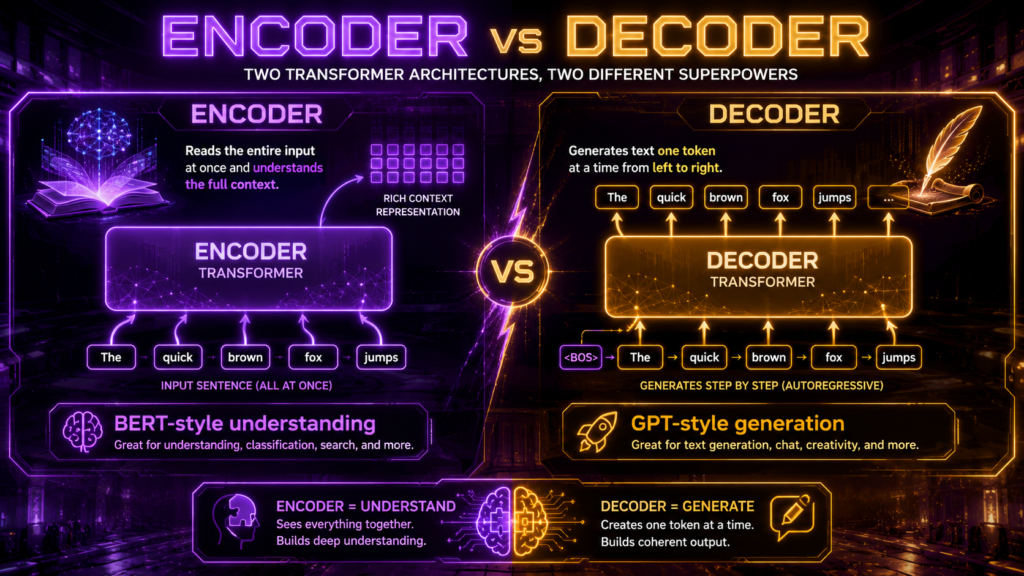
Encoder Models: The Reader
An encoder reads the full input first and builds a deep understanding of it.
How it works:
Takes the entire input sequence at once
Looks at both left and right context simultaneously
Builds a rich representation of the whole thing
Outputs an understanding, not new text
A good example is BERT (Bidirectional Encoder Representations from Transformers). It looks at both left and right context at the same time, so it can understand meaning very well.
Perfect for:
Text classification (Is this review positive or negative?)
Search (Which document is most relevant?)
Retrieval (Find the right information)
Understanding tasks (What is this text about?)
Simple analogy: Encoder = reads the whole paragraph and understands it.
Decoder Models: The Writer
A decoder generates text step by step.
How it works:
Takes the previous context
Predicts the next token
Adds the new token to the context
Repeats until it’s done
A good example is ChatGPT-style models (GPT = Generative Pre-trained Transformer). They only look at the previous context and predict the next token one step at a time. They do not look ahead at future tokens, because that would be cheating during generation.
Perfect for:
Text generation
Creative writing
Chatbots
Code generation
Simple analogy: Decoder = writes the next word one step at a time.
Comparison :
| Aspect | Encoder | Decoder |
|---|---|---|
| What it does | Understands input | Generates output |
| Looks at | Both left and right context | Only left context (past tokens) |
| Example | BERT | GPT, ChatGPT |
| Best for | Classification, Search | Generation, Chat |
| Output | Understanding (embeddings) | New text (tokens) |
Why This Distinction Matters
If you only say “Transformers use self-attention,” you’re missing the real design difference.
Modern systems use:
Encoder-only models for understanding (BERT, RoBERTa)
Decoder-only models for generation (GPT, Claude, Gemini)
Encoder-decoder models for translation, summarization, and sequence-to-sequence tasks (T5, BART)
That distinction is the real architecture story behind modern LLMs.
3. Masked Self-Attention: Why Cheating Is Forbidden
This is the missing piece most beginner articles skip. And it’s absolutely critical to understand.
The Problem
Earlier, we said Transformers look at words together. That is true for encoders.
But in text generation, a model must not see the future. It can only use what has already been written.
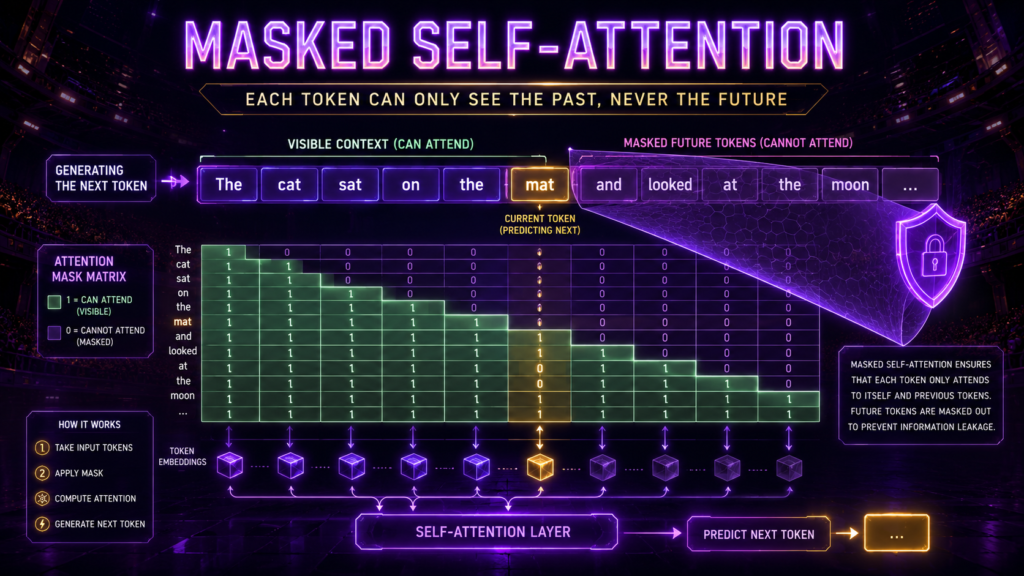
Think of it like taking a fill-in-the-blank exam: ‘The cat sat on the ____.’ If the AI can peek ahead and see that the answer is ‘mat’, that’s cheating. It’s just copying, not predicting. For real text generation, the AI must guess the next word using only what it has read so far, without looking at the answer key.
What Masked Attention Does ?
Masked attention blocks the model from seeing future tokens.
When the model is generating:
"The cat sat on the ..."
It can only use the words before the blank:
“The” ✅
“cat” ✅
“sat” ✅
“on” ✅
“the” ✅
(future words) ❌ Blocked! 👹
It cannot peek at the next word and cheat.
How the Mask Works
Imagine you have a 5-word sentence:
[The] [cat] [sat] [on] [the]
For each position, the mask looks like this:
| Position | Can See |
|---|---|
| 1 (The) | Position 1 only |
| 2 (cat) | Positions 1, 2 |
| 3 (sat) | Positions 1, 2, 3 |
| 4 (on) | Positions 1, 2, 3, 4 |
| 5 (the) | Positions 1, 2, 3, 4, 5 |
It’s like a triangular mask that gets wider as you move forward.
Why This Matters
Without masking, the model could look at future words during training and become unrealistically good in a way that would fail during real-world generation. Masked attention keeps generation honest. It forces the model to predict based only on what it already knows.
4. Positional Encoding: The Timestamp Analogy
This is another concept that often gets explained too quickly. Let me fix that.
The Problem
If Transformers process words in parallel, how do they know the order of words?
Remember: Transformers look at all words at once. But word order matters enormously.
“Dog bites man” = A dog attacks a person
“Man bites dog” = A person attacks a dog
Same words, completely different meanings.
The Solution: Positional Encoding
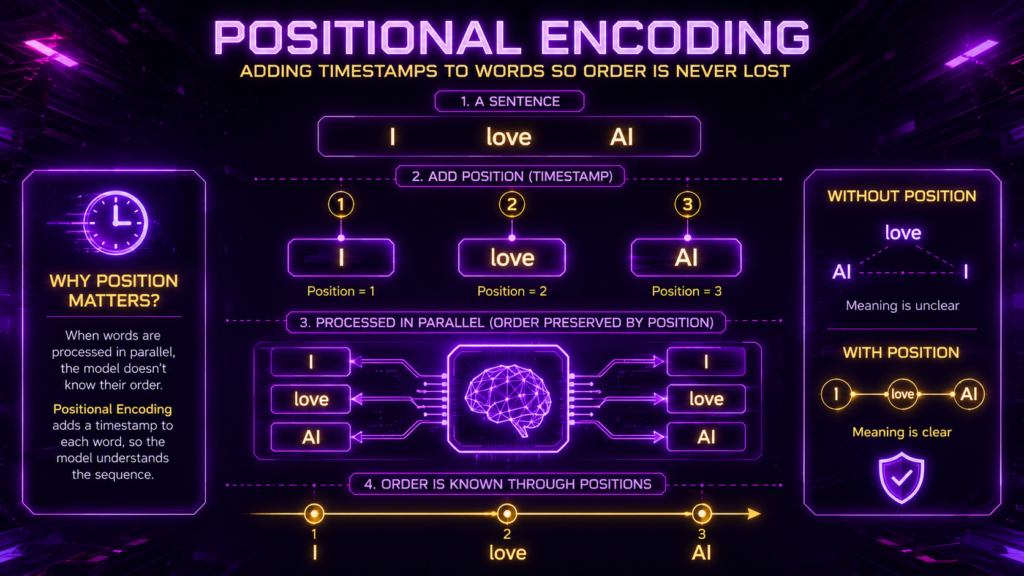
Positional encoding is like giving each word a timestamp.
"I"     → Position 1
"love"  → Position 2
"AI"    → Position 3
Even if all three words are processed together, positional encoding tells the model:
which word came first (I)
which came second (love)
which came third (AI)
Imagine three messages arriving at the same time:
Message 1: “I” (Timestamp: 10:00:01)
Message 2: “love” (Timestamp: 10:00:02)
Message 3: “AI” (Timestamp: 10:00:03)
Even though they all arrive at once, the timestamps tell you the order.
Positional encoding is exactly that. It adds a “timestamp” to each word so the model knows its position in the sequence.
How It Actually Works
Positional encoding adds a specific mathematical pattern to each word’s embedding.
The pattern is based on sine and cosine functions with different frequencies.
Why sine and cosine?
They create a unique pattern for each position
They allow the model to learn relative positions (word 5 is near word 7)
They work for sequences of any length
Why This Matters
Without positional encoding, the model would know the words exist, but not their order.
And word order changes everything:
“I like you” ≠ “You like I”
“The dog chased the cat” ≠ “The cat chased the dog”
“Eat, pray, love” ≠ “Love, pray, eat”
Positional encoding gives the model sequence awareness.
5. The Attention Formula
Attention(Q,K,V) = softmax(QKᵀ / √dₖ) × V
What Each Part Means :
| Symbol | Name | What It Does |
|---|---|---|
| Q | Query | What the model is looking for |
| K | Key | What each token offers |
| V | Value | The actual information being passed forward |
| QKᵀ | Similarity Score | Measures how well query matches key |
| √dₖ | Scaling Factor | Keeps values numerically stable |
| softmax | Softmax | Turns scores into probabilities |
| × V | Weighted Information | Returns the final attention output |
QKᵀ: Compare what you want with what each word offers
√dₖ: Keep the numbers stable (so they don’t explode)
softmax: Turn matches into probabilities
× V: Retrieve the actual information from the most relevant words
That formula is the heart of the Transformer.
6. Multi-Head Attention: The Panel of Experts
I mentioned multi-head attention briefly in Part 1. Now let’s really understand why it’s so powerful.
The Core Idea
One attention head is good. Multiple heads are better.
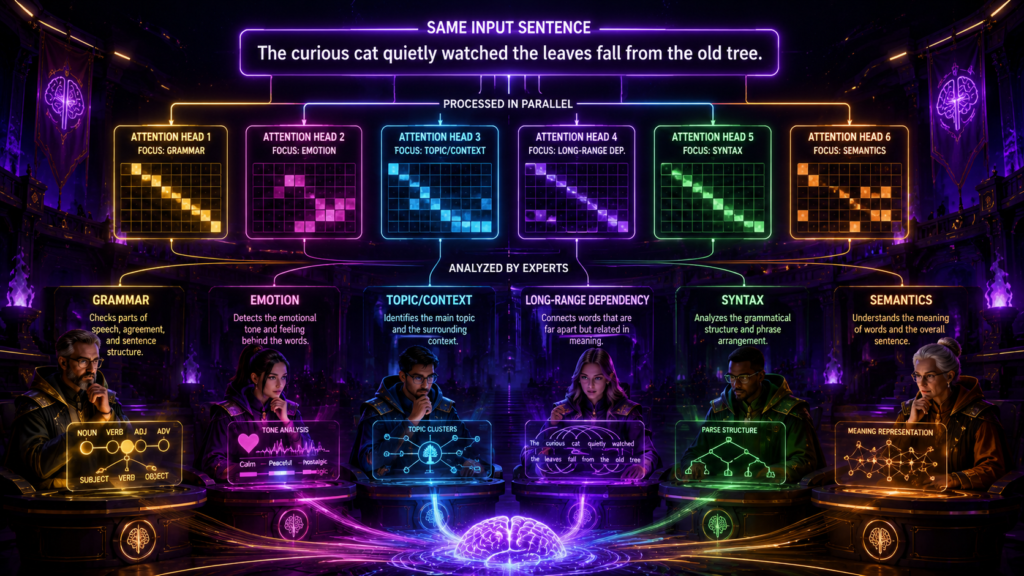
Instead of looking at relationships in just one way, the model uses several attention heads in parallel, and each one focuses on a different kind of signal.
Think of it like a panel of experts analyzing the same text:
| Expert | Focus | Example |
|---|---|---|
| Expert 1 | Grammar | “How is this word connected to that verb?” |
| Expert 2 | Emotion | “Is this word positive or negative?” |
| Expert 3 | Topic | “What subject is being discussed?” |
| Expert 4 | Long-range | “Does word 5 connect to word 95?” |
| Expert 5 | Syntax | “What’s the sentence structure?” |
| Expert 6 | Semantics | “What’s the actual meaning?” |
Each expert focuses on something different. Then they combine their insights.
How It Actually Works
Step 1: The input passes through multiple attention heads
Step 2: Each head computes attention differently:
Head 1 might focus on nearby words
Head 2 might focus on distant words
Head 3 might focus on grammatical connections
Head 4 might focus on semantic relationships
Step 3: The outputs from all heads are concatenated
Step 4: A linear layer combines everything into the final output
Why It Works Better
| Single Head | Multi-Head |
|---|---|
| One way of looking at relationships | Many ways of looking at relationships |
| Misses nuanced connections | Catches all types of connections |
| Limited understanding | Rich, comprehensive understanding |
Together, multiple heads give a much richer understanding than any single expert could.
WANT TO VIEW ALL THESE IN SIMULATIONS? CHECK OUT THESE LABS:
TOKEN LAB — The Token Party — Transformers as Gossip
SELF-ATTENTION LAB — Attention — Theatre Stage & Solar System
BERT LAB — BERT the Detective — vs GPT the Writer
SELF VS CROSS ATTENTION — The Translation Booth — Self-Attention vs Cross-Attention
GPT SANDBOX — GPT Sandbox — Play with the Machine
7. How Transformers Became GPT, BERT, and Modern LLMs
Let me tell you the story of how Transformers evolved into the models we use today.
2017: The Original Transformer
The paper: “Attention Is All You Need”
What it introduced:
The Transformer architecture
Self-attention
Multi-head attention
Positional encoding
Both encoder and decoder
Impact: It was a research paper. Nobody knew it would change everything.
2018: BERT (Encoder-Only)
What it was: Bidirectional Encoder Representations from Transformers
The innovation:
Encoder-only architecture
Masked language modeling (predict the blank)
Understanding task: Fill in the missing word
Perfect for:
Classification
Search
Question answering
The “BERT” way: Understand the full input → Do something with it
2018-2019: GPT (Decoder-Only)
What it was: Generative Pre-trained Transformer
The innovation:
Decoder-only architecture
Causal language modeling (predict the next token)
Generation task: Write the next word
Perfect for:
Text generation
Creative writing
Chatbots
The “GPT” way: Given previous text → Generate the next token
2020: GPT-3 (The Scale Up)
What it was: Massive decoder-only model (175B parameters)
The innovation:
Scaled up GPT-2
Few-shot learning
In-context learning
Impact: Showed that bigger = better
2022: ChatGPT (The Interaction Model)
What it was: GPT-3.5 fine-tuned for dialogue
The innovation:
Reinforcement learning from human feedback (RLHF)
Dialogue training
Safety alignment
Impact: Made AI accessible to everyone
2023-2024: Claude, Gemini, GPT-4
What they are: Mixed architectures
The innovation:
Combining encoder and decoder elements
Multimodal (text, image, video, audio)
Massive context windows
Better reasoning
The Evolution Table
| Year | Model | Architecture | Innovation |
|---|---|---|---|
| 2017 | Original Transformer | Encoder-Decoder | Self-attention, Multi-head attention |
| 2018 | BERT | Encoder-only | Masked language modeling |
| 2019 | GPT-2 | Decoder-only | Causal language modeling |
| 2020 | GPT-3 | Decoder-only | Scaling up to 175B parameters |
| 2022 | ChatGPT | Decoder-only | RLHF, Dialogue training |
| 2023 | GPT-4 | Mixed | Multimodal, Massive context |
| 2024 | Claude 3, Gemini | Mixed | Advanced reasoning, Multimodal |
8. Technical Comparison Table: RNNs vs Transformers
Here’s the improved table with stronger technical value.
| Feature | RNNs / LSTMs | Transformers |
|---|---|---|
| Processing Style | Sequential, one token at a time | Parallel, all tokens processed together |
| Time Complexity | O(N) for sequence processing | More parallel-friendly; attention allows efficient hardware use |
| Long-Range Context | Poor, often affected by vanishing gradients | Excellent, direct token-to-token connections |
| Hardware Optimization | Hard to parallelize on GPUs | Highly optimized for GPUs and TPUs |
| Training Speed | Slower on long sequences | Faster and more scalable |
| Sequence Order Awareness | Built into recurrence | Added through positional encoding |
| Generation Style | Step-by-step | Step-by-step in decoder-only models |
| Masking Requirement | Not typically used this way | Required in decoder self-attention |
| Primary Use Cases | Older speech/text tools, time-series | Modern LLMs, translation, summarization, retrieval |
9. The Full Stack: Putting It All Together
Let me show you the complete Transformer stack with everything we’ve discussed.
The Complete Architecture
Input Tokens
     ↓
Token Embeddings (Turn words into numbers)
     ↓
+ Positional Encoding (Add word order information)
     ↓
┌─────────────────────────────────────────────┐
│           Multi-Head Self-Attention         │
│  ┌──────┐  ┌──────┐  ┌──────┐  ┌──────┐  │
│  │Head 1│  │Head 2│  │Head 3│  │Head 4│  │
│  └──────┘  └──────┘  └──────┘  └──────┘  │
│     ↓          ↓          ↓          ↓     │
│     └──────────┴──────────┴──────────┘     │
│              Concatenation                  │
│              Linear Layer                   │
└─────────────────────────────────────────────┘
     ↓
Add & Normalize (Skip connection + Layer norm)
     ↓
Feed-Forward Neural Network
     ↓
Add & Normalize (Skip connection + Layer norm)
     ↓
┌─────────────────────────────────────────────┐
│  Repeat N times (Multiple Layers)           │
└─────────────────────────────────────────────┘
     ↓
Output Tokens
What Each Layer Does
| Layer | What It Does |
|---|---|
| Token Embeddings | Turns words into numbers (vectors) |
| Positional Encoding | Adds word order information |
| Multi-Head Self-Attention | Words talk to each other, multiple ways |
| Add & Normalize | Prevents degradation during training |
| Feed-Forward | Processes the attention output |
| Repeat | Goes through multiple layers for deeper understanding |
10. The Strongest Way to Remember It
If you want the shortest possible mental model:
| Concept | One-Liner |
|---|---|
| Encoder | Understands the full input |
| Decoder | Generates output one token at a time |
| Masked Attention | Prevents cheating during generation |
| Positional Encoding | Tells the model the order of words |
| Attention Formula | Decides what each word should focus on |
| Multi-Head Attention | Looks at relationships in multiple ways |
That is the real Transformer stack.
11. FAQs: Quick Answers to Common Questions
What’s the difference between encoder and decoder models?
Encoder models (like BERT) understand the full input at once. They look at both left and right context. Decoder models (like GPT) generate text one token at a time. They only look at previous tokens.
Why do decoders need masked attention?
During generation, a decoder must not see future tokens. That would be cheating. Masked attention blocks future tokens so the model can only use past context.
How do Transformers know word order if they process in parallel?
Through positional encoding. It adds a “timestamp” to each word, telling the model its position in the sequence.
What does the attention formula actually do?
It compares queries (what the model wants) with keys (what each word offers), turns matches into probabilities, and uses those probabilities to retrieve the most relevant information from the values.
Why is multi-head attention better?
One attention head looks at relationships in only one way. Multiple heads look at relationships in many ways (grammar, emotion, long-range, etc.), giving a much richer understanding.
How did Transformers become GPT and BERT?
BERT took the encoder part and added masked language modeling
GPT took the decoder part and added causal language modeling
GPT-3 scaled it up to 175B parameters
ChatGPT added dialogue training and RLHF
Which architecture should I use?
Understanding tasks (classification, search): Encoder-only (BERT)
Generation tasks (chat, writing, code): Decoder-only (GPT)
Translation, summarization: Encoder-decoder (T5)
12. Closing: The Architecture of Understanding
Modern AI isn’t just a magic trick; it’s a beautifully engineered system of choices. We don’t just throw a generic “Transformer” at a problem anymore. We carefully choose the right architecture for the exact kind of “thinking” we want the machine to do.
When the goal is to deeply understand the context of the world, we use the wide lens of an Encoder (like BERT).
When the goal is to create, imagine, and generate new ideas step-by-step, we rely on the focused mind of a Decoder (like GPT).
When we need to translate information across boundaries, we bridge them together (like T5).
To give the AI a sense of rhythm and sequence, we weave in Positional Encoding.
And to keep the AI honest—forcing it to actually generate rather than peek at the future—we apply Masked Attention.
Transformers didn’t just make AI faster. They finally gave machines the ability to pay attention. But it’s how we arrange these specific pieces that gives them the power to actually understand us.
Read first part here -> Transformers Explained: From “Huh?” to “Aha!” in 15 Minutes – neuralninjas.in

[…] Read the next part -> Transformers Deep Dive: Encoder vs Decoder, Masked Attention, and the Architecture Behind GPT & … […]