Learn where LoRA fits inside an agentic RAG pipeline, when to combine fine-tuning with retrieval, and how to train, evaluate, secure, and deploy specialized adapters.
The Question That Decides Your Entire Architecture
You have an LLM. You have a retrieval system. You may even have a LangGraph agent that can call tools, retry searches, and critique its own output.
Now comes the expensive question:
Which capabilities should be trained into the model with LoRA, and which knowledge should stay outside the model in the retrieval layer?
Get this decision wrong and you can spend days fine-tuning facts that become outdated next week. Make the opposite mistake and you may build an agent that retrieves excellent evidence but still routes badly, ignores citations, selects the wrong tool, and produces inconsistent answers.
This guide is about that boundary.
It does not treat LoRA as merely a cheaper way to fine-tune the final generator. It shows how LoRA adapters can specialize the control points across an agentic RAG system: routing, rewriting, grading, tool selection, answerability, generation, citation, safety, and memory decisions.
The one-line answer
- RAG changes what the model can read.
- LoRA changes how the model behaves.
- Agentic RAG decides what should happen next.
The strongest production systems combine the three deliberately instead of treating them as competing technologies.
1. What Is LoRA in an LLM?
Fine-tuning a large language model sounds simple until you look at the bill.
A modern LLM may contain billions of parameters. Updating all of them requires substantial GPU memory, optimizer state, storage, training time, and deployment complexity. LoRA—Low-Rank Adaptation—takes a more surgical approach.
Instead of modifying the full model, LoRA:
- freezes the original model weights;
- inserts small trainable matrices into selected layers;
- learns only those matrices;
- stores the resulting specialization as a lightweight adapter.
The base model remains intact. The adapter contains the learned behavioral change.
A better analogy than “rewriting the library”:
Imagine a skilled engineer who already understands mathematics, language, and general problem-solving. You do not erase and retrain everything they know just to teach them your company’s ticket format.
You give them a compact operating manual:
- use this terminology;
- call these tools;
- return this schema;
- escalate under these conditions;
- refuse when evidence is insufficient.
That operating manual is closer to what a LoRA adapter does.
What LoRA is good at
LoRA is especially useful when you need the model to repeat a stable behavior:
- classify queries consistently;
- select tools using a fixed policy;
- generate a strict JSON structure;
- use domain-specific terminology;
- follow an organization’s response style;
- judge evidence using a defined rubric;
- learn successful agent trajectories.
What LoRA is not
LoRA is not automatically:
- a searchable knowledge base;
- a citation system;
- a reliable way to store frequently changing facts;
- a replacement for document access control;
- a cure for weak retrieval.
That distinction becomes critical once LoRA is combined with RAG.
2. LoRA Mathematics Without the Headache
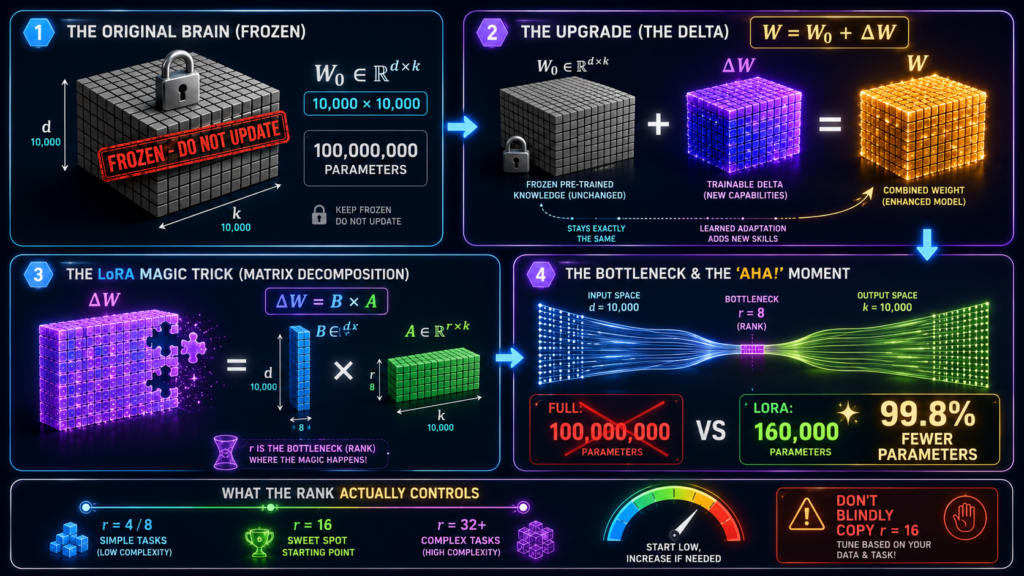
1. The Original Brain (Frozen)
Normally, a model layer relies on a massive grid of numbers, represented as:
W0∈Rd×k
is the original weight matrix. It has d rows and k columns. In a standard setup, full fine-tuning would force you to update every single number in this giant grid.
LoRA locks this matrix completely so it cannot change.
2. The Upgrade (The Delta)
To make the model learn something new, we need to add an update to the original weights. The new weights will be:
W=W0+ΔW
The updated model () is simply the frozen original model () plus the new things we want it to learn (ΔW).
3. The LoRA Magic Trick (Matrix Decomposition)
Learning the full matrix would be exactly as expensive as normal fine-tuning. Here is where the genius of LoRA comes in. It splits that giant matrix into two much smaller, skinnier matrices multiplied together:
ΔW=BA
Instead of training one massive block of numbers, we train two thin slices that, when multiplied together, mimic the shape of the massive block.
4. The Bottleneck (The Rank)
To make this multiplication work, the two new matrices are sized like this:
B∈Rd×r
A∈Rr×k
We introduce a new variable called r (the rank). The rank is a deliberately tiny number (like 8, 16, or 32) which is vastly smaller than the original dimensions d or k.
Matrix A acts as a funnel, squishing the massive input down to just dimensions. Matrix B expands it back out.
Why This Saves the Day (The “Aha!” Moment)
Imagine a model layer where d=10,000 and k=10,000.
Standard Fine-tuning: You have to update the full matrix, which is 100,000,000 parameters.
LoRA (with a rank r=8): Matrix has 8×10,000=80,000 parameters. Matrix B has 10,000×8=80,000 parameters.
Total parameters to train with LoRA? Just 160,000.
You achieved the exact same architectural shape while training 99.8% fewer parameters, allowing a model to be fine-tuned on a single consumer GPU instead of a massive server farm.
What the rank actually controls
Rank is not a universal “quality” knob. It controls the capacity of the adapter.
| Rank | Typical use |
|---|---|
r=4 or r=8 | Simple classification, formatting, narrow behavior |
r=16 | Strong general starting point for many task adapters |
r=32 or higher | More complex transformations, provided the dataset supports them |
A larger rank can learn more, but it also increases memory use and the risk of fitting noise. Start with the smallest rank that solves the measured problem.
Do not blindly copy r=16
The correct rank depends on:
- the base model;
- selected target modules;
- dataset size and diversity;
- task complexity;
- acceptable adapter size;
- latency and serving architecture.
Treat rank as a hyperparameter, not a ritual.
3. LoRA vs Full Fine-Tuning vs QLoRA
These techniques solve the same broad problem—adapting a model—but they make different trade-offs.
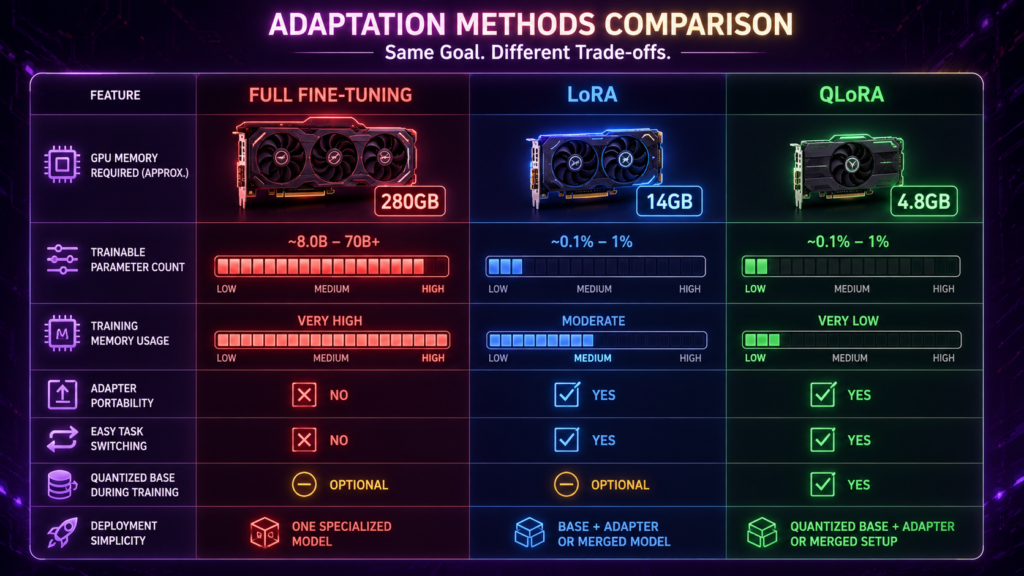
| Feature | Full fine-tuning | LoRA | QLoRA |
| Base weights updated | Yes | No | No |
| Trainable parameters | Very high | Low | Low |
| Training memory | Highest | Lower | Usually lowest |
| Adapter portability | No | Yes | Yes |
| Easy task switching | No | Yes | Yes |
| Quantized base during training | Optional | Optional | Yes |
| Deployment simplicity | One specialized model | Base + adapter or merged model | Quantized base + adapter or merged setup |
Full fine-tuning
Use full fine-tuning when:
- you have enough compute and data;
- the target domain differs substantially from the base model;
- maximum task performance matters more than adapter portability;
- maintaining a separate full model is acceptable.
LoRA
Use LoRA when:
- the base model already has the required general capability;
- you need a stable specialization;
- you want multiple swappable adapters;
- training cost and storage matter;
- you need faster experimentation.
QLoRA
QLoRA trains LoRA adapters while the base model is loaded in a low-bit representation, commonly 4-bit. This can make fine-tuning feasible on smaller GPUs.
But QLoRA is not “LoRA, only better.”
It may introduce trade-offs involving:
- quantization compatibility;
- training throughput;
- numerical stability;
- inference stack complexity;
- adapter merging;
- hardware-specific kernels.
Use QLoRA because your resource constraints justify it—not because a comparison table says it always wins.
4. What Is Agentic RAG?
Traditional RAG is usually a straight pipeline:
Query → Retrieve → Add context → GenerateThat architecture works well when:
- one retrieval pass is enough;
- the user’s query is already clear;
- one data source contains the answer;
- retrieved passages are usually relevant;
- no tool decision is required.
The moment those assumptions break, a fixed pipeline starts failing.
Agentic RAG adds control
An agentic RAG system can decide:
- whether retrieval is needed;
- how the query should be rewritten;
- which source or tool should be searched;
- whether the evidence is sufficient;
- whether another retrieval pass is needed;
- whether two sources conflict;
- when to stop;
- when to abstain;
- how to cite the final answer.
A useful mental model is:
Understand → Decide → Retrieve → Judge → Act → VerifyThe important word is not “agent.” It is control.
An agentic RAG system earns its complexity only when those decisions improve answer quality, cost, latency, or safety.
5. Where LoRA Fits Inside Agentic RAG
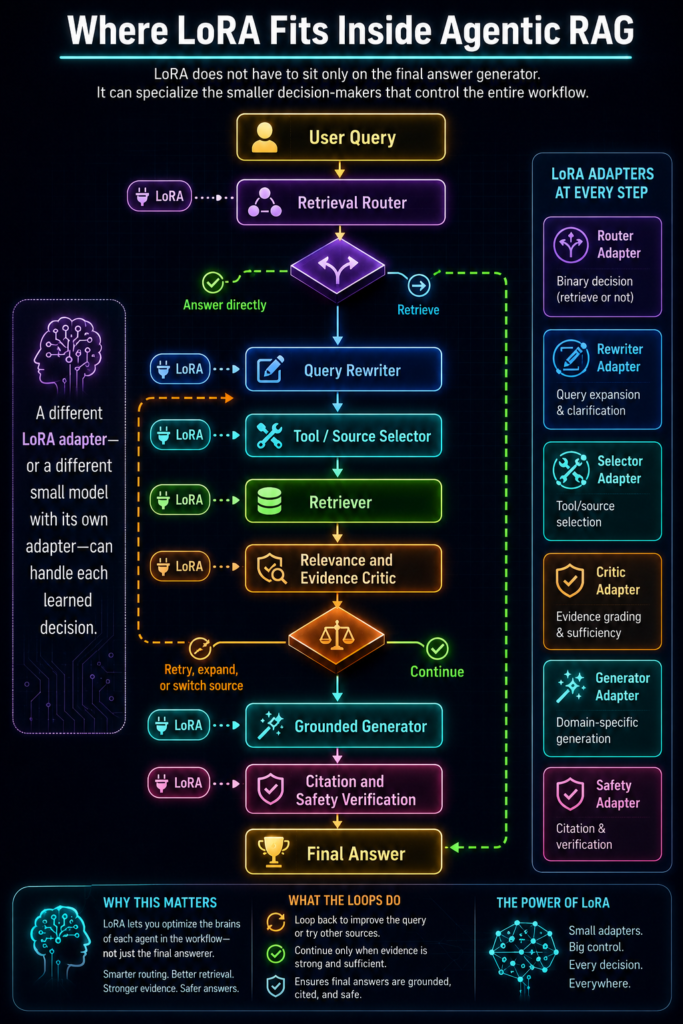
LoRA does not have to sit only on the final answer generator. It can specialize the smaller decision-makers that control the entire workflow.
User Query
   ↓
Retrieval Router
   ├── Answer directly
   └── Retrieve
          ↓
Query Rewriter
          ↓
Tool / Source Selector
          ↓
Retriever
          ↓
Relevance and Evidence Critic
   ├── Retry, expand, or switch source
   └── Continue
          ↓
Grounded Generator
          ↓
Citation and Safety Verification
          ↓
Final Answer
A different LoRA adapter—or a different small model with its own adapter—can handle each learned decision.
The architectural boundary
Use LoRA to encode stable policies such as:
- what counts as sufficient evidence;
- which tool fits which query;
- what output schema must be returned;
- when a tool failure should trigger a retry;
- when the agent must abstain.
Use RAG to supply replaceable information such as:
- current policies;
- private documents;
- prices;
- inventory;
- release notes;
- customer-specific data;
- evidence that must be cited.
6. Twelve Agent Components You Can Fine-Tune
Before retrieval
1. Retrieval router
Determines whether the query needs external information.
A useful router does more than output “yes” or “no.” It can classify the request as:
- direct answer;
- vector retrieval;
- web search;
- SQL lookup;
- tool execution;
- human escalation.
A small LoRA-tuned model can be effective here because the task is narrow and repeated frequently.
2. Query classifier
Labels the intent or task type.
Examples:
- factual lookup;
- troubleshooting;
- comparison;
- procedural request;
- code generation;
- account-specific question.
This label can control the rest of the graph.
3. Query rewriter
Converts vague or conversational input into a searchable query.
Example:
User: “How do I update it?”

Rewritten:
“How do I update the PostgreSQL connection parameters in the deployment configuration?”
The rewriter should use conversation state without inventing missing entities.
4. Query expander
Produces several retrieval-oriented variants.
For example:
- exact terminology;
- acronym expansion;
- alternative product name;
- error-code version;
- keyword-heavy version.
Expansion improves recall only when the variants remain faithful to the user’s intent.
During retrieval
5. Tool selector
Chooses among:
- vector search;
- keyword search;
- graph retrieval;
- SQL;
- web search;
- code repository;
- ticket system;
- internal API.
Tool selection is a strong LoRA target when the available tools and routing policy are stable.
6. Context relevance grader
Scores whether each retrieved passage actually helps answer the query.
This is different from vector similarity. A passage can be semantically similar and still be useless for the requested answer.
7. Answerability classifier
Determines whether the available evidence is sufficient.
Possible outputs:
ANSWERABLE
PARTIALLY_ANSWERABLE
CONFLICTING_EVIDENCE
INSUFFICIENT_EVIDENCE
This component helps prevent the generator from turning weak retrieval into confident prose.
After retrieval
8. Evidence critic
Decides the next action:
- continue to generation;
- retrieve again;
- expand the query;
- switch tools;
- ask a clarifying question;
- abstain.
This is one of the most valuable places to use a specialized adapter because it controls both quality and cost.
9. Reranker
Reorders passages by usefulness for the exact question.
For best results, train it with difficult negatives:
- similar but outdated documents;
- documents from the wrong product version;
- passages containing the same keywords but answering a different question.
10. Grounded generator
Produces the final answer using the retrieved evidence.
Fine-tune it for:
- domain terminology;
- answer structure;
- citation placement;
- uncertainty language;
- refusal behavior;
- concise or detailed response policies.
Do not train it only on polished final answers. Include the evidence it was supposed to use.
After generation
11. Claim or hallucination checker
Breaks the answer into claims and checks whether each claim is supported.
A useful checker should distinguish:
- directly supported;
- reasonably inferred;
- unsupported;
- contradicted.
12. Citation mapper
Maps each factual claim to its supporting passage.
This is more reliable than asking the generator to invent citation markers after the answer has already been written.
7. LoRA vs RAG vs Prompting vs Few-Shot Learning
Do not ask which technique is “best.” Ask what must change.
| Requirement | Prompting | Few-shot examples | LoRA | Traditional RAG | Agentic RAG | LoRA + Agentic RAG |
| Fast iteration | Strong | Strong | Medium | Medium | Lower | Lower |
| Current facts | Weak | Weak | Weak | Strong | Strong | Strong |
| Repeatable behavior | Medium | Medium | Strong | Weak | Medium | Strong |
| Source citations | Weak | Weak | Weak | Strong | Strong | Strong |
| Tool routing | Medium | Medium | Strong | None | Strong | Strong |
| Auditable knowledge | Weak | Weak | Weak | Strong | Strong | Strong |
| Multi-step retrieval | None | None | None | Limited | Strong | Strong |
| Domain terminology | Medium | Medium | Strong | Medium | Medium | Strong |
| Cheap initial setup | Strong | Strong | Medium | Medium | Lower | Lowest |
| Easy factual updates | Strong | Strong | Slow | Strong | Strong | Strong |
The clean distinction
- Prompting changes the instruction.
- Few-shot prompting changes the examples visible in the context.
- LoRA changes learned behavior.
- RAG changes the information available at inference time.
- Agentic RAG changes the decision process around retrieval and tools.
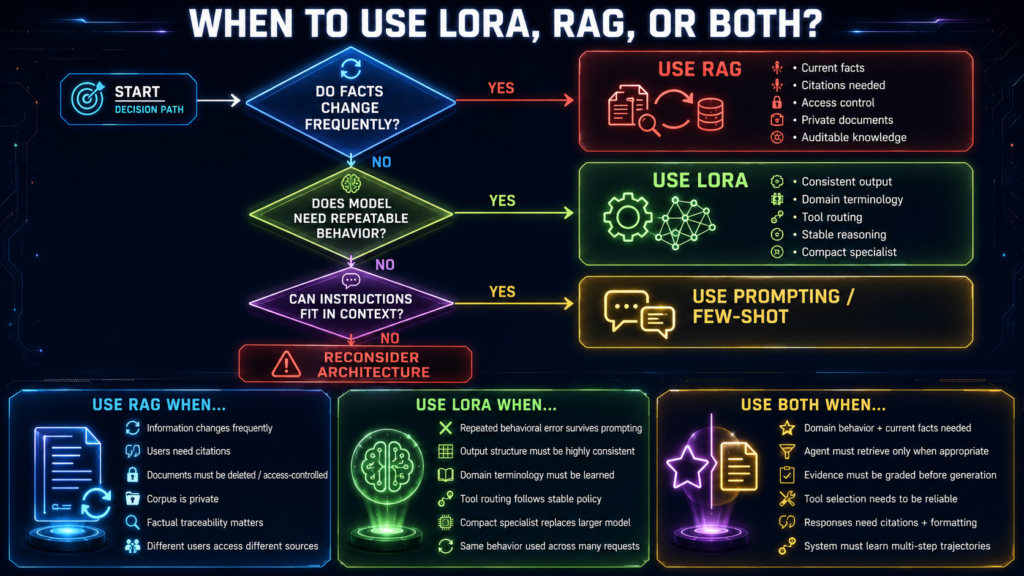
8. When Should You Use LoRA, RAG, or Both?
Use this decision path:
Do the required facts change frequently?
├── Yes → Keep them in retrieval.
└── No
    ↓
Does the model need repeatable behavior?
├── Yes → Consider LoRA.
└── No
    ↓
Can instructions and examples fit reliably in context?
├── Yes → Use prompting or few-shot prompting.
└── No → Reconsider the architecture or training strategy.
Use RAG when
- the information changes;
- users need citations;
- documents must be deleted or access-controlled;
- the corpus is private;
- factual traceability matters;
- different users can access different sources.
Use LoRA when
- a repeated behavioral error survives good prompting;
- output structure must be highly consistent;
- domain terminology must be learned;
- tool routing follows a stable policy;
- a compact specialist can replace a larger general model;
- the same behavior is used across many requests.
Use both when
- the model needs domain behavior and current facts;
- the agent must retrieve only when appropriate;
- evidence must be graded before generation;
- tool selection needs to be reliable;
- responses require both citations and consistent formatting;
- the system must learn successful multi-step trajectories.
9. Reference Architecture: LoRA + LangGraph + Vector Database:
A practical production design separates orchestration, retrieval, and learned behavior.
User
  ↓
LangGraph State
  ↓
LoRA Router
  ├── Direct response path
  └── Retrieval path
          ↓
LoRA Query Rewriter
          ↓
Tool Selector
          ↓
Vector / Keyword / SQL / Web Retrieval
          ↓
Evidence Critic
  ├── Retry or switch source
  ├── Ask for clarification
  ├── Abstain
  └── Generate
          ↓
LoRA Grounded Generator
          ↓
Claim and Citation Verification
          ↓
Final Response
Suggested responsibility split
| Layer | Responsibility |
| LangGraph | state, branching, retries, checkpoints, tool orchestration |
| LoRA adapters | stable learned decisions and response behavior |
| Vector or search layer | current and inspectable knowledge |
| Deterministic code | permissions, validation, budgets, hard safety limits |
| Evaluation layer | routing, retrieval, grounding, latency, cost, task success |
Do not train what should be deterministic:
The following should normally remain code or policy checks:
- user permissions;
- maximum tool-call budget;
- destructive-action confirmation;
- schema validation;
- SQL parameterization;
- file access restrictions;
- audit logging;
- timeout handling.
LoRA can assist these systems. It should not replace hard controls.
10. Dataset Design for Agentic LoRA Training
A weak dataset teaches the model to imitate answers. A strong dataset teaches the model to make decisions under realistic evidence conditions.
A retrieval-aware example
{
  "query": "What is the current status of the demo project?",
  "retrieved_passages": [
    {
      "id": "doc_1",
      "text": "The demo project entered QA on July 12.",
      "source": "project_status"
    },
    {
      "id": "doc_2",
      "text": "The planned release window is Q3.",
      "source": "release_plan"
    }
  ],
  "evidence_label": "sufficient",
  "answer": "The demo project is currently in QA, with release planned for Q3.",
  "claim_citations": [
    {"claim": "The project is in QA.", "source_id": "doc_1"},
    {"claim": "Release is planned for Q3.", "source_id": "doc_2"}
  ],
  "next_action": "answer"
}
Include difficult examples
Your training set should contain:
- sufficient evidence;
- partial evidence;
- conflicting documents;
- stale documents;
- irrelevant but keyword-matching passages;
- retrieval failures;
- empty tool responses;
- permission errors;
- malformed tool output;
- abstention cases;
- retry cases;
- escalation cases.
Separate datasets by role
Do not force one adapter to learn every stage at once unless you have evidence that a shared adapter performs better.
Create role-specific datasets:
router.jsonl
rewriter.jsonl
tool_selector.jsonl
evidence_critic.jsonl
generator.jsonl
citation_mapper.jsonl
This makes evaluation and debugging much easier.
11. Training a LoRA Adapter with Hugging Face PEFT:
The example below shows the core setup. A production training script still needs proper formatting, tokenization, padding, evaluation data, checkpointing, and experiment tracking.
Install dependencies
pip install -U transformers peft accelerate datasets bitsandbytes trlLoad the base model
import torch
from transformers import AutoModelForCausalLM, AutoTokenizer

model_id = "Qwen/Qwen2.5-3B-Instruct"

tokenizer = AutoTokenizer.from_pretrained(model_id)

model = AutoModelForCausalLM.from_pretrained(
    model_id,
    torch_dtype=torch.bfloat16,
    device_map="auto"
)
Configure LoRA
from peft import LoraConfig, TaskType, get_peft_model

lora_config = LoraConfig(
    r=16,
    lora_alpha=32,
    lora_dropout=0.05,
    target_modules=["q_proj", "k_proj", "v_proj", "o_proj"],
    bias="none",
    task_type=TaskType.CAUSAL_LM
)

model = get_peft_model(model, lora_config)
model.print_trainable_parameters()
Format the training examples
def format_example(example):
    messages = [
        {
            "role": "system",
            "content": (
                "You are an evidence critic. Return one of: "
                "SUFFICIENT, RETRY, SWITCH_TOOL, CLARIFY, or ABSTAIN."
            )
        },
        {
            "role": "user",
            "content": (
                f"Question:\n{example['query']}\n\n"
                f"Retrieved evidence:\n{example['evidence']}"
            )
        },
        {
            "role": "assistant",
            "content": example["label"]
        }
    ]

    return tokenizer.apply_chat_template(
        messages,
        tokenize=False,
        add_generation_prompt=False
    )
Train with an SFT trainer
from trl import SFTConfig, SFTTrainer

training_args = SFTConfig(
    output_dir="./evidence-critic-adapter",
    learning_rate=2e-4,
    num_train_epochs=3,
    per_device_train_batch_size=4,
    gradient_accumulation_steps=4,
    logging_steps=10,
    save_strategy="epoch",
    eval_strategy="epoch",
    bf16=True,
    max_length=2048
)

trainer = SFTTrainer(
    model=model,
    args=training_args,
    train_dataset=train_dataset,
    eval_dataset=eval_dataset,
    formatting_func=format_example,
    processing_class=tokenizer
)

trainer.train()

model.save_pretrained("./evidence-critic-adapter")
tokenizer.save_pretrained("./evidence-critic-adapter")
What must be tuned experimentally
Do not treat these values as universal:
- learning rate;
- rank;
- alpha;
- dropout;
- target modules;
- sequence length;
- batch size;
- epoch count;
- positive-to-negative example ratio.
Track each experiment and evaluate on held-out, realistic traffic.
12. Connecting a LoRA Adapter to a RAG Pipeline
Load the adapter
from peft import PeftModel
from transformers import AutoModelForCausalLM, AutoTokenizer

model_id = "Qwen/Qwen2.5-3B-Instruct"
adapter_path = "./evidence-critic-adapter"

tokenizer = AutoTokenizer.from_pretrained(model_id)

base_model = AutoModelForCausalLM.from_pretrained(
    model_id,
    device_map="auto"
)

model = PeftModel.from_pretrained(
    base_model,
    adapter_path
)
Merge only when the serving strategy permits it
merged_model = model.merge_and_unload()Merging can simplify inference for a single fixed adapter. It is not ideal when you need:
- runtime adapter switching;
- per-tenant adapters;
- A/B tests;
- dynamic routing;
- frequent adapter updates.
A minimal grounded generation function
def build_prompt(query: str, documents: list[str]) -> str:
    context = "\n\n".join(
        f"[Document {index + 1}]\n{document}"
        for index, document in enumerate(documents)
    )

    return f"""Answer the question using only the supplied documents.

If the documents do not contain enough evidence, say:
"Insufficient evidence in the retrieved documents."

Documents:
{context}

Question:
{query}
"""

def generate_answer(query, documents):
    prompt = build_prompt(query, documents)

    inputs = tokenizer(prompt, return_tensors="pt").to(model.device)

    output = model.generate(
        **inputs,
        max_new_tokens=300,
        do_sample=False
    )

    generated_tokens = output[0][inputs["input_ids"].shape[1]:]

    return tokenizer.decode(
        generated_tokens,
        skip_special_tokens=True
    )
13. A Real Agentic RAG Control Loop
Production systems need explicit state and bounded retries.
from dataclasses import dataclass, field

@dataclass
class AgentState:
    original_query: str
    rewritten_query: str = ""
    documents: list[str] = field(default_factory=list)
    attempts: int = 0
    max_attempts: int = 2
    decision: str = ""
    answer: str = ""

def run_agent(state: AgentState):
    state.decision = router.predict(state.original_query)

    if state.decision == "DIRECT":
        state.answer = direct_generator.generate(state.original_query)
        return state

    state.rewritten_query = rewriter.rewrite(state.original_query)

    while state.attempts < state.max_attempts:
        state.attempts += 1
        state.documents = retriever.search(state.rewritten_query)

        evidence_decision = critic.evaluate(
            query=state.original_query,
            documents=state.documents
        )

        if evidence_decision == "SUFFICIENT":
            break

        if evidence_decision == "RETRY":
            state.rewritten_query = expander.expand(
                state.rewritten_query
            )
            continue

        if evidence_decision == "CLARIFY":
            state.answer = "I need one more detail before I can search accurately."
            return state

        state.answer = "I could not find enough reliable evidence to answer."
        return state

    if not state.documents:
        state.answer = "No relevant documents were found."
        return state

    draft = grounded_generator.generate(
        query=state.original_query,
        documents=state.documents
    )

    state.answer = verifier.verify_and_cite(
        query=state.original_query,
        answer=draft,
        documents=state.documents
    )

    return state
The key production features are:
- a retry limit;
- explicit decisions;
- a no-document path;
- clarification and abstention states;
- verification after generation.
14. Training Retrieval-Aware Agent Trajectories
A final answer hides the decisions that produced it.
An agent trajectory exposes them.
1. Route the request
2. Select a tool
3. Rewrite the query
4. Retrieve evidence
5. Grade the evidence
6. Retry or continue
7. Call an action tool
8. Verify the result
9. Respond
Why final-answer accuracy is not enough
An agent can return the correct answer while still behaving badly:
- calling unnecessary tools;
- retrieving the same documents repeatedly;
- using an expensive model for a trivial decision;
- ignoring a failed API call;
- selecting the wrong data source;
- reaching the answer through leaked benchmark patterns.
Trajectory evaluation reveals those failures.
A better trajectory record
{
  "task_id": "ticket_creation_104",
  "steps": [
    {
      "action": "route",
      "input": "Create tickets for all critical bugs",
      "output": "USE_GITHUB"
    },
    {
      "action": "tool_call",
      "tool": "github_search",
      "arguments": {
        "repository": "my-org/my-repo",
        "label": "critical"
      },
      "result_count": 5
    },
    {
      "action": "evidence_check",
      "output": "SUFFICIENT"
    },
    {
      "action": "tool_call",
      "tool": "jira_create",
      "result_count": 5
    },
    {
      "action": "verify",
      "output": "5_OF_5_CREATED"
    }
  ],
  "outcome": "success"
}
Train on both successful and failed trajectories. Otherwise the model learns only what success looks like, not how to recover when the world behaves differently.
15. Evaluation: Measure the Entire System
A single “accuracy” score cannot tell you why an agent failed.
Measure each layer separately.
Retrieval
| Metric | What it reveals |
| Recall@k | Whether relevant evidence entered the candidate set |
| MRR | How early the first relevant result appears |
| NDCG | Whether highly relevant passages rank above weaker ones |
| Filter accuracy | Whether metadata and permission filters behaved correctly |
| Freshness accuracy | Whether current documents outranked outdated versions |
Routing
| Metric | What it reveals |
| Routing accuracy | Whether the correct path was chosen |
| Per-route precision and recall | Which paths are overused or missed |
| Unnecessary retrieval rate | Cost wasted on queries that needed no retrieval |
| Missed retrieval rate | Questions answered without required evidence |
| Tool-selection accuracy | Whether the correct source was selected |
Generation
| Metric | What it reveals |
| Faithfulness | Whether claims are supported by context |
| Answer relevance | Whether the response answers the question |
| Citation precision | Whether citations support the attached claims |
| Citation coverage | Whether factual claims have citations |
| Abstention accuracy | Whether the model refuses only when appropriate |
Agent behavior
| Metric | What it reveals |
| Task success rate | Whether the user’s actual goal was completed |
| Average tool calls | Workflow efficiency |
| Retry rate | Retrieval or policy instability |
| Loop rate | Control-flow failure |
| P50/P95 latency | Typical and worst-case response time |
| Cost per successful task | Economic efficiency |
| Human escalation rate | How often automation needs help |
Do not publish invented targets
Targets such as “hallucination below 1%” or “P95 below five seconds” depend on the task, model, corpus, and business requirements.
Publish your own baseline and improvement:
Router v1 accuracy: 81.4%
Router LoRA v2 accuracy: 89.7%
Missed retrieval rate: 11.2% → 4.6%
Average tool calls: 4.1 → 2.8
P95 latency: 7.4 s → 5.2 s
Real measurements are more persuasive than universal-looking numbers without context.
16. Failure Modes That Look Fine in a Demo
Failure 1: Treating LoRA as a document store
A model can absorb patterns from training data, but that does not make the information:
- exactly retrievable;
- source-linked;
- removable;
- permission-aware;
- current.
Fix: keep mutable and auditable knowledge in retrieval.
Failure 2: Fine-tuning around bad retrieval
A generator may learn to answer common benchmark questions even when the retriever returns weak evidence. The system looks improved until a genuinely new question appears.
Fix: evaluate retrieval before training the generator.
Failure 3: Training only on ideal answers
Polished answers teach fluent confidence. They do not teach what to do when the evidence is incomplete.
Fix: include abstention, conflict, missing-document, and tool-error examples.
Failure 4: Adapter interference
A style adapter, tool-use adapter, safety adapter, and domain adapter may not combine cleanly.
Fix: benchmark:
- one adapter at a time;
- adapter composition;
- merged adapters;
- router-selected adapters.
Do not assume the combination inherits the strengths of every component.
Failure 5: Benchmark leakage
Random row splitting often leaks near-duplicate templates, documents, users, and task structures across train and test sets.
Fix: split by:
- source document;
- project;
- customer;
- time period;
- task family;
- tool workflow.
Failure 6: Misleading “zero latency” claims
A merged adapter can avoid runtime adapter switching overhead. A multi-adapter service still pays for:
- loading;
- caching;
- routing;
- batching constraints;
- model replicas;
- cold starts.
Fix: describe the exact serving setup behind every latency claim.
Failure 7: Agentic RAG becomes an expensive loop
More reasoning steps do not automatically mean better reasoning.
Fix: enforce:
- maximum retries;
- tool-call budgets;
- stop conditions;
- cheap routing models;
- cached retrieval;
- deterministic validation.
Failure 8: One model performs every role
Using the largest generator for routing, grading, rewriting, and verification may be accurate but economically wasteful.
Fix: use the smallest model that meets the measured threshold for each decision.
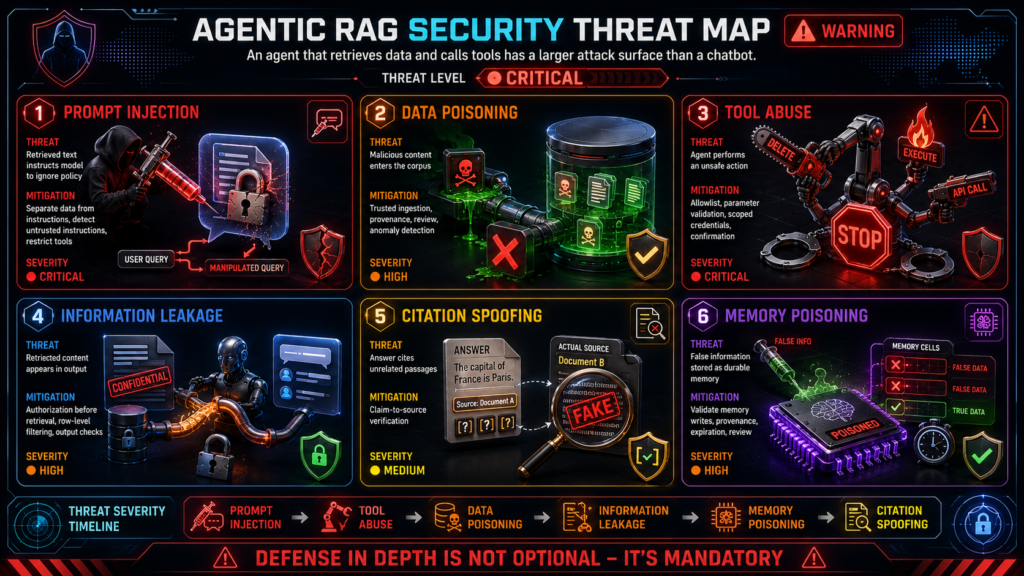
17. Security: LoRA Does Not Remove Agent Risk
An agent that can retrieve data and call tools has a larger attack surface than a chatbot.
| Threat | What can happen | Stronger mitigation |
| Prompt injection | Retrieved text instructs the model to ignore policy | Separate data from instructions, detect untrusted instructions, restrict tools |
| Data poisoning | Malicious content enters the corpus | Trusted ingestion, provenance, review, anomaly detection |
| Tool abuse | The agent performs an unsafe action | Allowlist, parameter validation, scoped credentials, confirmation |
| Information leakage | Restricted content appears in output | Authorization before retrieval, row-level filtering, output checks |
| Citation spoofing | The answer cites unrelated passages | Claim-to-source verification |
| Memory poisoning | False information is stored as durable memory | Validate memory writes, provenance, expiration, review |
Why simple string blocking is insufficient
This is not robust security:
if "ignore previous instructions" in query.lower():
    reject()
Attackers can paraphrase, encode, fragment, or place malicious instructions inside retrieved documents.
A safer tool gate
ALLOWED_TOOLS = {
    "vector_search": {"read_only": True},
    "github_search": {"read_only": True},
    "jira_create": {"requires_confirmation": True}
}

def authorize_tool_call(user, tool_name, arguments):
    if tool_name not in ALLOWED_TOOLS:
        raise PermissionError("Tool is not allowlisted.")

    validate_schema(tool_name, arguments)
    validate_user_permissions(user, tool_name, arguments)

    policy = ALLOWED_TOOLS[tool_name]

    if policy.get("requires_confirmation"):
        return {
            "status": "confirmation_required",
            "tool": tool_name,
            "arguments": arguments
        }

    return {"status": "authorized"}
Security-critical decisions should be enforced by code, not merely requested in a prompt.
18. Adapter Deployment, Switching, and Versioning
Three deployment patterns
| Pattern | Best for | Trade-off |
| Merged adapter | One stable specialization | Harder to switch or test dynamically |
| Live adapter | Multiple specializations on one base | Runtime and batching complexity |
| Adapter routing | Per-query or per-tenant specialization | Router quality becomes critical |
A safer adapter manager concept
Do not repeatedly wrap an already wrapped model with PeftModel.from_pretrained. Load named adapters into one compatible PEFT model and activate the required adapter.
from peft import PeftModel
from transformers import AutoModelForCausalLM

base_model = AutoModelForCausalLM.from_pretrained(
    "Qwen/Qwen2.5-3B-Instruct",
    device_map="auto"
)

model = PeftModel.from_pretrained(
    base_model,
    "./adapters/general",
    adapter_name="general"
)

model.load_adapter(
    "./adapters/code",
    adapter_name="code"
)

model.load_adapter(
    "./adapters/finance",
    adapter_name="finance"
)

def activate_adapter(name: str):
    if name not in {"general", "code", "finance"}:
        raise ValueError("Unknown adapter.")

    model.set_adapter(name)
    return model
Version every adapter like software
Store:
- base model ID and revision;
- PEFT version;
- tokenizer revision;
- training dataset hash;
- hyperparameters;
- evaluation results;
- target modules;
- rank and alpha;
- approval status;
- rollback version.
Example:
router/
  v1.2.0/
    adapter_config.json
    adapter_model.safetensors
    training_manifest.json
    evaluation_report.json
19. LoRA-Augmented Generation and Parametric Retrieval
A newer family of systems treats adapters themselves as retrievable experts.
Instead of selecting only documents, the system can select a specialization:
Query
  ↓
Adapter Retriever or Router
  ├── Code Adapter
  ├── Finance Adapter
  ├── Medical Adapter
  └── General Adapter
          ↓
Generation
This creates two distinct retrieval layers:
- non-parametric retrieval — documents, database rows, web pages;
- parametric retrieval — adapters or learned experts.
Why this is interesting
Adapter retrieval can be useful when:
- many tenants share one base model;
- domains need different behavior;
- specialist adapters are small;
- the correct expertise can be selected reliably.
Why it does not replace document RAG
An adapter is still a poor substitute for:
- current facts;
- exact citations;
- deletable records;
- user-specific permissions;
- frequently updated policies.
The more realistic future is not “LoRA instead of RAG.” It is:
retrieve the right evidence, activate the right behavior, and use an agent to control both.
20. Production Checklist
Data and retrieval
Chunking has been evaluated on real questions.
Metadata and access filters are tested.
Outdated documents are handled explicitly.
Retrieval recall is measured before generator tuning.
Difficult negatives are included in evaluation.
Training
Each adapter has one clearly defined responsibility.
Training examples include real retrieval context.
Abstention and failure cases are present.
Dataset splits prevent source and template leakage.
Rank and target modules were tested, not copied blindly.
Agent control
Every loop has a maximum attempt count.
Tool budgets are enforced.
Stop, clarify, retry, and abstain states are explicit.
Destructive actions require confirmation.
Deterministic validation follows model decisions.
Evaluation
Retrieval, routing, generation, and end-to-end metrics are separate.
Cost is measured per successful task.
P50 and P95 latency are tracked.
Citation precision and coverage are measured.
Full trajectories are evaluated.
Deployment
Base model and adapter versions are pinned.
Rollback is tested.
Adapter cache and switching latency are measured.
A/B tests use stable traffic allocation.
Monitoring distinguishes model, retrieval, and tool failures.
Security
Authorization happens before retrieval.
Tool schemas are validated.
- Credentials use minimum required permissions.
Retrieved content is treated as untrusted.
Memory writes include provenance and review rules.
21. Frequently Asked Questions
Does LoRA add knowledge to an LLM?
It can influence parametric knowledge and behavior, but it does not provide the guarantees of a database or retrieval system. Use RAG when knowledge must be current, inspectable, permission-aware, or cited.
Should I use RAG or LoRA?
Use RAG when the missing capability is access to information. Use LoRA when the missing capability is repeated behavior. Use both when the system needs current evidence and consistent decision-making.
Can LoRA and RAG be used together?
Yes. A common design uses RAG for evidence and LoRA for routing, rewriting, grading, tool selection, grounded generation, or citation behavior.
Is LoRA better than prompt engineering?
Not automatically. Prompting is faster and cheaper to iterate. LoRA becomes attractive when a well-designed prompt still produces inconsistent behavior at production scale.
Can LoRA improve retrieval?
LoRA can improve query rewriting, tool selection, reranking, and relevance grading. It does not repair missing documents, weak indexing, incorrect permissions, or poor chunking by itself.
Does LoRA reduce hallucinations?
It can help a model follow grounding and abstention policies more consistently. Hallucination reduction must be measured on held-out data. LoRA alone does not guarantee factuality.
How much training data does LoRA need?
There is no universal number. A narrow classifier may work with hundreds of carefully labeled examples. A complex agent policy may require thousands of diverse trajectories. Data quality and coverage matter more than a headline count.
What rank should I use?
Start with a modest rank such as 8 or 16, then compare it against smaller and larger settings. Select the smallest adapter that meets the evaluation target.
Is QLoRA suitable for production?
Yes, particularly when training memory is constrained. Test the exact quantization, hardware, serving stack, and adapter workflow before making performance claims.
Can multiple adapters be loaded?
Yes, depending on the PEFT and serving stack. You can switch, compose, merge, or route adapters, but every strategy requires evaluation for interference, latency, and batching behavior.
How should agentic RAG be evaluated?
Evaluate:
- retrieval quality;
- routing accuracy;
- evidence sufficiency decisions;
- grounded generation;
- citation correctness;
- tool success;
- task completion;
- latency;
- cost;
- full agent trajectories.
22. The Bottom Line
LoRA, RAG, and agentic orchestration solve different layers of the problem.
- LoRA teaches repeatable behavior.
- RAG supplies external evidence.
- Agentic RAG controls the workflow.
Do not fine-tune facts that belong in a database. Do not expect retrieval to repair a model that routes badly, ignores evidence, or uses tools inconsistently. Do not add an agent loop unless its decisions improve a measured outcome.
The strongest architecture is not the one with the most components. It is the one that puts each responsibility in the right place:
Facts in retrieval. Behavior in adapters. Control in the graph. Hard safety rules in code.
That is how LoRA becomes more than a cheap generator fine-tune. It becomes a set of specialized, testable operators across the agentic RAG control loop.
LoRA should not be sprinkled across an agent because it is fashionable. Put it where a stable learned decision beats another giant prompt—and prove the improvement with real measurements.

[…] LoRA in LLMs and Agentic RAG: The Complete Production Guide – LoRA in LLMs and Agentic RAG: The Complete Production Guide – neuralninjas.in […]