LLMs do not constantly learn from you in real time. The base model stays frozen, while preferences and conversation context live only inside the current chat window unless memory is explicitly added.
The Honest Question We All Have
You’ve been chatting with an AI assistant for a while now. You asked it to write in a casual tone. It did. Then you asked for bullet points. It switched. Then you corrected it on a fact. It apologized and gave the right answer. And you thought—wait, is this thing actually learning from me? Is it getting smarter because of our conversation?
Let me give it to you straight.
No. The core model does not keep learning from you in real time.
Its weights are frozen after training. It does not silently update its brain every time you type a message. That’s not how this works.
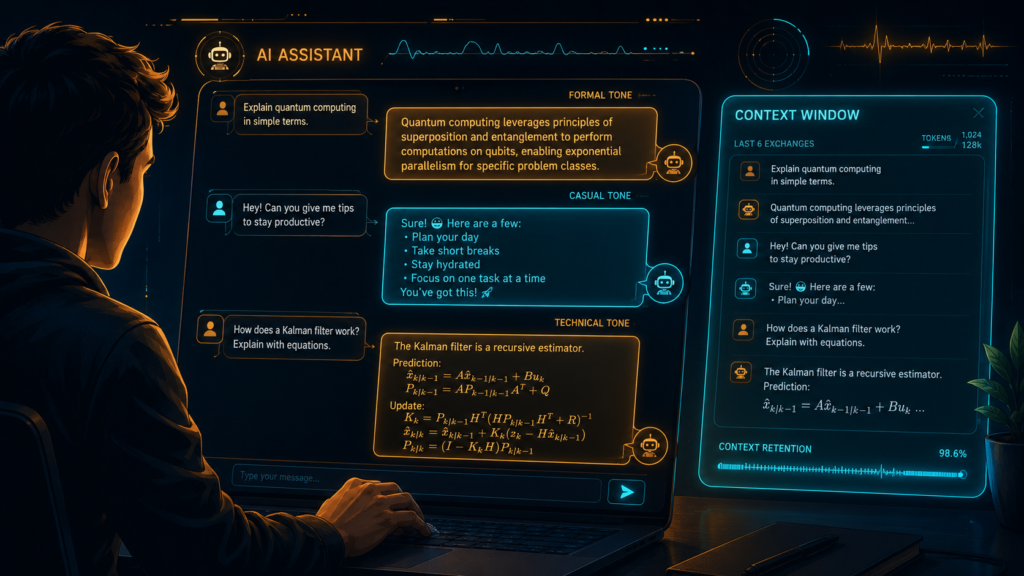
What usually feels like “learning” is just the model using the current conversation context to adapt its replies inside that one chat. Think of it like a really smart assistant reading your notes from earlier in the meeting. They haven’t memorized you forever. They’re just good at keeping track of what you said five minutes ago.
The Simple Truth: Two Very Different Things
Here’s where most people get confused. There are two completely separate things happening:
| What It Is | What Actually Happens | Does It Change the Model? |
|---|---|---|
| Model Learning | Changing the model’s internal weights during training or fine-tuning. | YES – Permanent change |
| Context Adaptation | Using the chat history in the current session to respond better. | NO – Temporary only |
Only the second one happens in normal chat use.
So when the assistant starts matching your tone, remembering your last instruction, or answering based on earlier messages—that is not permanent learning. That is temporary context use.
And honestly? That’s a good thing. You don’t want your AI becoming a different model just because someone had a weird conversation with it.
Why the Model Feels So Damn Smart
Let’s be real—LLMs can feel like they are learning from you because they are incredibly good at pattern matching.
Think about it.
You say:
“Keep it short.”
Then later,
“Make it more technical.”
Then later,
“Use simple English.”
The model adjusts every single time. But why? Because all of that is still visible in the context window. It is not “learning” in the human sense. It is just reading the live conversation and updating its answer accordingly.
Real-world example:
Imagine you’re working with a junior developer. You tell them, “I prefer clean code with comments.” They write clean code with comments. Then you say, “Actually, no comments, just clear variable names.” They adapt.
The junior dev didn’t “learn” permanently. They just followed your current instruction. If you start a new project with them tomorrow, they won’t remember unless you tell them again.
That’s exactly what your AI is doing. It’s the world’s most obedient junior developer.
What the Context Window Actually Does
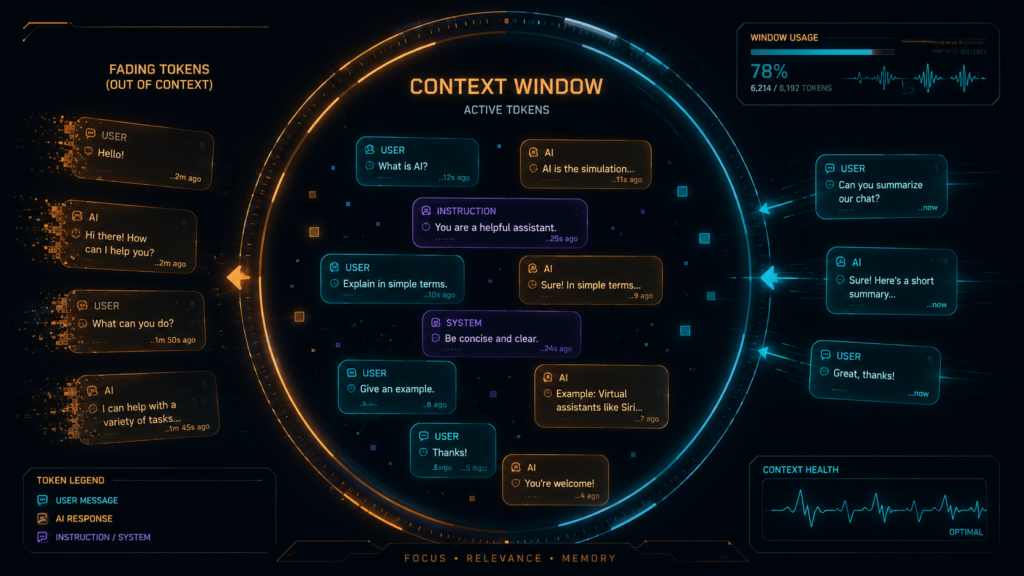
The context window is the model’s short-term working memory for that session.
It holds:
your recent messages,
the assistant’s recent replies,
any instructions you gave in the chat,
and sometimes retrieved external information (if you’re using a RAG system).
But here’s the kicker—it’s limited.
If the conversation gets too long, older parts may fall out of the window. That means the model can forget earlier details unless they are summarized or stored somewhere else.
Real-world example:
You’re chatting about your startup’s product roadmap. You mention your target audience 20 messages ago. You ask a question about pricing strategy. The model might completely forget that audience detail if it fell out of the window.
That’s not the model being stupid. That’s the context window doing exactly what it’s designed to do—prioritize recent information.
What Is Actually Frozen?
Let’s make this crystal clear.
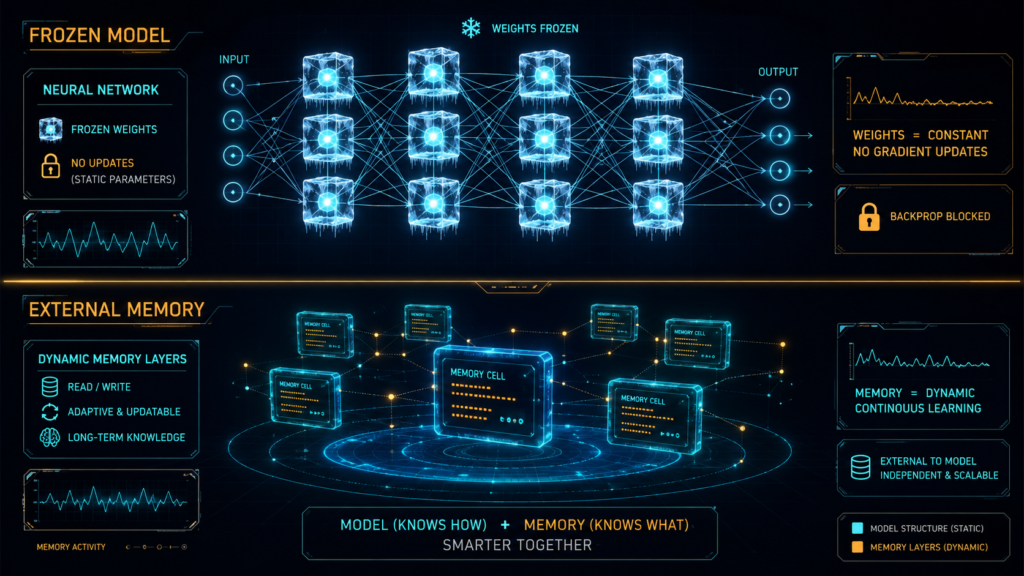
The core model is frozen.
That means:
its parameters do not change during your chat,
it does not rewrite itself after each reply,
it does not permanently absorb your preferences,
and it does not become “trained on you” just because you interacted with it.
Real learning happens only in controlled processes like:
pretraining (the massive initial training on the entire internet),
fine-tuning (specializing on specific datasets),
reinforcement learning (human feedback training),
or explicit memory systems built around the model.
Think of it like a textbook. The textbook doesn’t rewrite itself every time you read it. You can put sticky notes on it (context), you can bookmark pages (memory systems), but the actual words on the page stay the same unless a new edition is published (retraining).
Temporary Preference Learning (The Confusing Part)
Okay, here’s where it gets tricky.
The model can still seem to remember your style because it is using the current chat history.
Example flow:
You prefer crisp answers.
The model starts answering crisply.
You ask for more detail.
It expands.
You ask for a summary.
It compresses again.
That is not permanent memory. It is just session-level adaptation.
Real-world scenario:
You’re a product manager using AI to write user stories. In one chat, you say “use Agile format.” It writes in Agile format. You switch to “use PRD format.” It switches. You close the chat, open a new one, and ask for a user story. It defaults back to whatever its base style is.
Frustrating? Maybe. But that’s the trade-off. Flexibility without permanent baggage.
When It Really Can Remember (The Important Exception)
Some systems add extra memory layers on top of the model.
That can include:
user preference storage,
session summaries,
long-term memory databases,
personalization profiles.
In those cases, the system may remember that you like short answers or that you work on agentic RAG. But again, that is not the base model “learning itself.” That is the application storing and reusing information.
Real-world example:
ChatGPT’s “Custom Instructions” feature. You tell it once, “I’m a software engineer building RAG systems,” and it remembers across sessions. But that’s not the model changing. That’s the application injecting that instruction into the beginning of every new conversation.
Same with Claude’s “Project Knowledge” or any RAG system’s vector database. The base model stays frozen. The external memory does the heavy lifting.
Why This Actually Matters ?
This distinction is not academic. It changes what you should expect.
If the model were constantly learning in real time, that would create:
Privacy risks – your personal data becoming part of the model permanently,
Safety risks – bad actors poisoning the model with malicious inputs,
Unpredictable behavior – the model becoming weirder over time,
Hard-to-debug responses – no one knowing why the model changed.
A frozen model is much safer and more controllable. The system can still be personalized, but the personalization happens through context and memory layers, not by changing the core brain on the fly.
For enterprise users (that’s you, if you’re building RAG systems):
This is why we keep saying “the retrieval is the source of truth.” Because if your RAG system hallucinates, it’s not because the model “learned” something wrong. It’s because:
The retrieval gave it bad context,
The prompt didn’t enforce grounding,
You didn’t have a fact-checking layer,
Or the context window got overloaded with noise.
All of these are fixable. Because the model is frozen and predictable.
The One-Line Answer :
No, LLMs do not constantly learn from you in real time. They use your current chat context temporarily, while the core model stays frozen unless it is explicitly retrained or connected to memory systems.
| Component | What It Does | How Long It Lasts |
|---|---|---|
| Frozen Model | Permanent knowledge and behavior | Forever (until retrained) |
| Context Window | Temporary working memory | Only during your current chat |
| Memory System | Optional long-term recall | Across sessions (if implemented) |
So yes, the model may feel like it is learning from you, but in normal chat use, it is only adapting temporarily, not truly learning.
What this means for your RAG systems ?
If you’re building applications with LLMs, stop worrying about the model “learning” bad things from users. That’s not happening. Start worrying about:
Retrieval accuracy,
Prompt engineering,
Citation forcing,
Faithfulness evaluation,
And context window management.
Because those? Those are the actual sources of both intelligence and hallucinations. And those? You can control.
Frequently Asked Questions
Q: Can I permanently teach an LLM new things?
A: Only through fine-tuning, which requires structured training data and computational resources. Not through normal chatting.
Q: Does the model remember my previous conversations?
A: Only if the application has a memory system. ChatGPT’s memory feature or Claude’s project knowledge are examples. The base model itself doesn’t remember.
Q: If it doesn’t learn, why does it get better with my feedback?
A: The feedback is part of the current context. It’s adapting, not learning permanently.
Q: How do RAG systems use this frozen model concept?
A: RAG keeps the model frozen but injects relevant documents into the context window. This gives the model fresh information without retraining.
Q: Does every chat with an LLM have a separate context window?
A: Yes. That’s why starting a new chat resets everything.
Final Thoughts :
You’re not training the model. You’re just having a conversation.
And that’s actually freeing. It means you can experiment, push boundaries, ask weird questions, and give contradictory instructions—all without permanently messing up the AI for everyone else.
The model is your tool. The context is your canvas. Use it wisely.
And if you’re building systems on top of these models? Invest in retrieval. Invest in prompts. Invest in evaluation. Because that’s where the real magic happens.