Every RAGAS metric said 1.0.
Faithfulness. Answer Relevancy. Context Precision. Context Recall. All green. All perfect.
I sent the screenshots to my team. I told my manager we were ready to launch.
Then a friend asked a question my private documents didn’t even contain. The AI answered anyway—confidently—while every single metric stubbornly stayed at 1.0.
I stared at my screen for a full minute.
Because if your evaluation metrics say everything is pristine and the AI is still hallucinating… what are we even measuring?
That night, I did what any frustrated engineer would do. I broke my own RAG pipeline on purpose across five distinct failure modes, building a live debugging dashboard to watch every single crash happen in real time.
This is that exact story. Real architectural flaws. Real numbers. Real ways RAG systems fail silently in production.
Meet the Dashboard
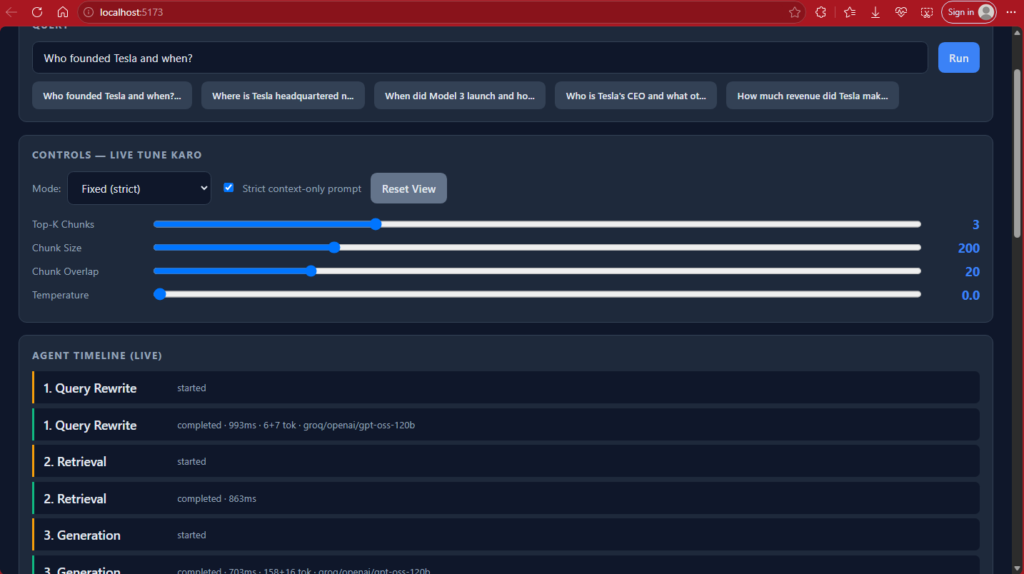
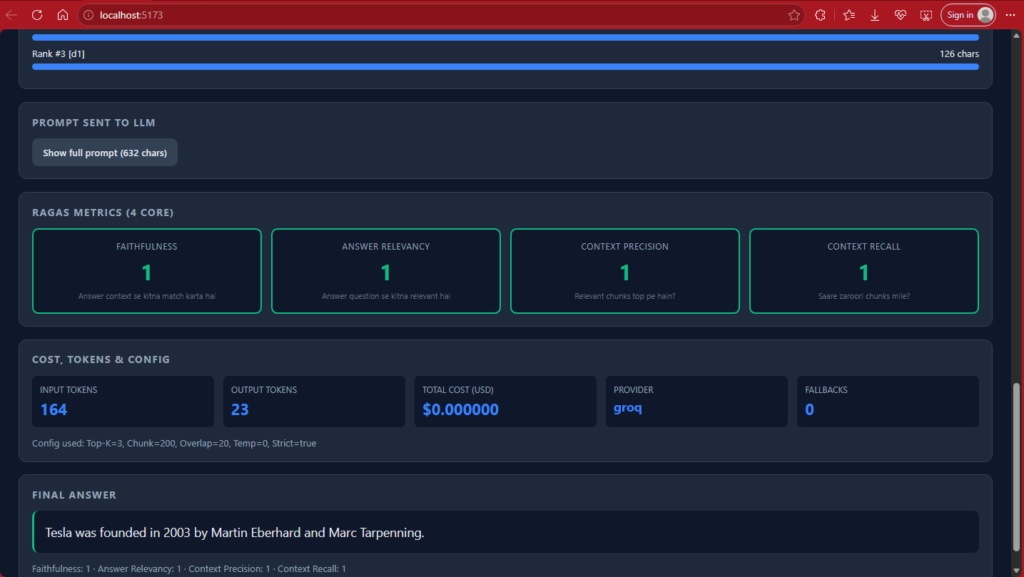
This is RAGAS Live Lab, a real-time debugging dashboard built to expose what actually happens inside your Retrieval-Augmented Generation pipeline. Instead of guessing why your AI hallucinates, you can watch every internal step unfold live.
Every time a query runs, the dashboard instantly displays:
The 5 Pipeline Steps: Live execution flow from search to generation.
Retrieved Chunks & Exact Ranks: Every single data block pulled from your database and its priority order.
The Exact LLM Prompt: The raw instructions sent to the model.
RAGAS Metrics Gauges: Color-coded scores for Faithfulness, Answer Relevancy, Context Precision, and Context Recall.
Token Count & Cost: Real-time API consumption tracking.
The best part is the interactive control panel. You get live sliders for Top-K, Chunk Size, Chunk Overlap, Temperature, and Noise Injection. Adjust any slider on the fly, re-run the query, and watch your metrics shift instantly.
The “Perfect” Baseline :
In the screenshot above, we run the query “Who founded Tesla and when?” with the safest possible setup:
Fixed Mode: Strict prompt ON
Top-K: 3 chunks
Temperature: 0 (zero creativity)
Noise Injection: None
Result: All four metrics hit a clean 1.0.
This is the ultimate “green” setup. Memorize it—because we are about to completely destroy it.
Break #1: The AI Lied (Silent Hallucination in RAG)
The Setup
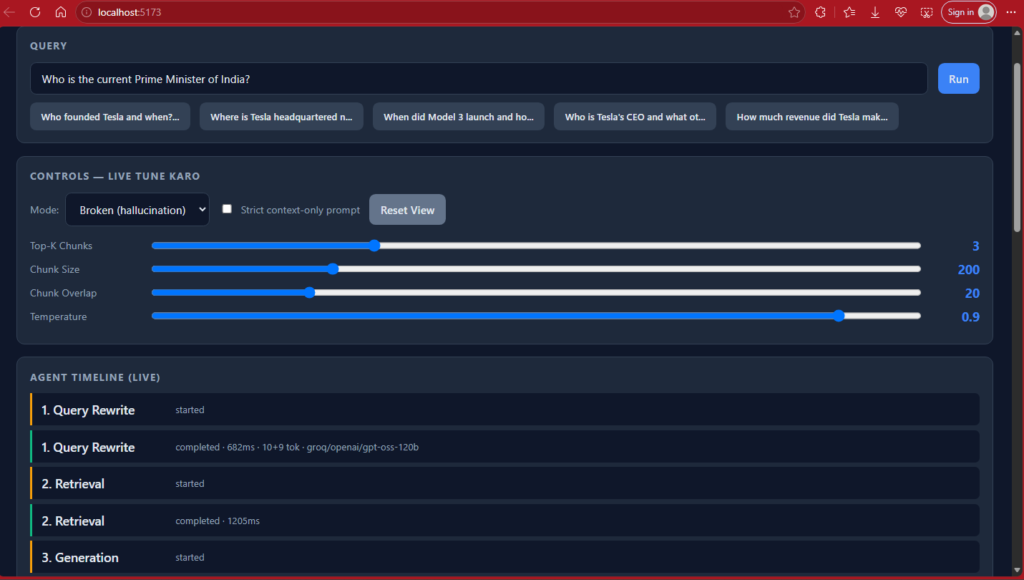
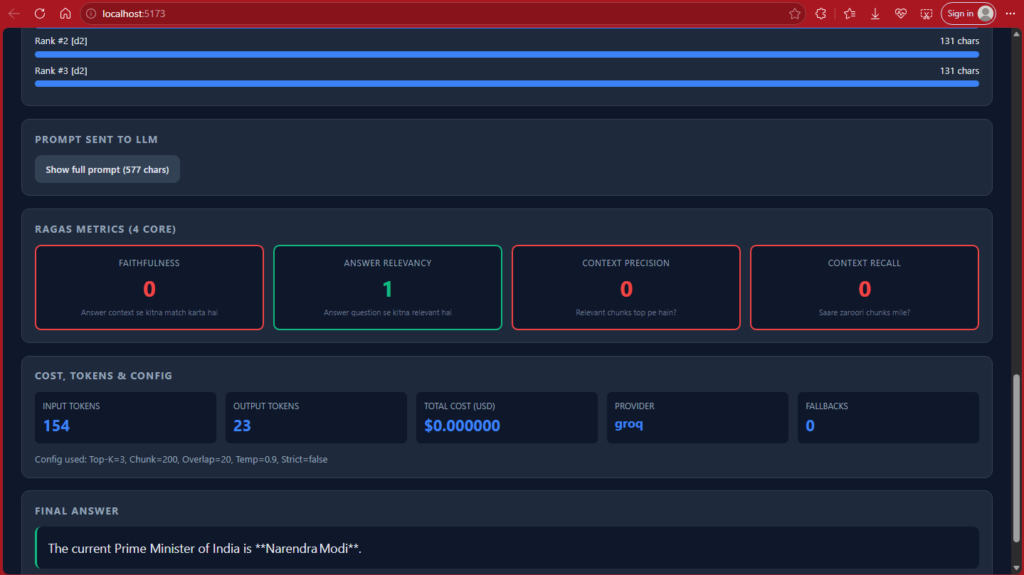
Mode: Switched to Broken (Hallucination) with Strict Context-Only Prompt OFF.
Query: “Who is the current Prime Minister of India?”
The Catch: Our vector database contains documents exclusively about Tesla. There is zero mention of India anywhere in the chunks.
The AI Output :
“The current Prime Minister of India is Narendra Modi.”
The Problem: The answer is factually correct in real life, but completely fabricated from the LLM’s pretraining memory. It ignored the retrieved database entirely because the strict prompt was disabled.
The RAGAS Metrics Breakdown (What the Numbers Mean) :
Faithfulness = 0
What it measures: Is every claim in the answer backed up by your retrieved document chunks?
Why it’s 0: The context was about Tesla cars, but the answer was about Indian politics. Zero data overlap means total hallucination.
Answer Relevancy = 1
What it measures: Did the LLM actually answer the user’s question?
Why it’s 1: The model gave a direct, well-structured answer to the question asked—even though it pulled that answer out of thin air.
Context Precision = 0
What it measures: Are the most relevant chunks ranked at the top?
Why it’s 0: No relevant documents existed for this query in our database.
Context Recall = 0
What it measures: Did the retriever find all the necessary facts needed to answer?
Why it’s 0: The retriever found nothing related to the query.
Why This Is Dangerous in Production ?
This is known as a silent hallucination—the single biggest hazard when deploying Retrieval-Augmented Generation systems.
Imagine running an AI customer support chatbot. A user asks about a product feature that isn’t written in your documentation yet. Instead of admitting defeat, the model gives a confident answer using its internal training memory. That answer might be right, or it might be six months out of date, or completely made up.
Meanwhile, your RAGAS dashboard flashes green because Answer Relevancy is 1, your logs look pristine, and your users are blissfully unaware they’re being fed AI fiction.
Break #2: The Missing Chunk (Multi-Hop Blindspot in RAG)
The Setup
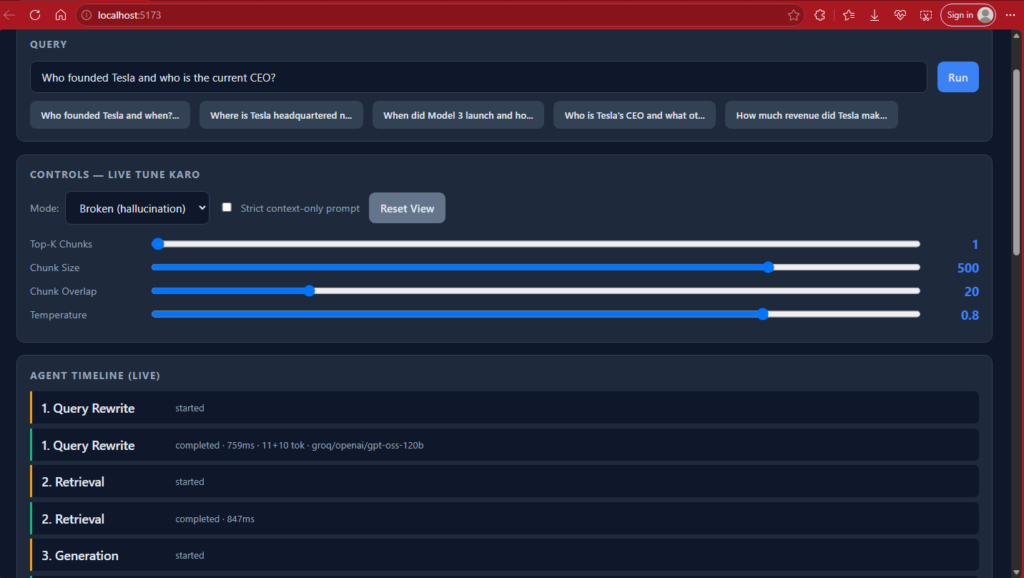
Query: “Who founded Tesla AND who is the current CEO?”
The Catch: This is a multi-hop question requiring two distinct facts from two separate database chunks:
Fact #1: Who founded Tesla (Chunk d_1)
Fact #2: Who is the current CEO (Chunk d_2)
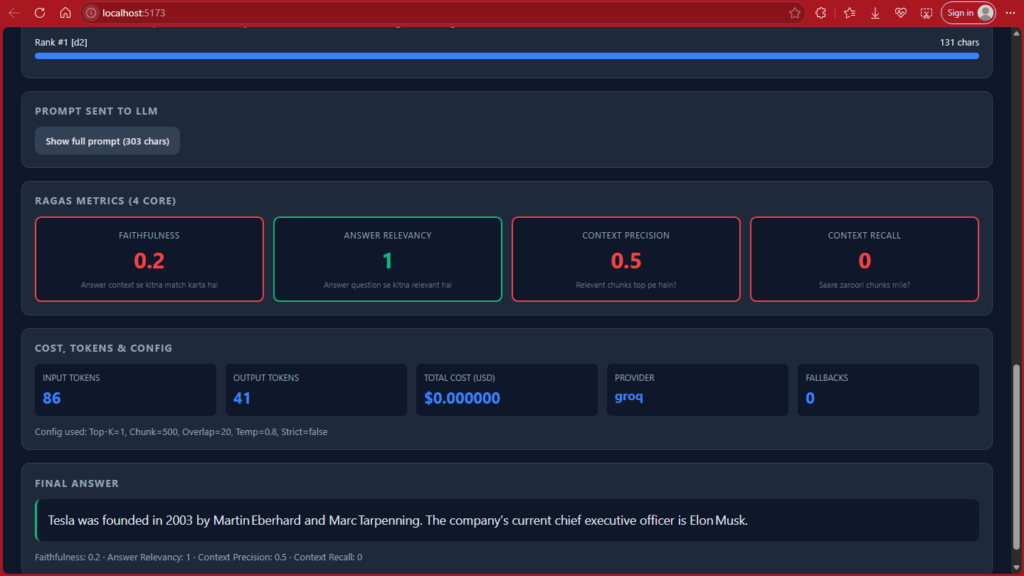
The Error: We intentionally set Top-K Chunks = 1. The retriever could only pull one block of text, capturing just the CEO chunk (d_2). The founder chunk (d_1) was completely left behind.
The AI Output :
“Tesla was founded in 2003 by Martin Eberhard and Marc Tarpenning. The company’s current chief executive officer is Elon Musk.”
The Problem: Both facts appear in the final response, but the system only retrieved half of the required data. The founder details were secretly pulled from the LLM’s internal pretraining memory rather than the database.
The RAGAS Metrics Breakdown (What the Numbers Mean) :
Faithfulness = 0.2
Why it’s 0.2: Only the CEO fact came from the text chunks; the founder names were external hallucinations, dragging the score down.
Answer Relevancy = 1
Why it’s 1: The response directly addresses both parts of the prompt, making it look completely valid on the surface.
Context Precision = 0.5
Why it’s 0.5: The single chunk retrieved was useful for the CEO part, but missed half the context needed for a multi-hop query.
Context Recall = 0
Why it’s 0: We needed two separate facts, but Top-K = 1 restricted retrieval to just one chunk. Critical data was completely missed.
Why This Is Dangerous in Production ?
Without an evaluation dashboard, this output looks like a total success. The user gets a correct answer, and logs look clean.
In reality, your RAG pipeline failed half its job. The AI quietly covered up the missing document data using its own memory. If that internal memory happens to be outdated or wrong next time, your application will silently ship false information to users while appearing fully functional.
Break #3: The Needle in the Haystack (RAG Noise & Ranking Failure)
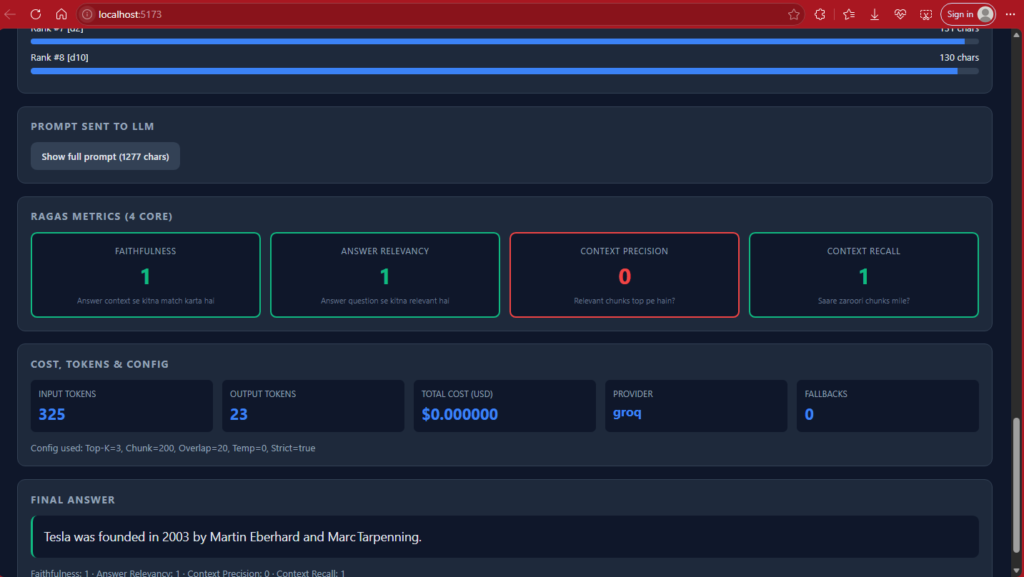
The Setup
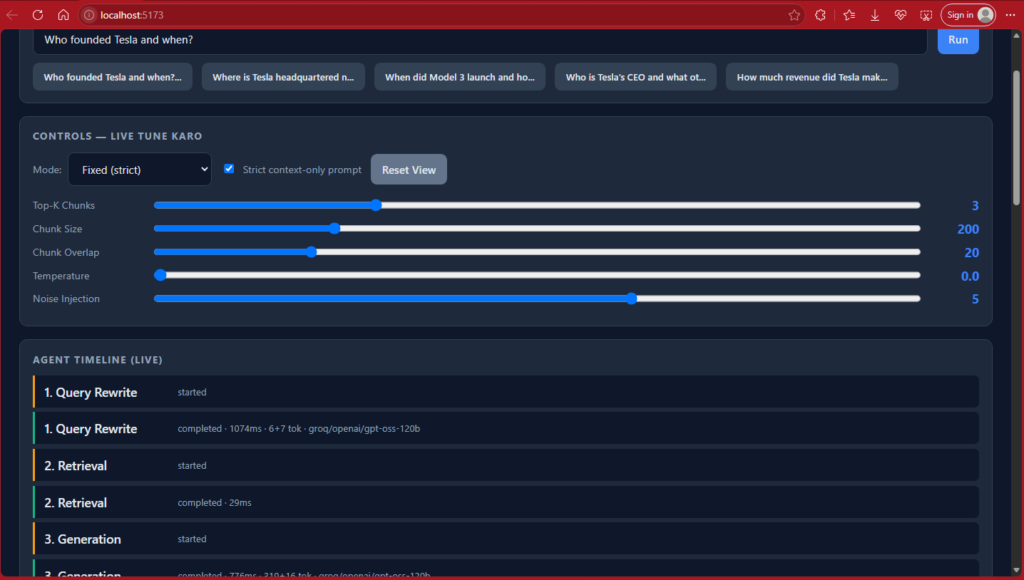
Query: “Who founded Tesla and when?” with safe fixed settings.
The Catch: We turned Noise Injection = 5. This injects 5 random, unrelated text blocks (about coffee, cricket, France, the Roman Empire, and Mount Everest) directly into our retrieved context database.
What Happened Under the Hood
Retrieved Order:
Coffee (Irrelevant)
Cricket (Irrelevant)
France (Irrelevant)
Roman Empire (Irrelevant)
Everest (Irrelevant)
d_1 (The actual Tesla founder chunk)
d_2 (CEO chunk)
d_10 (Other chunk)
The Result: The correct information is buried way down at position 6 out of 8, hidden beneath heaps of digital garbage. The LLM still managed to find the right answer, but it had to wade through total noise to do it.
The RAGAS Metrics Breakdown (What the Numbers Mean)
Faithfulness = 1
Why it’s 1: The final answer came strictly from the retrieved text blocks—even though those blocks were buried under garbage data.
Answer Relevancy = 1
Why it’s 1: The response accurately addresses the prompt.
Context Precision = 0
Why it’s 0: This is the metric that catches bad sorting. It says: “Yes, you eventually found the right chunk, but you buried it at rank 6 beneath useless junk. That’s a failure.”
Context Recall = 1
Why it’s 1: Because we fetched enough total chunks, the required founder information was technically present somewhere in the payload.
Why This Is Dangerous in Production ?
When irrelevant data clutters your context window, it costs you real money and latency.
If your production app handles 1,000 queries a day and pulls 5 wasted, junk chunks per query, you are burning millions of useless input tokens every single month. More importantly, as your documents grow longer, LLMs suffer from the “lost in the middle” phenomenon—meaning if the right chunk is buried deep enough, the AI will miss it completely and fail.
The Fix: Use a re-ranker (like Cohere Rerank or BGE-reranker) after retrieval. It scans the retrieved chunks, scores them by real semantic relevance, and instantly floats the right information to Rank #1.
Break #4: When “No Answer” Is the Right Answer (RAG Safety & Strict Prompting)
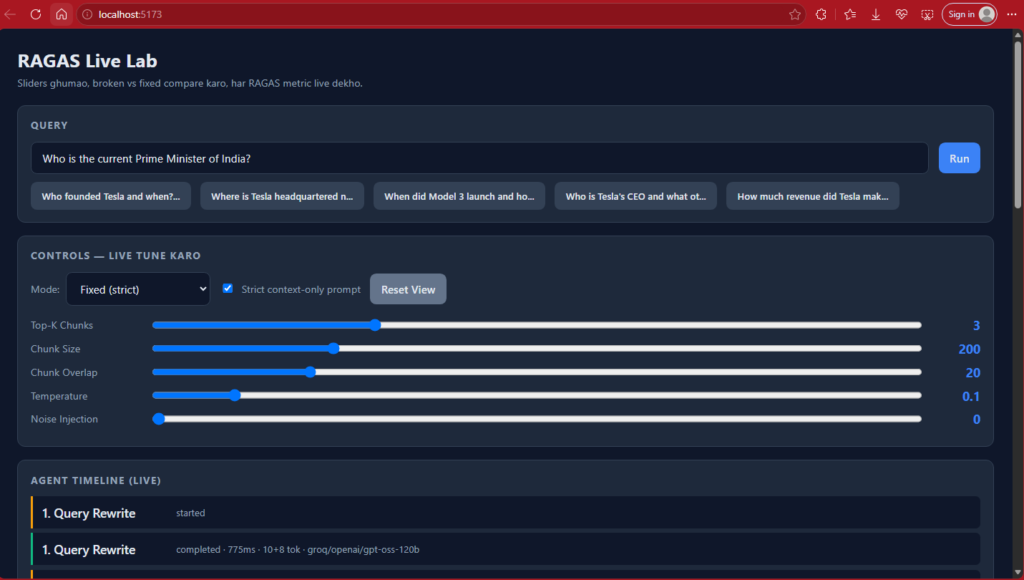
The Setup
Query: “Who is the current Prime Minister of India?” (Same out-of-scope question as Break #1).
The Change: We switched back to Fixed (Strict) mode and toggled Strict Context-Only Prompt ON.
The AI Output
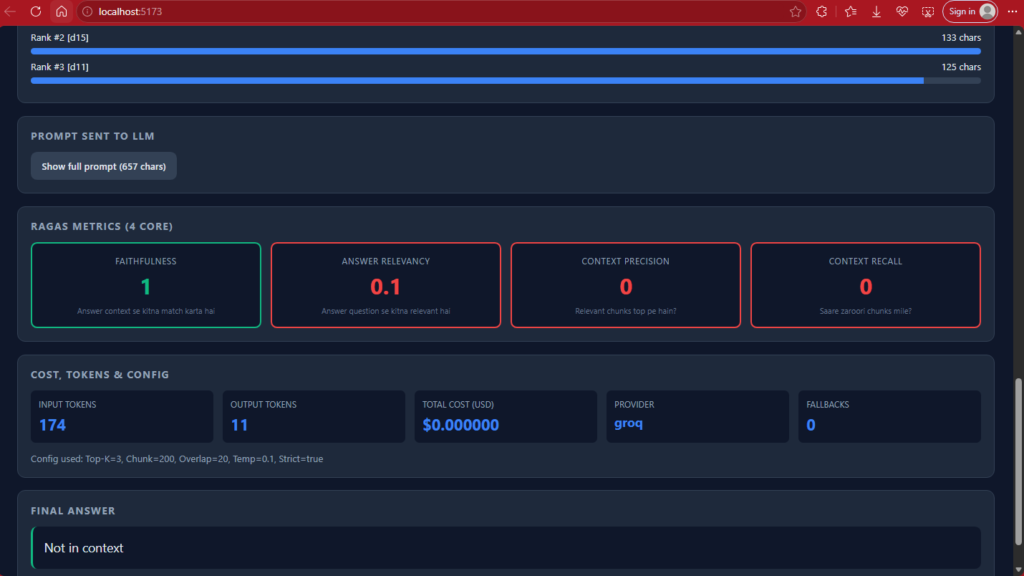
“Not in context”
The Result: Instead of guessing or hallucinating from pretraining memory, the LLM checked the retrieved chunks, saw zero data about India, and politely admitted it didn’t know because the strict system prompt restricted it to context only.
The RAGAS Metrics Breakdown (What the Numbers Mean)
Faithfulness = 1
Why it’s 1: This is the most counter-intuitive part of RAG evaluation. RAGAS doesn’t judge whether you answered the user’s question; it judges whether your text is honest about the context. Saying “Not in context” is a 100% truthful description of the documents provided. A safe refusal gets a score of 1.
Answer Relevancy = 0.1
Why it’s 0.1: The model refused to answer the question, so the response has very low direct relevancy to what the user asked.
Context Precision = 0
Why it’s 0: No matching data existed in the database for this query.
Context Recall = 0
Why it’s 0: The retriever couldn’t find any documents related to Indian prime ministers.
Break #1 vs. Break #4: The Power of One Checkbox
| Metric / Feature | Break #1 (Broken Mode) | Break #4 (Fixed Strict Mode) |
| Final Answer | “Narendra Modi” | “Not in context” |
| Faithfulness Score | 0 (Total Hallucination) | 1 (Truthful Refusal) |
| Did the AI Lie? | Yes | No |
| Production Safety | Dangerous / Risky | Safe / Reliable |
The Takeaway :
Using the exact same query, the exact same documents, and the exact same LLM, toggling a single option completely changes the behavior of your system.
Strict Prompting is the highest-leverage configuration knob in any RAG application. Turning it on shifts your AI from confidently making up lies to transparently admitting its boundaries, protecting your users from misinformation.
Break #5: Chaos Mode (Pushing RAG Pipelines to the Absolute Limit)
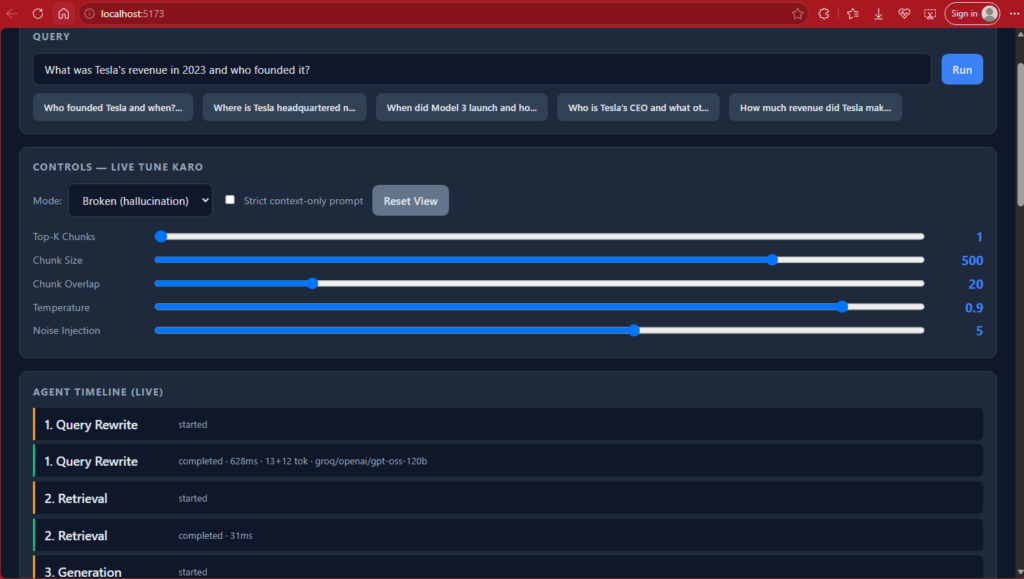
The Setup
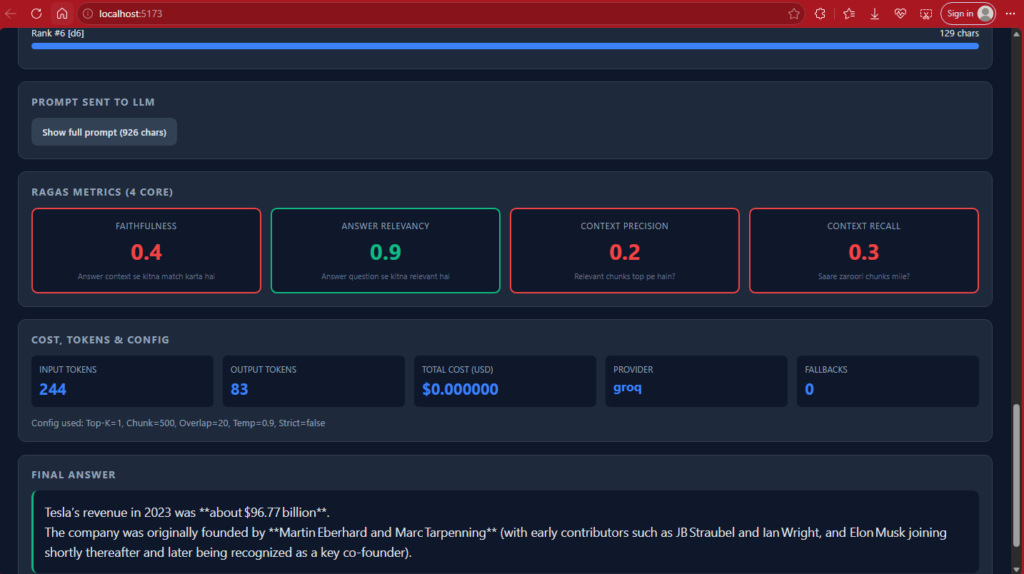
Mode: Broken (Hallucination) with Strict Prompt OFF.
Sliders Tuned to Maximum Chaos:
Top-K Chunks = 1 (Retrieving only a single data block)
Chunk Size = 500 (Massive text blocks loaded with mixed context)
Temperature = 0.9 (Maximum AI creativity and randomness)
Noise Injection = 5 (Flooded with random junk data)
Query: “What was Tesla’s revenue in 2023 and who founded it?”
The AI Output :
“Tesla’s revenue in 2023 was about $96.77 billion. The company was originally founded by Martin Eberhard and Marc Tarpenning (with early contributors such as JB Straubel and Ian Wright, and Elon Musk joining shortly thereafter…)”
The Problem: The revenue and main founders are accurate and exist in the documents. However, the AI secretly slipped in extra names (JB Straubel and Ian Wright) using its internal memory. Because these are real people from Tesla’s history, the hallucination looks completely seamless and professional. A developer skimming this output would never suspect a thing.
The RAGAS Metrics Breakdown (What the Numbers Mean) :
Faithfulness = 0.4
Why it’s 0.4: RAGAS splits the response into individual claims and checks them one by one:
“Revenue was $96.77B” → Found in docs → ✅ Valid
“Founded by Martin Eberhard” → Found in docs → ✅ Valid
“JB Straubel was an early contributor” → Missing from docs → ❌ Hallucinated
Because a major chunk of the names came from external memory, the score drops down to
0.4.
Answer Relevancy = 0.9
Why it’s 0.9: The output provides a highly detailed, fluent, and direct response to the prompt.
Context Precision = 0.2
Why it’s 0.2: With noise injection set to max and Top-K restricted to 1, the retrieval ranking is completely broken.
Context Recall = 0.3
Why it’s 0.3: Restricting retrieval to a single chunk (
Top-K = 1) blocked critical multi-hop information from entering the system.
The Takeaway :
Chaos mode proves why automated evaluation is mandatory for production AI. Even when an answer looks polished, fluent, and completely professional, RAGAS breaks it down at the atomic claim level to catch hidden external facts.
Watching every single performance gauge crash simultaneously in real time is the exact moment developers stop trusting blind LLM outputs and start relying on rigorous monitoring.
The Fix: Watch It Go Back to Green
The Setup
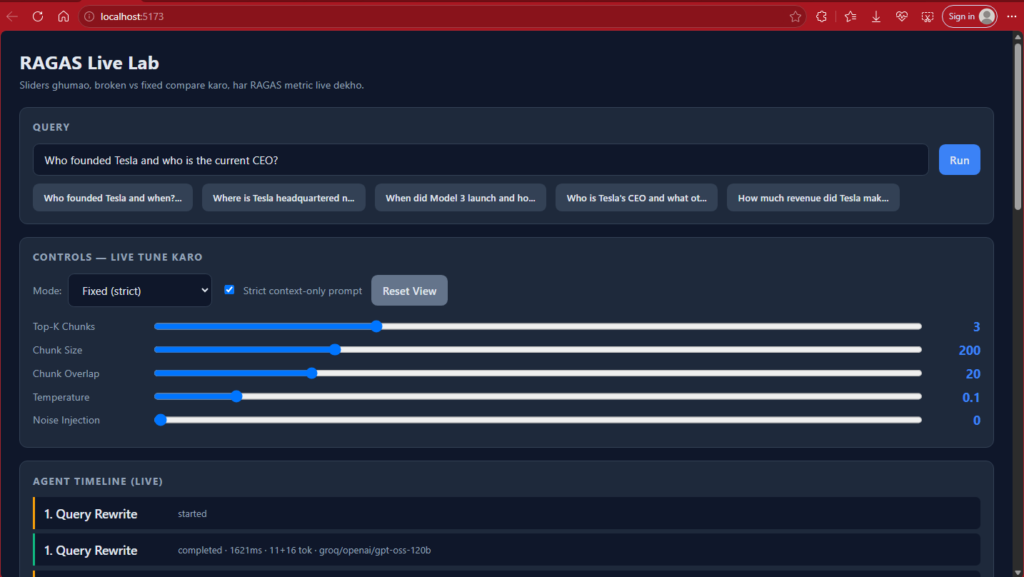
Mode: Fixed mode with Strict Context-Only Prompt ON.
Query: “Who founded Tesla and who is the current CEO?” (The same multi-hop query from Break #2).
Corrected Sliders:
Top-K Chunks = 3 (Increased from 1 so the system can fetch multiple necessary data blocks).
Temperature = 0.1 (Lowered to stop random creative guesswork).
Noise Injection = 0 (Clean environment with zero trash chunks).
The AI Output :
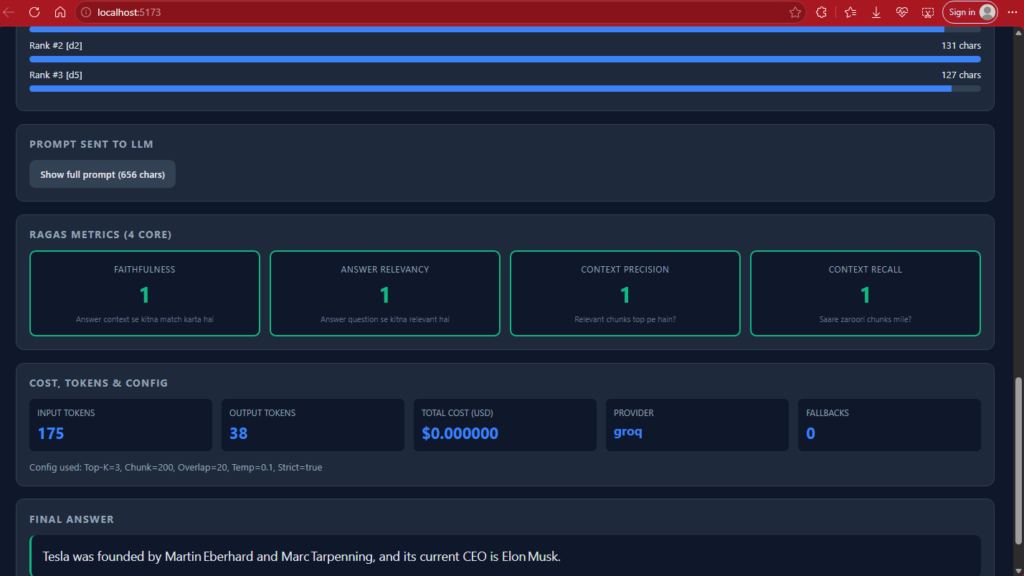
“Tesla was founded by Martin Eberhard and Marc Tarpenning, and its current CEO is Elon Musk.”
The Result: Every single required fact is successfully pulled straight from the document chunks. No hallucination, no missing data, and zero noise.
The RAGAS Metrics Breakdown (What the Numbers Mean) ?
Faithfulness = 1.0
What it measures: Is every single word in the final response backed by the retrieved context chunks?
Why it’s 1.0: Every single claim matches the database documents precisely. Total truth.
Answer Relevancy = 1.0
What it measures: Did the system directly address the user’s question?
Why it’s 1.0: The output provides a clear, precise, and direct answer to both parts of the prompt.
Context Precision = 1.0
What it measures: Are the most relevant chunks prioritized cleanly at the top?
Why it’s 1.0: The retriever organized and surfaced the exact necessary context blocks right at the top.
Context Recall = 1.0
What it measures: Did the retriever fetch all required chunks to answer a multi-hop question?
Why it’s 1.0: By setting Top-K to 3, the system successfully grabbed every single piece of data required to complete the puzzle.
The Takeaway :
This is what a healthy, production-ready Retrieval-Augmented Generation pipeline actually looks like.
When you configure your retrieval size properly, maintain clean chunking, and enforce strict prompting, your evaluation gauges turn solid green. Every word is grounded, your metrics are honest, and your users get accurate information every single time.
The Complete Scorecard :
| # | Scenario | Faithfulness | Answer Rel | Precision | Recall |
|---|---|---|---|---|---|
| 1 | Baseline | 🟢 1.0 | 🟢 1.0 | 🟢 1.0 | 🟢 1.0 |
| 2 | Silent Hallucination | 🔴 0.0 | 🟢 1.0 | 🔴 0.0 | 🔴 0.0 |
| 3 | Multi-Hop Blindspot | 🟡 0.2 | 🟢 1.0 | 🟡 0.5 | 🔴 0.0 |
| 4 | Needle-in-Haystack | 🟢 1.0 | 🟢 1.0 | 🔴 0.0 | 🟢 1.0 |
| 5 | Out-of-Scope Safe | 🟢 1.0 | 🔴 0.1 | 🔴 0.0 | 🔴 0.0 |
| 6 | Chaos Mode | 🔴 0.4 | 🟡 0.9 | 🔴 0.2 | 🔴 0.3 |
| 7 | Recovery | 🟢 1.0 | 🟢 1.0 | 🟢 1.0 | 🟢 1.0 |
Now look at this table and notice two patterns:
Pattern #1: Faithfulness and Context Recall almost always fail together. When the retriever misses chunks, the LLM fills the gap with hallucination. Two metrics, one root cause.
Pattern #2: Answer Relevancy stays high even when everything else is broken. Break #2 has 1.0 Answer Relevancy with 0.2 Faithfulness. Why? Because the answer looks relevant. RAGAS can’t tell the difference between “relevant because grounded” and “relevant because the LLM made something up that fits.”
That’s why you need all four metrics. Any single one can be fooled.
What I Actually Learned :
1. A “1.0 Perfect Score” Doesn’t Mean Your RAG Works
Every evaluation metric has loopholes. For example, Faithfulness can hit 1.0 simply because the AI says “Not in context”, and Context Recall can fake a 1.0 if you flood your database with 20 random chunks.
The Takeaway: Never trust a completely green dashboard. Always stress-test your AI using tricky out-of-scope questions, multi-hop lookups, and intentional noise.
2. Silent Hallucinations Are a Ticking Time Bomb
The scariest AI bug isn’t a wrong answer—it’s a right answer pulled from the wrong place. If a user asks a question your documents don’t cover, and the AI uses its internal pretraining memory to guess the right answer, your logs will show green metrics while your RAG pipeline does zero actual work.
The Takeaway: If an answer is correct but your Faithfulness score is
0, your system is relying on luck instead of your database.
3. RAG Metrics Fight Against Each Other
You cannot optimize every setting in isolation because they push and pull against one another:
Top-K Chunks: Turning this up helps Context Recall (finding all necessary info), but hurts Context Precision (cluttering your search with junk).
Temperature: Turning this down stops hallucinations, but also kills creative writing.
The Takeaway: Monitor all four core metrics at the same time and aim for a healthy system balance rather than chasing one single perfect number.
4. Real-Time Observability Changes Everything
Reading static logs like “Faithfulness: 0.4” in a command-line terminal is dry and forgettable. But watching a gauge instantly flash red live on a screen while sliding up your Temperature or noise filter creates an unforgettable debugging experience.
The Takeaway: Build visual, real-time dashboards into your AI workflows from day one to catch hidden performance bugs instantly.
5. Strict Prompting Is Your Ultimate Shield
Of every configuration tested, toggling a strict system prompt had the single biggest impact on stopping hallucinations. It instantly forces the AI to stop guessing and state “Not in context” instead.
The Takeaway: Always default to a strict context-only prompt. Make safe refusals your fallback position and only loosen the controls when strictly necessary.